Advisories

Since September 29, a wildfire that began near Xylokastro, Greece, has spread in the south of the country.

Since September 29, a wildfire that began near Xylokastro has spread in southern Greece. It has caused several towns to be evacuated and the shutdown of the highway between Athens and Patras. Over 350 firefighters have been deployed to stop the fire alongside specialized aircraft. Similar fires are expected to break out in the southeastern Aegean, including Rhodes.

Monitor regional developments and avoid travel to many Middle Eastern countries due to the Israel-Hezbollah conflict.

Since September 23, Israel has intensified military operations against Hezbollah in Lebanon, with expectations for continued conflict. Hezbollah and Iranian-backed groups have expanded their attacks, and both sides have vowed not to back down. Israel does appear willing to launch a limited ground invasion of southern Lebanon.

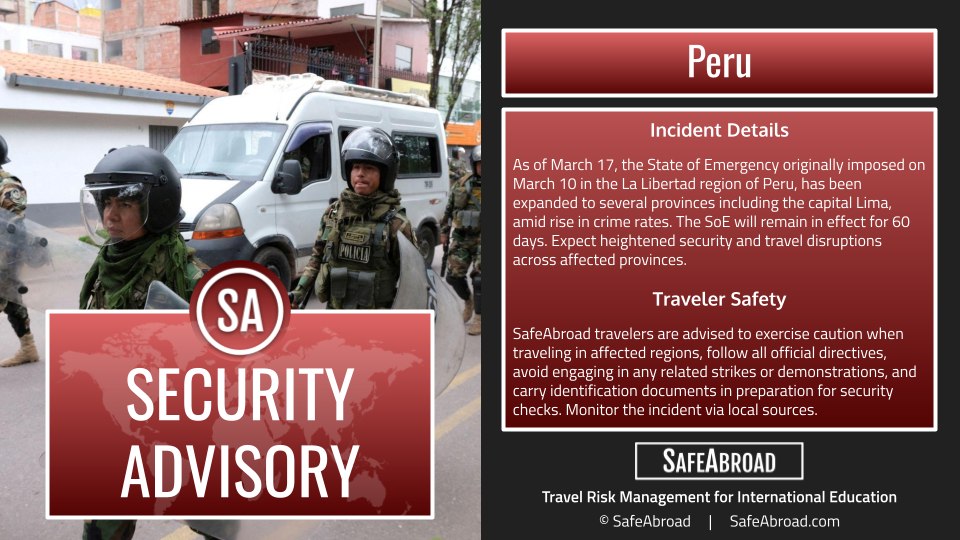
Until at least November 25, certain districts of Peru are in a state of emergency due to transport strikes.

On September 26, Peru declared a sixty-day state of emergency for several districts until at least November 25 due to transport strikes and associated protests. The right to free transit, assembly, and warrantless searches are suspended under this state of emergency. Several schools and universities have canceled classes and curfews and stay-at-home orders are possible.

Severe weather is expected in Switzerland through at least October 2.

A storm system will move through western Switzerland through at least October 2 producing heavy rain, flooding, and potential landslides. Flooding is expected to occur in low-lying regions as well as throughout urban centers including Geneva, Lausanne and Bern. Power outages are expected and disruptions will linger in the days following the storm. 

Over the coming month, the risk of contracting Marburg virus disease (MVD) will be elevated in Rwanda.

On September 27, Marburg virus disease (MVD) was detected in Rwanda. Twenty cases are currently under investigation with six deaths so far. Marburg virus causes hemorrhagic fevers with a high fatality rate. There is no known treatment or vaccination. The virus spreads through contact with infected individuals, bats or primates, or bodily fluids including saliva, blood, urine, and sexual fluids. Symptoms include chest and abdominal pain, nausea, vomiting, sore throat, and diarrhea.

Download this Report for Free