Overview
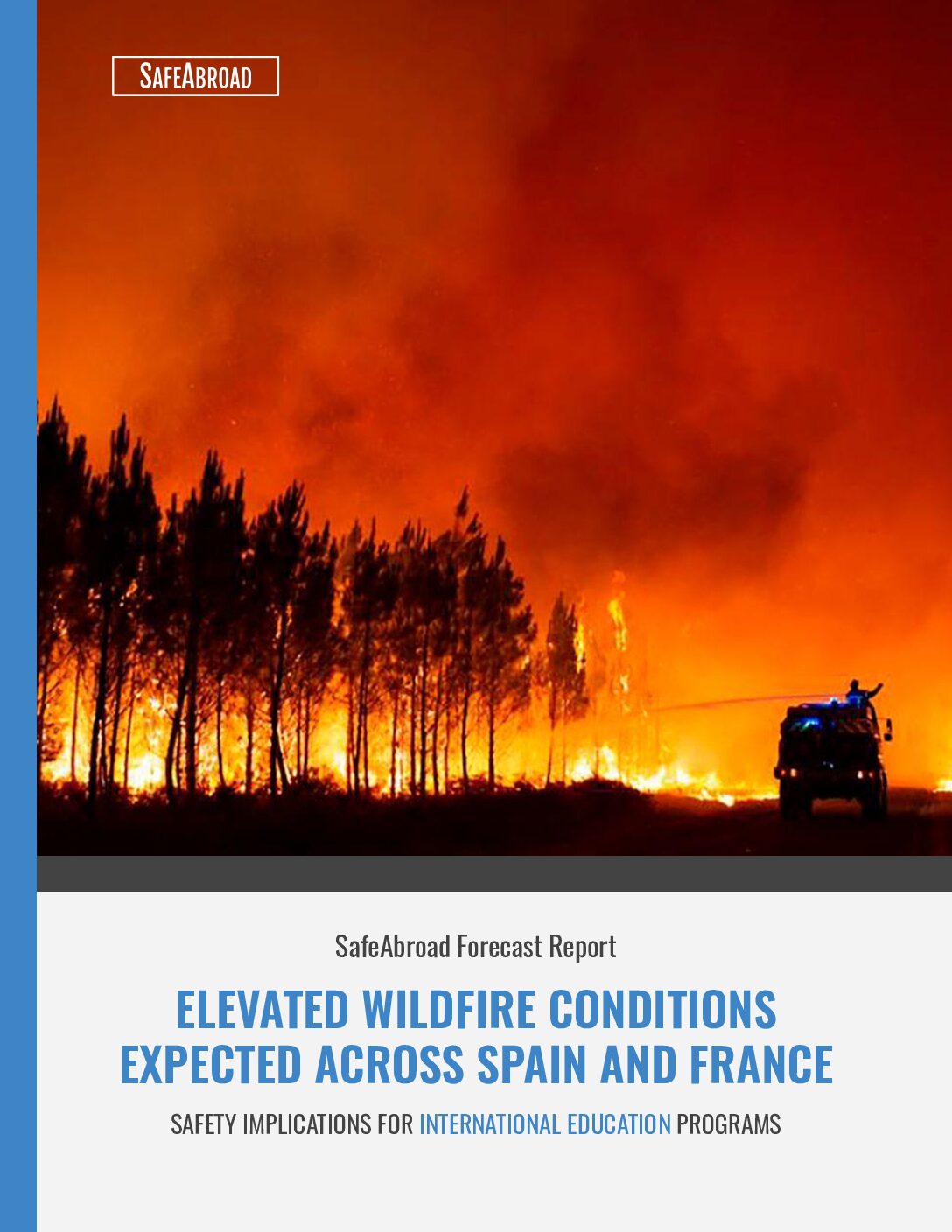
SafeAbroad analysts have assessed wildfire activity across Spain and France and the challenges it presents with a focus on the remainder of the 2026 summer season. Wildfire activity will remain elevated across Spain and France for the remainder of summer 2026, with periods of heightened fire danger expected during episodes of extreme heat and dry weather.1
Key Takeaways
- Wildfires across Spain and southern France throughout the remainder of the 2026 summer season are expected to remain elevated. These fires are driven by persistent heatwaves, drought conditions, and dry vegetation.2 While the overall fire danger is expected to remain high, wildfire impacts are likely to be localized rather than nationwide.
- The wildfires do not indicate a need to suspend study abroad programs in either country. Major university cities are expected to remain operational, supported by well-established emergency management systems and resilient infrastructure. However, any programs or university activities in rural, mountainous, or forest-adjacent areas face a higher likelihood of temporary disruption.3
- Climate change is expected to increase the frequency and intensity of wildfire seasons across Southern Europe over the coming summers. Climate change is making wildfire preparedness an increasingly important component of institutional risk management and duty-of-care planning for study abroad programs. Program managers should anticipate that wildfire risk will become a recurring operational consideration rather than an isolated seasonal event.4
Background
Wildfires have become one of the most significant climate-related hazards affecting Spain and France in the last few years. Spain has recorded fires burning over 30,000 hectares over the last five years, one of the largest annual burned areas within the European Union.5 France has experienced a notable expansion of wildfire activity beyond its traditionally affected Mediterranean regions into western and central parts of the country.6
Historically, wildfire seasons peaked between July and August. However, recent years have demonstrated that the fire season is becoming longer, beginning earlier in the summer and extending into autumn as drought conditions persist.7 Research suggests that climate change is increasing both the frequency of extreme fire weather and the likelihood of large, fast-moving wildfires across Mediterranean Europe.8
Spain is one of the most heavily wildfire-affected countries in Europe, with climate change and heatwaves causing high fire risks during the summers.9 The wildfires in Spain experience wildfire season during the months of June to September with peak heat during the months of July to August.10 Over the last five years, Spain has experienced significant wildfires, with a fire in Sierra de la Culebra in 2022 burning more than 55,000 hectares.11 Another fire took place in Tenerife in 2023, which burned over 15,000 hectares.12
France has had an increase in the wildfire season over the years; the fires in Gironde in 2022 in southwestern France burned over 30,000 hectares near Bordeaux.13 Similar to Spain, France’s wildfire season falls in June to September and peaks in July to August.
Factors that contribute to the elevation of wildfire risks across both countries:
- prolonged heatwaves reaching temperatures of around 110.84°F.14
- Wet winters followed by hot and dry summers.
- strong regional winds capable of accelerating fire spread.
- Human activity and accidental ignitions remain significant contributors to wildfire outbreaks, particularly during periods of heightened fire danger.15
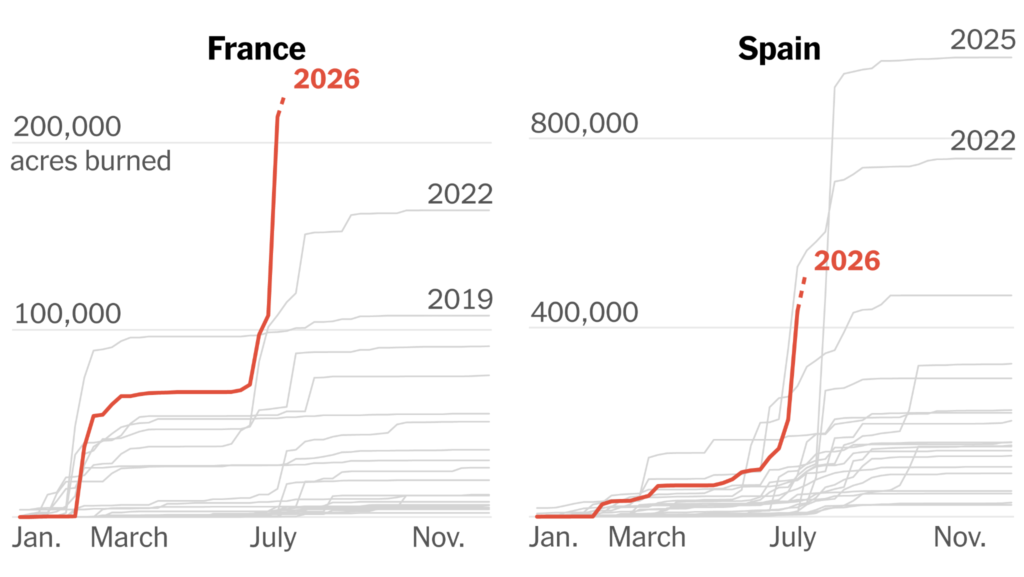
Scale and variability of hectares burnt from wildfires in Spain and France.16
Implications for Study Abroad Programs
The forecast indicates that wildfire danger will remain high across much of Spain and southern France over the next two to three months, particularly during periods of extreme heat.17
The overall risk to study abroad programs is primarily operational; however, life-safety risks cannot be discounted. Wildfires have resulted in large-scale evacuations across Spain and France in recent years, with more than 360,000 being evacuated in the last few weeks.18 This demonstrates that rapidly developing fire incidents can pose a direct threat to individuals located within affected areas.
Although universities are generally located away from high-risk forested areas, students participating in fieldwork, excursions, internships, hiking activities, or independent travel may encounter wildfire-related hazards. Program managers are encouraged to maintain communication channels with students, prepare for emergency travel adjustments, revise excursion schedules and conduct welfare checks during major wildfire incidents. They should also ensure that students are familiar with local emergency procedures and know how to access official alerts and evacuation instructions if wildfire conditions worsen. Given the potential for wildfire conditions to change rapidly, regular monitoring of official forecasts and emergency advisories will be critical to supporting timely operational decisions and ensuring student safety.
Wildfire-related smoke presents a potential health risk as it can reduce the air quality beyond the immediate fire perimeters. 19Students with asthma or other respiratory conditions may require additional support, particularly during prolonged smoke events. Program managers should monitor local air-quality forecasts alongside wildfire warnings. Program managers should also ensure students are aware of how to access local healthcare services and understand when symptoms warrant medical assessment. Students with pre-existing respiratory conditions should ensure they have an adequate supply of prescribed medication and limit outdoor activity when air-quality advisories indicate elevated levels of smoke.
On the Horizon
Climate projections indicate that wildfire activity across Spain and France is expected to become increasingly frequent, longer-lasting, and geographically widespread. The expansion of wildfire-prone conditions into regions previously considered low risk suggests that wildfire preparedness should become a routine component of international program planning.20 Overall, wildfires are expected to result in occasional localized disruptions rather than widespread program interruption during the remainder of this summer and next summer.
- Wildfire conditions are likely to remain elevated through the remainder of summer 2026 and for summer 2027. Periods of prolonged heat, below-average rainfall, and dry vegetation are expected to continue contributing to heightened fire danger across Spain and France. Current climate trends suggest that elevated wildfire risk is likely to remain a recurring feature of summers across Southern Europe.21 While the severity and geographical extent of individual fire events will vary according to local weather conditions, elevated wildfire risk is likely to remain a recurring seasonal consideration for study abroad programs.
- For study abroad providers, this means wildfire preparedness should continue to form part of routine operational planning over the next 12 months. Program managers should anticipate the possibility of temporary disruptions to travel, outdoor activities, and excursions during periods of elevated fire danger, particularly in rural and forested regions. Maintaining flexible itineraries, monitoring official wildfire forecasts, and ensuring effective communication with students and host institutions will remain key to reducing operational impacts.
- Wildfires are expected to cause travel disruptions, including temporary road closures, rail delays, flight disruption due to the smoke, restricted access to national parks and rural destinations and evacuation of small communities.22 These disruptions are expected to remain temporary but may affect program itineraries with limited notice. Periods of extreme fire danger may also result in precautionary restrictions being introduced with little warning; therefore, program managers should build a flexible program to adapt quickly to changing conditions.
- Despite the continued wildfire threat, Spain and France remain among Europe’s most established destinations for international education.23 Their emergency management systems, healthcare infrastructure, and university support services provide a strong foundation for managing localized wildfire incidents and supporting international students when disruptions occur.
- https://joint-research-centre.ec.europa.eu/projects-and-activities/natural-and-man-made-hazards/forest-fires/current-wildfire-situation-europe_en ↩︎
- https://edition.cnn.com/2026/07/29/world/live-news/france-spain-wildfires-heat-wave ↩︎
- https://www.geminismart.org/learning/how-are-universities-in-california-responding-to-fires-and-power-outages/ ↩︎
- https://www.independent.co.uk/news/world/europe/france-spain-wildfires-heatwave-climate-change-b3024572.html ↩︎
- https://english.news.cn/20260731/f48fee2c7d3646a78e04360781bad830/c.html ↩︎
- https://climate.axa/publications/wildfire-risk-is-spreading-across-france/ ↩︎
- https://www.telegraph.co.uk/world-news/2026/07/29/europes-wildfires-nightmare-in-maps-and-charts/ ↩︎
- https://www.reuters.com/sustainability/cop/climate-change-made-fire-prone-weather-conditions-more-likely-spain-france-2026-07-30/ ↩︎
- https://currentwildfires.com/en/wildfires-spain/ ↩︎
- https://currentwildfires.com/en/wildfires-spain/ ↩︎
- https://grupos.unileon.es/atmos/files/2024/08/2023_EAC_JM_Abstract.pdf ↩︎
- https://www.reuters.com/world/europe/tenerife-firefighters-stabilise-huge-wildfire-after-nine-days-2023-08-25/ ↩︎
- https://currentwildfires.com/en/wildfires-france/ ↩︎
- https://wmo.int/media/news/western-europe-has-hottest-june-record ↩︎
- https://news.sky.com/story/climate-change-fuelled-france-and-spain-wildfires-experts-say-13568639 ↩︎
- https://www.nytimes.com/interactive/2026/07/28/world/europe/france-spain-wildfires-2026-fire-season.html ↩︎
- https://www.reuters.com/sustainability/cop/climate-change-made-fire-prone-weather-conditions-more-likely-spain-france-2026-07-30/ ↩︎
- https://news.sky.com/story/climate-change-fuelled-france-and-spain-wildfires-experts-say-13568639 ↩︎
- https://www.theguardian.com/world/live/2026/jul/29/france-spain-wildfires-heatwave-extreme-heat-europe-latest-news-updates ↩︎
- https://www.reuters.com/sustainability/cop/climate-change-made-fire-prone-weather-conditions-more-likely-spain-france-2026-07-30/ ↩︎
- https://www.reuters.com/sustainability/cop/climate-change-made-fire-prone-weather-conditions-more-likely-spain-france-2026-07-30/ ↩︎
- https://www.bbc.co.uk/news/articles/ce3qv0ggndno ↩︎
- https://www.gooverseas.com/blog/should-study-abroad-in-spain-france ↩︎