Overview
West Nile virus (WNV) transmission has intensified across Europe demonstrating a higher-than-average WNV circulation with 1,926 locally acquired human cases reported across 19 European countries as of October 16.1 Italy, Greece, Spain, France and Romania account for the majority of reported infections, although cases have also been detected in the Netherlands, Belgium, Austria, Hungary and Germany.2 The European Centre for Disease Prevention and Control (ECDC) has identified 202 affected areas across Europe, including 16 areas newly reporting transmission during the week ending September 30.
Key Takeaways
- West Nile virus activity remains widespread across Europe, with transmission reported in multiple countries during the 2026 mosquito season. As of October 16, 2026, 16 European countries had reported 1,926 locally acquired human cases, highlighting the scale of the 2026 transmission season. Italy and Greece remain the primary areas of concern due to their high case numbers.3
- West Nile virus transmission is being reported in a broader range of European countries. Reports of local transmission in countries such as Belgium and the Netherlands highlight the presence of WNV in parts of western and northern Europe. This geographic spread suggests that study abroad programs should consider destination-specific transmission data rather than focusing solely on southern European hotspots.
- West Nile virus transmission is expected to decline as the mosquito season ends. West Nile Virus transmission in Europe typically peaks between July and September and generally decreases as temperatures fall during autumn. However, cases may continue to emerge beyond October in areas where conditions remain favorable for mosquito activity, meaning study abroad programs should maintain appropriate mosquito-bite prevention measures until local transmission subsides.
Background
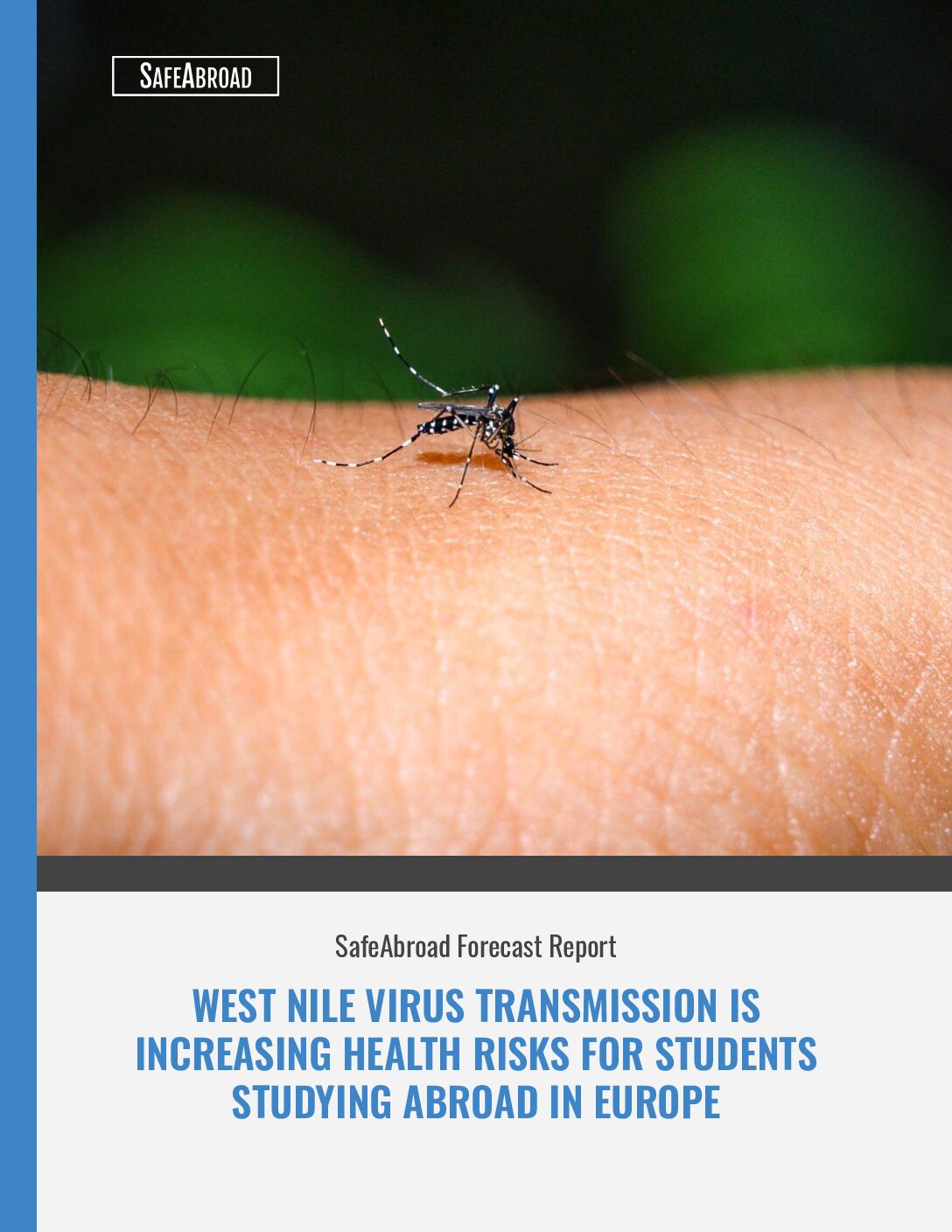
West Nile virus is a mosquito-borne virus that spreads primarily when mosquitoes become infected and subsequently transmit the virus to humans through mosquito bites.4
Humans can become infected when bitten by infected mosquitoes. The principal WNV vectors in Europe are Culex pipiens and Culex modestus.5 Symptoms typically start 2-6 days after being bitten by an infected mosquito. Yet, for individuals with a weakened immune system it may take longer for symptoms to start.6
Approximately 80% of WNV infections are asymptomatic. Around 20% may result in West Nile fever, with symptoms including fever, headache, muscle aches, vomiting, rash and fatigue. Less than 1% of infections develop into neuroinvasive disease, such as meningitis or encephalitis, which can require hospitalisation and can be life-threatening. The risk of severe disease is substantially greater among older adults and people with certain underlying health conditions or weakened immune systems.
WNV is established in parts of southern, eastern and western Europe, but its geographic distribution has expanded in recent years. In 2025, 14 European countries reported 1,112 locally acquired human cases, including 779 cases in Italy alone. France also recorded its highest number of cases on record, with transmission identified in 14 regions for the first time.7 The 2026 season has continued this pattern of substantial transmission. As of October 16, Italy had reported 764 cases, Greece 455, France 128, Spain 141, and Romania 121.8 Notably, the Netherlands reported 59 cases and Belgium 15, illustrating the continued geographic expansion of WNV activity into parts of western and northern Europe.9
Environmental conditions influence WNV transmission, with temperature, available water, wetlands, mosquito populations and migratory bird routes contributing to the virus’s ability to establish and spread. ECDC has also warned that Europe is experiencing longer and more intense transmission seasons for mosquito-borne diseases, although the extent of the effect varies considerably between locations.10
Implications for study abroad programs
Reinforce routine mosquito-bite prevention, particularly for programs operating in areas reporting active West Nile Virus transmission.
- West Nile virus transmission will likely continue to pose a health risk to students studying abroad in affected European countries through the remainder of the 2026 mosquito season. Italy, Greece, Spain, France, and Romania have reported substantial numbers of infections, increasing the likelihood of student exposure in affected areas. Although most infections are asymptomatic or cause mild illness, severe cases can result in neurological complications requiring hospitalization. Students should take precautions to reduce mosquito bites, particularly when participating in outdoor activities.11
- The mosquito exposure will remain the primary concern for students studying in affected European destinations. Outdoor excursions, walking tours, fieldwork, and evening activities may increase opportunities for exposure to infected mosquitoes. Students should use insect repellent, wear clothing that covers their arms and legs where practical, and stay in accommodation with functioning window screens or air conditioning where available. Program managers should incorporate mosquito-bite prevention into pre-departure briefings and provide additional guidance for students participating in outdoor activities in areas reporting active transmission.12
- The geographic expansion of West Nile virus across Europe will likely require continued monitoring by study abroad program managers for the remainder of the 2026 mosquito season, particularly in areas reporting new or increasing cases. Although transmission has historically been concentrated in southern and eastern Europe, new cases in countries including the Netherlands, Belgium, and France demonstrate that the virus can emerge in previously less-affected areas. Program managers should monitor local public health updates and ECDC surveillance data to identify emerging outbreaks and assess whether additional precautions are necessary for students in affected locations.
On the Horizon
Overall, West Nile virus poses a low but ongoing health risk to study abroad students, however, continued West Nile virus transmission, expanding into previously less-affected areas and persisting for the remainder of the year, poses a health risk to students in affected locations, particularly those participating in outdoor activities.
What to watch for in late 2026:
- West Nile virus transmission to gradually decline across Europe as temperatures decrease and mosquito activity subsides during autumn. Despite declining rates of transmissions, infections are expected to continue for the remainder of the year in areas where environmental conditions remain favorable for mosquito activity. Italy, Greece, Spain, France, and Romania are expected to remain key areas of concern due to the high number of cases reported during the 2026 transmission season. Students studying in these locations should continue taking precautions to reduce mosquito exposure, particularly when participating in outdoor activities.
- The geographic expansion of West Nile virus across Europe will likely remain a public health concern in the coming years. Rising temperatures and changing environmental conditions may create more favorable conditions for mosquito populations to survive and spread into previously less-affected areas. The detection of cases in countries including the Netherlands, Belgium, and France demonstrates that transmission is not limited to traditionally affected areas of southern Europe. If these trends continue, study abroad programs operating in western and northern Europe should also need to strengthen mosquito-bite prevention measures and monitor local public health advisories more closely.
- Although widespread disruption to study abroad programs is not currently anticipated, localized increases in West Nile virus cases may require additional precautions throughout the remainder of the transmission season. If cases continue to emerge in new areas, program managers should reassess activity specific risks, particularly for outdoor excursions, fieldwork, and evening events. Students who develop symptoms consistent with West Nile virus infection following potential mosquito exposure should seek medical attention. Continued monitoring of European Centre for Disease Prevention and Control (ECDC) surveillance data and local public health guidance will be important for identifying emerging transmission hotspots and determining whether additional student health measures are necessary.
- https://beaconbio.org/en/report/?search=west+nile+virus&reportid=6c9e2d37-b8d4-4211-be86-850afca0044f ↩︎
- https://www.ecdc.europa.eu/en/west-nile-fever/surveillance-and-disease-data/disease-data-ecdc ↩︎
- https://beaconbio.org/en/report/?search=west+nile+virus&reportid=6c9e2d37-b8d4-4211-be86-850afca0044f ↩︎
- https://my.clevelandclinic.org/health/diseases/10939-west-nile-virus ↩︎
- https://www.cdc.gov/west-nile-virus/about/index.html ↩︎
- https://www.cdc.gov/west-nile-virus/about/index.html ↩︎
- https://www.ecdc.europa.eu/en/west-nile-fever/surveillance-and-disease-data/historical ↩︎
- https://www.ecdc.europa.eu/en/west-nile-fever/surveillance-and-disease-data/disease-data-ecdc ↩︎
- https://www.ecdc.europa.eu/en/west-nile-fever/surveillance-and-disease-data/disease-data-ecdc ↩︎
- https://www.ecdc.europa.eu/en/west-nile-fever/facts ↩︎
- https://www.ecdc.europa.eu/en/west-nile-fever/facts ↩︎
- https://www.ecdc.europa.eu/en/west-nile-fever/surveillance-and-disease-data/disease-data-ecdc ↩︎