Overview
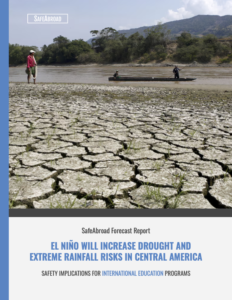
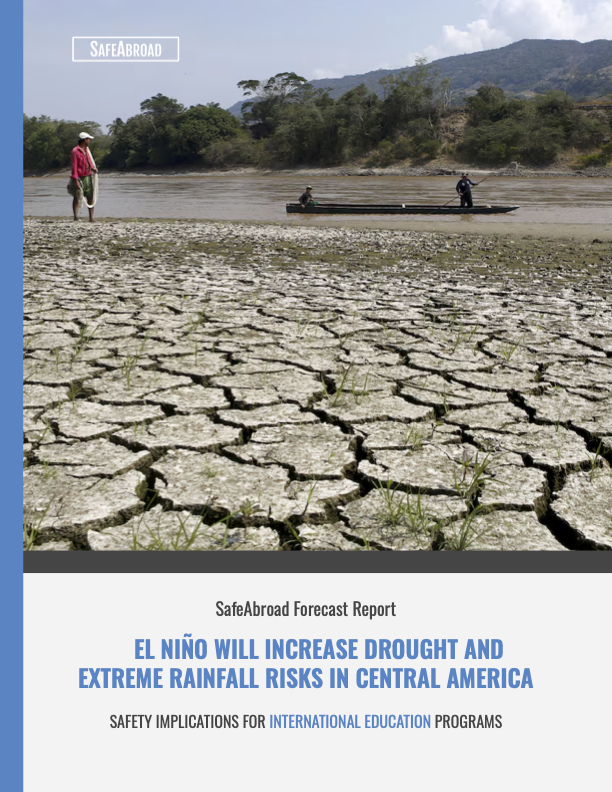
El Niño conditions are forecast to strengthen significantly across the next six months, increasing the likelihood of drought, above normal temperatures and rainfall variability across Central America.1 These conditions are expected to create operational challenges for study abroad programs, particularly through impacts on water availability, transportation, outdoor activities and student health and safety.
Key Takeaways
- El Niño is expected to strengthen through late 2026 and remain influential into early 2027.2 Current forecasts indicate a greater than 90% likelihood of a very strong El Niño during the Northern Hemisphere fall and winter.3 The strengthening event is expected to continue influencing temperature and rainfall patterns across Central America through at least early 2027.4
- Drought is expected to be the dominant climate-related concern across Guatemala, Panama and Costa Rica through early 2027.5 Drier than normal conditions are expected to become more pronounced from October 2026, increasing the potential for water shortages, agricultural impacts, and disruptions to activities that depend on reliable water availability.6 Pacific-facing areas are expected to experience the greatest impacts, although conditions will vary considerably by location.
- Flooding and landslides will remain significant secondary hazards despite the broader drought outlook. Localised heavy rainfall can still produce flash floods, river flooding and landslides, particularly in Caribbean-facing areas and during individual storm events. Panama has already recorded more than 15,000 people affected by flooding in 2026, demonstrating that flooding can occur alongside broader regional rainfall deficits.7
Background
El Niño can significantly alter rainfall and temperature patterns, creating droughts, flooding, and extreme heat risks in affected regions.8
El Niño is firmly established and is expected to intensify over the coming months, increasing the potential for extreme heat, drought and flooding in different parts of the world.9 For Central America, the expected pattern is generally warmer and drier conditions on the Pacific side, but this should not be interpreted as an absence of rainfall.10 The region remains exposed to individual weather systems capable of producing intense rainfall over short periods.11
Consequently, a country can simultaneously experience water shortages and flooding in different locations or at different times. While El Niño is generally expected to produce warmer and drier conditions across parts of the region, localized rainfall events can still produce intense flooding and landslides.12 As a result, programs may face water shortages in one area while experiencing transportation disruptions, flooding, or infrastructure damage elsewhere. This variability means programs should not treat the broader regional drought forecast as an indication that flooding or heavy rainfall risks are reduced.
Across Guatemala, Panama, and Costa Rica, El Niño is driving increasingly variable rainfall patterns, with significant drought conditions in some areas occurring alongside localized flooding in others.13 In Guatemala, it has been reported that rainfall deficits are approximately one third of normal national levels, with particularly significant deficits in the Pacific and Central Altiplano and above normal temperatures expected through late 2026.14 Panama declared a National State of Emergency on August 26 due to El Niño-related conditions, with rainfall deficits of up to 55% forecast in some areas through December and the emergency remaining in effect through June 2027. However, Bocas del Toro has experienced approximately 25% above normal rainfall, contributing to flooding and landslide concerns, with more than 15,000 people affected by flooding across the country since January.15 Costa Rica is experiencing a similar divide, with significantly reduced rainfall expected across the Pacific and Central Valley while Caribbean areas may receive substantially wetter conditions. El Niño is expected to persist through the upcoming dry season and into early 2027, increasing the likelihood of continued drought, heat and water-stress conditions while maintaining the potential for localised heavy rainfall, flooding and landslides.16
Implications for Study Abroad Programs
Study abroad programs should prepare for the combined impacts of water shortages, flooding, extreme heat, wildfires, and weather-related transportation disruptions.
Study abroad programs operating in Central America over the next six months should consider the impacts droughts in the region may have on their programs. Reduced rainfall can lower river and reservoir levels and place pressure on municipal water supplies, with Panama’s National State of Emergency demonstrating that water availability is already a significant government concern.17 For study abroad programs, prolonged dry conditions could result in temporary water restrictions at universities or accommodations, reduced water availability for showers and sanitation, restrictions on water-intensive activities, disruptions to rural fieldwork or community-based programs, increased demand for bottled or treated drinking water, and potential impacts on agriculture and food availability.18
Despite the drought forecast, flooding remains an expected implication as localized heavy rainfall can still produce flash floods, river flooding, and landslides. Panama provides a clear example of this dual hazard, with Bocas del Toro experiencing above normal rainfall and flooding despite significant rainfall deficits being forecast elsewhere in the country.19 More than 15,000 people have reportedly been affected by flooding nationally during 2026, with damage also reported to roads and bridges.20 For study abroad programs, individual rainfall events could result in road closures and travel delays, temporary isolation of rural communities, unsafe river and stream crossings, landslides along mountainous roads, cancellation of outdoor activities, disruptions to electricity or communications, and difficulties accessing airports or accommodation. These risks are particularly relevant to programs involving rural travel, ecological fieldwork, hiking, service learning and homestays, where students may be more exposed to areas with limited infrastructure and fewer alternative transport routes.
Above normal temperatures and prolonged dry conditions associated with strengthening El Niño are expected to increase heat related health risks and wildfire potential across parts of Central America.21 Guatemala is already forecasting above normal temperatures, with some areas potentially reaching 33.8-35.6°F above average in October.22 Study abroad programs should review outdoor activity protocols by scheduling strenuous activities during cooler periods, providing reliable access to drinking water, increasing shaded and rest periods, educating students on the signs of heat exhaustion and heatstroke, and establishing thresholds for postponing strenuous outdoor activities. Prolonged dry conditions may also increase vegetation dryness and wildfire potential, particularly in forests, conservation areas, and rural communities. Wildfires could result in temporary site closures, poor air quality, road closures and changes to planned hiking, agricultural, conservation or environmental fieldwork.23 Programs should monitor national and local fire warnings.
Transportation disruptions are expected to be concentrated in areas affected by localized extreme weather, particularly flooding and landslides across Central America. Drought conditions may affect water dependent infrastructure and communities, while heavy rainfall events can trigger flash flooding, landslides and road damage. Panama has already reported damage to roads and bridges associated with extreme weather, particularly in Bocas del Toro, Colón and Coclé.24 In Costa Rica, the Caribbean region has also experienced recurring closures of major highways due to flooding and landslides, highlighting the potential for heavy rainfall to disrupt road travel and temporarily isolate communities.25 Programs should therefore maintain flexibility when planning rural excursions, mountain travel, river crossings, hiking routes, long-distance road travel and outdoor fieldwork, and be prepared to adjust itineraries if weather conditions affect road accessibility or local infrastructure.
On the Horizon
El Niño conditions are expected to remain elevated through March 2027, with the greatest operational concerns expected to involve prolonged drought, water stress, extreme heat, and increasingly variable rainfall across Central America.
- Weather conditions are likely to become increasingly pronounced through the remainder of 2026, with El Niño expected to reach historically strong levels during October-December. Guatemala, Panama, and Costa Rica are expected to experience continued rainfall deficits and above normal temperatures, particularly across Pacific-facing areas, while Panama’s Caribbean region and other areas exposed to localized rainfall remain susceptible to flooding and landslides. These contrasting conditions mean that drought should not be treated as an indication that heavy rainfall or flooding risks have diminished.
- Study abroad programs are expected to experience localized climate-related disruptions through early 2027 as El Niño continues to influence rainfall and temperature patterns across Central America. The most likely impacts include reduced water availability, restrictions or cancellations affecting outdoor activities and fieldwork, and periodic transportation disruptions caused by flooding, landslides, or extreme heat. Programs involving rural travel or locations with limited infrastructure are expected to have greater exposure to these disruptions.
- Despite the drought forecast, localized flooding, flash floods, and landslides will remain a hazard throughout the forecast period. These events could cause temporary road closures, travel delays, isolation of rural communities, cancellations of outdoor activities, and disruption to access routes, particularly in mountainous and Caribbean-facing areas. Programs should therefore maintain the ability to modify excursions and transportation arrangements at short notice when localized weather conditions deteriorate.
- https://ticotimes.net/2026/09/12/el-nino-very-strong-costa-rica-june-2027 ↩︎
- https://ticotimes.net/2026/09/12/el-nino-very-strong-costa-rica-june-2027 ↩︎
- https://www.reuters.com/business/environment/us-forecaster-says-more-than-90-risk-very-strong-el-nino-2026-09-10/ ↩︎
- https://ticotimes.net/2026/09/12/el-nino-very-strong-costa-rica-june-2027 ↩︎
- https://www.global-agriculture.com/global-agriculture/el-nino-drought-triggers-emergency-declarations-across-central-america/ ↩︎
- https://wmo.int/news/media-centre/el-nino-set-become-very-strong-raising-risks-of-extreme-weather-2027 ↩︎
- https://www.plataformamedia.com/en/2026/08/26/panama-declares-national-emergency-el-nino-drought/ ↩︎
- https://www.noaa.gov/understanding-el-nino ↩︎
- https://wmo.int/news/media-centre/el-nino-set-become-very-strong-raising-risks-of-extreme-weather-2027 ↩︎
- https://science.nasa.gov/earth/explore/el-nino/ ↩︎
- https://interactive.carbonbrief.org/el-nino-explainer/index.html ↩︎
- https://www.lemonde.fr/en/environment/article/2026/09/14/el-nino-understanding-the-weather-disrupting-event-and-why-it-could-break-records-this-year_6757520_114.html?srsltid=AfmBOoqOS3ZNFKeaNwAEePKwebYYC6ENSwpuXWCXHREh891nkva1fntr ↩︎
- https://theconversation.com/2026s-el-nino-is-shaping-up-to-be-a-doozy-its-already-affecting-global-shipping-fish-behavior-and-heat-291490 ↩︎
- https://insivumeh.gob.gt/insivumeh-informa-al-congreso-sobre-perspectivas-climaticas-y-condiciones-hidrologicas-del-pais/ ↩︎
- https://www.sinaproc.gob.pa/fenomeno-de-el-nino-sinaproc/ ↩︎
- https://ticotimes.net/2026/09/12/el-nino-very-strong-costa-rica-june-2027 ↩︎
- https://www.sinaproc.gob.pa/fenomeno-de-el-nino-sinaproc/ ↩︎
- https://blogs.worldbank.org/en/latinamerica/a-closer-look-at-droughts-in-latin-america-and-the-caribbean ↩︎
- https://www.igopanama.com/news/panama-declares-a-state-of-emergency-over-el-nino-as-rainfall-swings-between-flood-and-drought ↩︎
- https://newsroompanama.com/2026/08/26/panamanian-government-declares-a-national-state-of-emergency-due-to-the-el-nino-phenomenon/ ↩︎
- https://wmo.int/news/media-centre/el-nino-set-become-very-strong-raising-risks-of-extreme-weather-2027 ↩︎
- https://livinginguatemala.com/blog/el-nino-la-nina-guatemala-2026/ ↩︎
- https://www.sbs.com.au/news/article/el-nino-effects-around-the-world/f7vvh8wdp ↩︎
- https://newsroompanama.com/2026/08/06/in-the-last-24-hours-sinaproc-responded-to-20-panama-emergencies-due-to-rain-and-wind/ ↩︎
- https://ticotimes.net/2026/08/16/costa-rica-heavy-rains-cause-flooding-and-travel-disruptions ↩︎