Overview
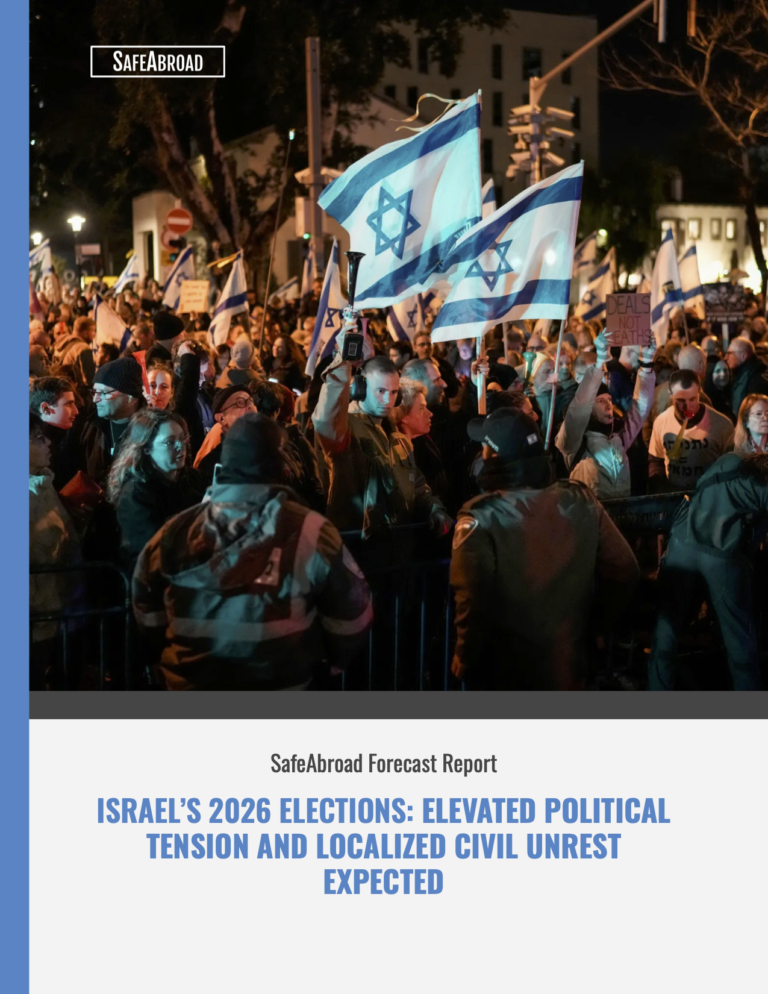
SafeAbroad analysts expect Israel to experience continued and elevated political tension, demonstrations, and localized disruptions in the lead-up to and following the general election on October 27 of this year. This will likely be driven by heightened political polarization, ongoing disputes over military conscription, divisions within Prime Minister Benjamin Netanyahu’s governing coalition, and continued public opposition to government policies. These tensions have already contributed to recurring demonstrations, road blockades, and confrontations with police.1
Key Takeaways
- Protest activity is expected to increase as the election approaches, particularly around major political developments, campaign events, and contentious government decisions. Several hundred people demonstrated in Jerusalem and Tel Aviv in July, while a separate demonstration in central Tel Aviv attracted approximately 1,000 people and focused on government accountability following October 7.2 Political tensions could also extend beyond the election if no clear governing coalition emerges. Study abroad programs should anticipate intermittent demonstrations in major population centers and monitor planned gatherings before students travel within affected areas.
- Political disputes surrounding Netanyahu’s leadership and ultra-Orthodox military-service exemptions are likely to remain major drivers of demonstrations and political tension. Netanyahu’s coalition is currently projected to fall short of the 61 seats required to form a government, while divisions within Likud, Netanyahu’s right-wing political party and disagreements over military-service exemptions have increased political volatility and strained the governing coalition.3 These issues could generate further demonstrations, including activity independent of the election campaign, and may attract counter-protests or heightened police activity as competing groups seek to influence government policy and the formation of the next government.4
- The October 27 election is expected to have significant implications for Israel’s future political direction and its operating environment as a study-abroad destination.5 The election will determine the composition of the next government at a time of heightened domestic polarisation and ongoing regional conflict, with its outcome potentially influencing national security policy, the Gaza conflict, relations with the United States, and the role of religious parties in government.6 Prolonged political uncertainty, continued demonstrations, or a contentious coalition-formation process could affect perceptions of Israel as a study-abroad destination and create additional operational challenges for programs.
Background
Israel’s political environment has been polarized since the formation of Netanyahu’s current coalition and the government’s attempts to reform the judiciary.7
Those judicial reforms, which sought to reduce the powers of Israel’s Supreme Court and increase political control over judicial appointments, generated one of the country’s largest protest movements, with hundreds of thousands participating in demonstrations before the October 2023 Hamas attacks shifted national attention toward the conflict.8 Many of the underlying political disagreements remain unresolved and are likely to re-emerge as the election provides an opportunity for voters to determine the country’s political direction.9
This upcoming election in October is particularly significant because it will be the first national election since the October 7, 2023, attacks and the subsequent regional conflicts.10 The vote is expected to have far-reaching implications for Israel’s domestic and international direction, with national security, the Gaza conflict, relations with the United States, the role of ultra-Orthodox parties, and Netanyahu’s leadership likely to influence voters.11
Security Implications for Study Abroad Programs
Demonstrations are expected to continue and are expected to create localized disruption around central Tel Aviv, Jerusalem, and other major urban centers. Recent protests have occurred at Habima Square in Tel Aviv, near the Knesset in Jerusalem, and at political party offices, demonstrating the geographic spread of protest activity.12 Transportation disruptions are a major impact due to the demonstrations. Recent protests in Tel Aviv have involved protesters blocking roads and disrupting traffic, prompting police intervention and arrests.13 Programs should monitor planned demonstrations and advise students to avoid protest locations, associated counter-protests, and unnecessary interaction with demonstrators or security personnel. Managers should also maintain flexibility in student transportation plans and allow additional travel time when demonstrations are expected.
The possibility of confrontations between protesters and counter-protesters could increase as election day approaches. A recent demonstration outside a conference for ultra-Orthodox recruits escalated into a riot, while another protest at a Religious Zionism party office involved police intervention following attempts to block access.14 Students should maintain a low profile around politically contentious gatherings and immediately leave areas where crowd tension, aggressive rhetoric, or clashes begin to develop.
Election-related demonstrations could coincide with the wider regional security threat environment. Ongoing military operations and unresolved negotiations over Gaza continue to create a volatile external environment alongside domestic political tensions.15 Study abroad programs should therefore avoid treating political demonstrations as an isolated risk and should incorporate them into broader contingency planning for sheltering, communications, transportation, and emergency relocation.
On the Horizon
Overall, Israel is expected to experience elevated political tension, increased protest activity, and localized disruption during the September–October election period and potentially beyond. The election, political divisions within Netanyahu’s coalition, and uncertainty surrounding coalition formation are likely to drive demonstrations, isolated confrontations, and transport disruptions, particularly in major urban centers. Study abroad programs should maintain enhanced monitoring and contingency planning through the election and post-election period, due to the potential for disruptions to student movements, activities, and field trips if protests escalate or become geographically widespread.
- Increased protest activity and localized disruptions are expected during September and October as the election campaign intensifies. Party lists for the 120-seat Knesset must be finalized by September, with the national election scheduled for October 27.16 Study abroad programs should anticipate a higher frequency of demonstrations, political rallies, campaign events, and associated traffic disruption during this period.
- Political tensions will peak in the weeks immediately preceding election day, with demonstrations or isolated confrontations possible following major campaign developments. Netanyahu faces internal divisions within Likud, while recent polling indicates a competitive contest without a clear governing majority.17 Contentious government decisions, political scandals, polling developments, or heightened campaign rhetoric could act as triggers for further protest activity.
- Political disruptions are expected to continue beyond election day, particularly if coalition negotiations are prolonged or the result is highly contested. Israel’s proportional electoral system means coalition formation can depend on smaller parties, while current reporting indicates that no clear governing coalition is assured.18 Programs should therefore maintain enhanced monitoring through November and be prepared to adjust student movements, activities, and field trips if demonstrations become larger, more confrontational, or geographically widespread.
- https://www.courthousenews.com/as-election-nears-israelis-fear-polarization-could-spark-violence/ ↩︎
- https://www.timesofisrael.com/liveblog_entry/netanyahu-is-a-con-man-and-liability-to-us-israel-alliance-protesters-rally-in-jerusalem-tel-aviv/ ↩︎
- https://en.idi.org.il/israeli-elections-and-parties/parties/likud/ ↩︎
- https://thecradle.co/articles/israels-election-trap-runs-deeper-than-netanyahu ↩︎
- https://www.aljazeera.com/news/2026/8/16/a-nation-divided-what-do-israelis-want-in-octobers-elections ↩︎
- https://www.chathamhouse.org/2026/07/israels-general-election-will-be-no-other ↩︎
- https://jppi.org.il/en/is-israel-too-polarized-for-a-constitution-thats-why-we-need-one/ ↩︎
- https://www.aljazeera.com/gallery/2023/10/29/hundreds-of-thousands-march-worldwide-against-israeli-bombardment-of-gaza ↩︎
- https://www.cfr.org/global-conflict-tracker/conflict/israeli-palestinian-conflict ↩︎
- https://www.tandfonline.com/doi/full/10.1080/1057610X.2026.2613426#abstract ↩︎
- https://www.chathamhouse.org/2026/07/israels-general-election-will-be-no-other ↩︎
- https://www.timesofisrael.com/liveblog_entry/protest-leader-bressler-tells-jerusalem-demo-that-netanyahu-seeks-eternal-kingship-will-lose-election ↩︎
- https://www.ynetnews.com/article/bjawe5gugg ↩︎
- https://www.haaretz.com/israel-news/elections/2026-08-08/ty-article/.premium/protests-across-israel-against-netanyahu-government-haredi-and-settler-funding ↩︎
- https://www.reuters.com/world/netanyahus-re-election-hopes-ride-divided-partys-primaries-2026-08-17 ↩︎
- https://israelpolicyforum.org/2026/07/22/israeli-party-lists-from-primaries-to-direct-selection/ ↩︎
- https://www.jpost.com/israel-election-2026/article-905740 ↩︎
- https://www.aa.com.tr/en/middle-east/explainer-how-israel-s-election-system-works/4036927 ↩︎