
Overview
SafeAbroad analysts have assessed that Dengue Fever is the fastest spreading mosquito-borne disease.1 Dengue Fever records are showing a persistent upward trajectory, while 2024 shows the highest global records, data from December 2025 to May 2026 reveals an alarming trend. Dengue Fever is now expanding into territories that were previously unaffected.2 The disease is driven by rapidly changing climate patterns, rapid urbanization combined with the low public immunity against the changing viral strains. Dengue Fever poses an immediate and escalating threat to international travelers.3
Key Takeaways
- The combination of emerging variants, a lack of natural defence and no prior immunity creates an ongoing and unpredictable threat for travelers. The primary driver behind the current spike in cases is due to the lack of immunity in travelers. The lack of immunity is dictated by their origin, with those from non-endemic regions lacking any natural defence against a primary infection, while those from endemic regions face severe risks if they encounter a completely new variant. New variants of Dengue Fever are being exposed to populations for the first time, which leaves individuals vulnerable with their immune systems being unprepared.4 With Dengue Fever, there is no specific treatment therefore travelers are advised to prioritize mosquito bite prevention.
- There has been an increase in cases in 2026 compared to the 2025 baseline data. Since the end of 2025, the number of cases has increased dramatically. The rapid spread is caused by intense outbreaks across Southeast Asia and sudden spikes throughout the Pacific Islands, which makes traveling to these regions riskier for underprepared students.
- The next three months pose a rising risk in Dengue Fever infections. The global risk windows for Dengue Fever are expanding into new territories. This shift is driven by the arrival of Northern Hemisphere summer peaks and the monsoon season.
Background
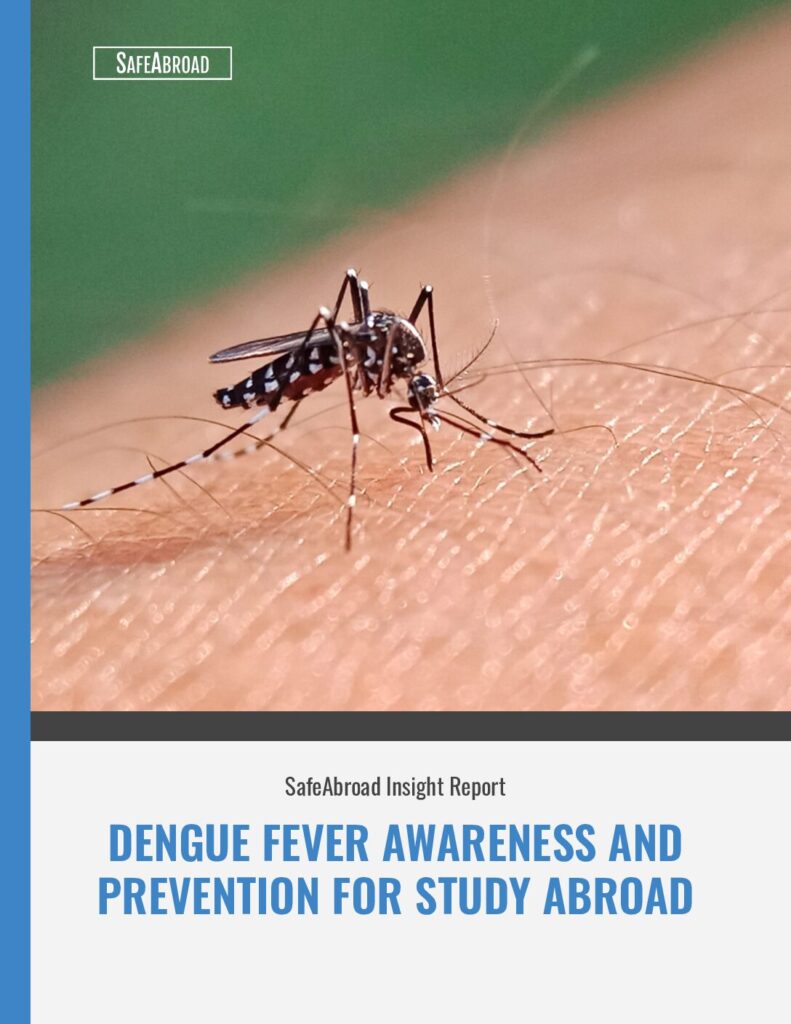
Dengue Fever is a viral infection transmitted by Aedes aegypti mosquitos that causes symptoms similar to influenza.
Recognizing the symptoms;
Mild cases of Dengue Fever can have symptoms similar to severe influenza or COVID-19, such as sudden onset of a high fever, severe “behind-the-eyes” headache, intense muscle and joint aches, nausea, vomiting, and a distinct skin rash, although doctors look for specific symptoms to identify the Dengue Fever virus. Warning signs of Dengue Fever that doctors use to distinguish also include abdominal pains, frequent vomiting, blood in vomit and stool, nose bleeds and bleeding gums and extreme tiredness.
One of the most dangerous factors of Dengue Fever is that it is four different diseases wrapped into one. There are four different variants of the virus, DENV-1, DENV-2, DENV-3, and DENV-4. Getting infected with DENV-1 gives you permanent immunity against DENV-1.Once that temporary shield fades, a traveler’s body is left vulnerable to the remaining strains, increasing the risk of a second infection. If the traveler is to catch a second, different strain, the traveler’s immune system experiences Antibody-Dependent Enhancement (ADE). Through ADE, the leftover old antibodies from the first infection actually assist the virus rather than neutralizing. This allows the new variant to attach to and invade immune cells much faster. This causes the infection to worsen and increases your chances of developing Severe Dengue (Dengue Hemorrhagic Fever), which causes internal bleeding, plasma leakage from blood vessels, and dangerously low blood pressure.5
The Transmission Cycle;
Dengue Fever is not a disease that spreads directly from person to person. You cannot catch it by touching, kissing, or sitting next to someone who is sick. Instead, the disease operates in a continuous human-to-mosquito-to-human loop;6 The initial bite comes from a specific mosquito which is primarily the Aedes aegypti (recognizable by the distinctive white bands on its legs).The loop begins when a mosquito bites a human who is already infected with the Dengue virus, turning the mosquito into a permanent carrier. When the infected mosquito bites a healthy individual, it injects the virus directly into their bloodstream via its saliva. The virus then multiplies inside the human host for four to ten days before physical symptoms appear. Dengue infected mosquitoes are daytime biters, with peaking early in the morning and right before sunset. Infected mosquitoes thrive in urban areas and breed in pockets of stagnant water.7
Geographic Outlook and High-Risk Windows
The next three months trigger peak danger zones with the onset of monsoon season in the Northern Hemisphere. The heavy rainfall creates stagnant water pools, which is perfect for egg-laying, while the intense humidity extends the lifespan of adult mosquitoes.
Dengue was historically restricted to tropical rainforest zones, yet today is spreading globally and moving into urban centers and climates such as temperate, Mediterranean, and high-altitude zones due to global changes. Warmer average global temperatures speed up the life cycle of the mosquito and allow the virus to grow and transfer twice as fast as temperatures climb toward 86°F. It also expands the geographical range where these mosquitoes can survive the winter. Beyond the global factors, infected but asymptomatic travelers constantly introduce new viral strains into areas where local mosquitoes are present, sparking sudden local outbreaks in places that haven’t seen Dengue in many years or ever.8
| Region | Peak Dengue Season |
| South Asia (India, Bangladesh, Sri Lanka) | July to November (Monsoon/Post-Monsoon) |
| The Americas (Brazil, Colombia, Caribbean) | January to May (Southern Hemisphere Summer) |
| Sub-Saharan Africa (Kenya, Senegal, Ghana) | August to November (Rainy Season) |
| Europe (Southern & Western regions, France, Italy and Spain) | June to September (Northern Hemisphere Summer) |
Traveler Guidance
Because there is no targeted medication or treatment to cure Dengue Fever, therefore mitigation of the disease solely relies on personal protection.
Defending against daytime bites travelers should;
- Chemical barriers: Travelers should be applying EPA-registered insect repellents that contain DEET (20%-30%), Picaridin, or oil of Eucalyptus. Travelers need to ensure they are reapplying frequently throughout the day, especially in hot and humid tropical climates.9
- Appropriate clothing: Travelers should wear loose-fitting, long sleeved tops and long pants for full body protection. Travelers should also treat their clothing with permethrin spray, which provides an additional secondary shield of protection.
- Equipped accommodation: Travelers should ensure accommodations are equipped with functioning air conditioning and have tightly sealed doors and windows with screens. If travelers are sleeping in open-air rooms or areas, they should ensure to sleep under insecticide bed nets.
Manage Stagnant Water;
- Travelers should ensure that any accommodation travel locations do not have any stagnant water nearby. When in long-term accommodation, travelers should empty and clean any containers that hold water (buckets, vases and pool covers) at least once a week to assist in disrupting the mosquito breeding cycle.
Medical Treatment and Protocols;
- If a student suspects they have contracted Dengue Fever it is critical to monitor for the 24-48 hours when the fever drops. Health and medical advice is primarily focused on home care and strict medical rules.
- Avoid taking Ibuprofen, Aspirin and Naproxen as a form of medication. Dengue Fever attacks the blood platelets and can prevent clotting. Using non-steroidal anti-inflammatory medication can heavily increase the risk of severe and dangerous internal bleeding.10
- If travelers experience any emergency warning signs they should seek immediate emergency medical care. The most dangerous phase of Dengue Fever begins 24-48 hours after the fever goes away, which is when the blood vessels can become leaky which can potentially lead to Dengue Hemorrhagic Fever.
- https://www.worldmosquitoprogram.org/news-stories/world-mosquito-day-2025-global-health-crisis ↩︎
- https://www.ecdc.europa.eu/en/dengue-monthly ↩︎
- https://iris.who.int/server/api/core/bitstreams/0188524a-5187-400b-bdf1-ace39749768c/content ↩︎
- https://www.worldmosquitoprogram.org/news-stories/world-mosquito-day-2025-global-health-crisis ↩︎
- https://pmc.ncbi.nlm.nih.gov/articles/PMC10062565/ ↩︎
- https://pmc.ncbi.nlm.nih.gov/articles/PMC10062565/ ↩︎
- https://www.vdci.net/blog/meet-the-dengue-mosquito-what-you-need-to-know-about-this-daytime-biter/ ↩︎
- https://pmc.ncbi.nlm.nih.gov/articles/PMC10802639/ ↩︎
- https://www.healthytravel.com.au/news/dengue-fever-outbreak-in-timor-leste ↩︎
- https://www.healthdirect.gov.au/dengue-fever ↩︎