Overview
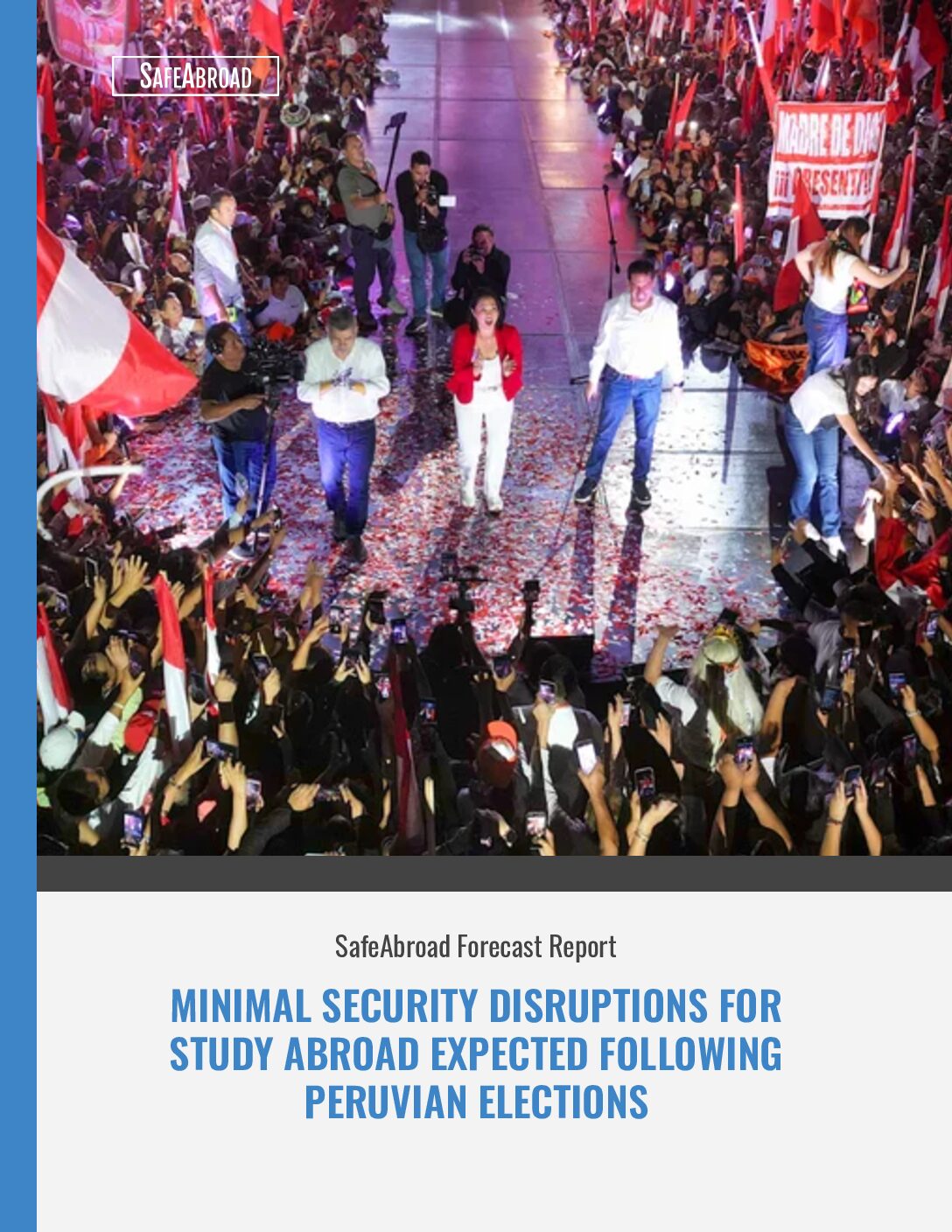
Peru’s post-election period is expected to present a security environment characterised by continued political uncertainty, localized civil unrest, and persistent public safety concerns.1 While Peru is likely to remain a viable destination for study abroad programs, program managers should anticipate the need for increased monitoring, flexible planning, and proactive student safety measures.
The most likely risks for study abroad operations are expected to come from localized political demonstrations, transportation disruptions, and everyday crime concerns rather than widespread instability.2 Following the recent election outcome and transition to a new administration, Peru’s security environment is expected to shift toward a greater focus on public security, crime reduction, and maintaining social order.3 However, the government may continue to face challenges related to political polarization, public confidence, and potential opposition to new policies, which could contribute to localized protests or disruptions. For study abroad programs, the primary impacts are expected to remain operational, including possible changes to transportation, programming schedules, and student mobility rather than broad restrictions on international activities.4
Key Takeaways
- Political uncertainty is expected to cause continued localized unrest. Peru has experienced ongoing political demonstrations linked to government decisions and broader social grievances since the beginning of 2018, with protests intensifying following the removal of President Pedro Castillo in late 2022.5 These events can escalate quickly and may disrupt transportation routes, public spaces, and local services.6 With the most recent presidential election, demonstrations are expected to increase in the near term due to political polarization and opposition to the new administration.7
- Disruptions to study abroad programs are more likely to be operational as opposed to program-altering in nature. The primary impacts for international programs are expected to involve adjustments to transportation, excursions, and daily activities rather than widespread threats to program continuity. However, short-term volatility linked to protests, public demonstrations, or localized security incidents may require flexible scheduling and rapid operational adjustments by program staff.8
- Security conditions are expected to differ by region throughout Peru. Major study abroad locations such as Lima and Cusco will experience different challenges, ranging from demonstrations and transportation disruptions to tourist-related safety concerns. The U.S. Department of State similarly emphasizes that risk levels vary significantly across regions in Peru, with urban centers and tourist destinations facing different security conditions that require programs to monitor local developments and adapt their safety measures accordingly.9
Background
Peru has experienced periods of political instability over the recent years, with tensions between government institutions, political actors, and segments of the population contributing to repeated demonstrations and public dissatisfaction.10
Political protests in Peru can occur with limited warning and may result in road closures, transportation interruptions, and disruptions to normal activities. For example, during the 2022-2023 political crisis following the removal of President Pedro Castillo, widespread demonstrations led to highway blockades, disruptions to public transportation, temporary airport closures, and interruptions to access routes for major tourist destinations such as Cusco and Machu Picchu.11 These dynamics are typically episodic rather than continuous, but they can escalate rapidly in response to political developments, creating short-term operational uncertainty for both residents and international programs.12
For study abroad programs, these conditions are most relevant because disruptions affect student mobility, academic activities, and program scheduling. However, security conditions vary significantly by location. While certain regions face elevated risks related to crime or political unrest, major tourism and study abroad destinations generally continue to operate with appropriate precautions.13
Security Implications for Study Abroad Programs
Overall, Peru’s current security environment is expected to present manageable but evolving risks for study abroad programs, with the greatest impacts likely to involve localized protests, transportation disruptions, and everyday safety concerns rather than widespread threats to program themselves. Program managers and students should prioritize situational awareness, flexible planning, and location-specific risk mitigation strategies to adapt to short-term changes.
- The likelihood of demonstrations remains a key implication to student travelers in Peru’s post-election environment. Although protests are not typically directed at international students, they may create indirect risks through crowd activity, roadblocks, transportation delays, or changes to local operating conditions. Potential impacts can include, adjustments to excursions and academic programming, demonstration areas taking place in and around learning locations and changes to transportation arrangements due to road blockages or delays. Previous demonstrations in Peru have affected highways, public transportation, and access routes, creating challenges for travelers and organizations operating in affected areas.14 For example, in November 2020, protests following the removal of President Martín Vizcarra led to widespread demonstrations in Lima and other cities, resulting in road disruptions, public transportation impacts, and temporary closures of some public areas. The unrest highlighted how political developments can quickly affect mobility and daily operations in urban areas.15
- The security conditions for study abroad programs should be assessed based on program location due to the risk varying by region. Lima is expected to have a higher exposure to political demonstrations, public gatherings, and urban crime concerns, due to its being Peru’s political and administrative center, where government institutions, major public spaces, and large population centers are concentrated.Cusco and surrounding tourist areas will have heightened exposure to disruptions affecting tourism routes, transportation, and access to major sites, due to these locations being a key spot for tourism infrastructure and the importance of road and rail connections for visitor movement. As for remote and border regions, these areas are expected to face additional risks related to organized crime, infrastructure limitations, and reduced emergency response capacity.
- The new administration has identified public security and crime reduction as key policy priorities in response to growing public concern over violent crime and organized criminal activity. As these policies are implemented, there may be an increased presence of police and security forces in major cities, around government buildings, and in areas experiencing demonstrations. While these measures are intended to improve public order and reassure the public, their implementation may temporarily affect mobility and access to certain locations.16 For study abroad programs, enhanced security operations are unlikely to pose a direct threat to participants but may influence the day-to-day operating environment. Increased police activity, temporary road closures, security checkpoints, or restricted access to areas hosting political events could require adjustments to planned activities or travel routes. Program managers should remain informed of local security announcements and maintain communication with host institutions to anticipate and respond to operational changes.
On the Horizon
Over the next 6–12 months, Peru is expected to remain operationally stable for study abroad programs but politically and socially active, with the most likely disruptions expected to be from localized protests, transportation disruptions, and evolving government security measures rather than systemic instability.
- The post-election period is likely to be characterized by continued political polarization and a public security agenda centered on crime reduction and restoration of public order. Public security remains a domestic concern, with crime and government effectiveness among key issues shaping political debate. The new administration’s focus on security measures is therefore likely to influence policing activity and public responses, particularly in urban areas.17 As a result, operational impacts for study abroad programs are expected to remain intermittent rather than sustained, with disruptions most commonly affecting mobility, scheduling, and access to public spaces.
- Security conditions are expected to vary significantly by region, with Lima and other major urban centers more exposed to demonstrations and policing activity, while tourism-heavy areas such as Cusco may experience indirect disruptions primarily through transport constraints and crowd management around key sites. This regional variation reflects Peru’s geographic and economic differences as Lima serves as the country’s political and administrative center, making it a focal point for demonstrations, while Cusco’s reliance on tourism means disruptions to transportation networks can have a disproportionate effect on visitors and international programs. Crime is expected to remain a baseline concern across all locations, particularly in high-traffic tourist areas, and will continue to require consistent mitigation measures regardless of political developments.18
- https://lens.civicus.org/peru-a-knife-edge-election-and-an-ongoing-crisis/ ↩︎
- https://www.bbc.co.uk/news/articles/c9d21184e7yo ↩︎
- https://www.theguardian.com/world/2026/jun/30/keiko-fujimori-wins-peru-presidential-election-polls-runoff ↩︎
- https://travel.state.gov/content/travel/en/traveladvisories/traveladvisories/peru-travel-advisory ↩︎
- https://www.congress.gov/crs-product/IF12372 ↩︎
- https://travel.state.gov/content/travel/en/traveladvisories/traveladvisories/peru-travel-advisory ↩︎
- https://www.gov.uk/foreign-travel-advice/peru/safety-and-security ↩︎
- https://travel.state.gov/content/travel/en/traveladvisories/traveladvisories/peru-travel-advisory ↩︎
- https://travel.state.gov/content/travel/en/traveladvisories/traveladvisories/peru-travel-advisory ↩︎
- https://americasquarterly.org/article/perus-political-instability-enters-a-new-chapter-under-balcazar/ ↩︎
- https://www.theguardian.com/world/2022/dec/07/peru-president-detained-pedro-castillo-coup ↩︎
- https://www.gov.uk/foreign-travel-advice/peru/safety-and-security
↩︎ - https://travel.state.gov/content/travel/en/traveladvisories/traveladvisories/peru-travel-advisory ↩︎
- https://www.theguardian.com/world/2023/feb/08/peru-protests-president-election-what-is-happening-explainer ↩︎
- https://www.theguardian.com/world/2020/nov/13/peru-protests-impeachment-president-martin-vizcarra ↩︎
- https://www.reuters.com/world/americas/keiko-fujimori-leads-perus-presidential-race-after-official-count-concludes-2026-06-29/ ↩︎
- https://www.hrw.org/world-report/2025/country-chapters/peru ↩︎
- https://www.gov.uk/foreign-travel-advice/peru/safety-and-security ↩︎