Overview
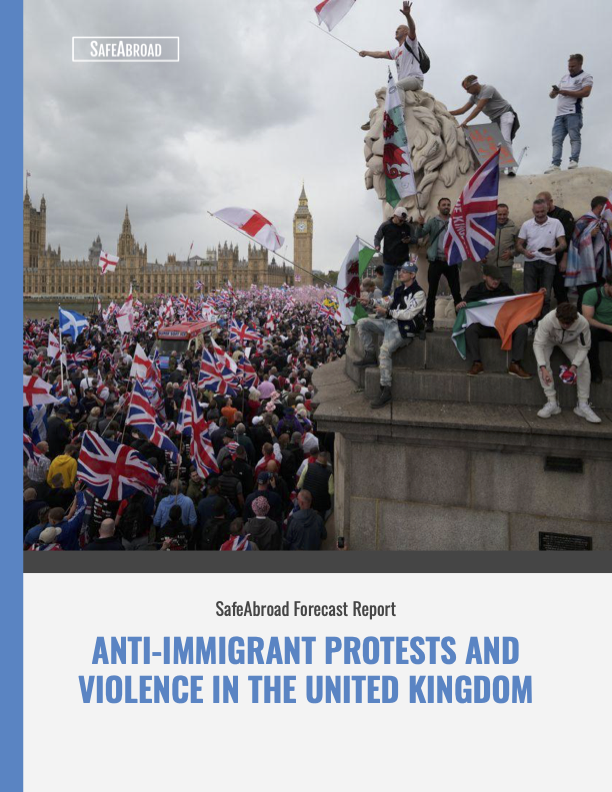
SafeAbroad analysts have assessed that anti-immigrant protests are likely to remain a recurring public-order issue across the United Kingdom during the next six months. The threat environment is characterized by localized demonstrations that target asylum accommodation sites, migrant housing facilities, and government migration policies. While widespread national unrest comparable to the August 2024 riots remains unlikely, the risk of isolated violence, disorder, and clashes remains elevated.
Key Takeaways
- Anti-immigrant protests are likely to continue throughout summer and autumn 2026. Most activity is expected to be concentrated around asylum hotels, migrant accommodation centres, and other sites associated with asylum and immigration policies. While demonstrations are expected to remain in major cities and heightened locations such as Southampton and Belfast, these locations will continue to serve as focal points for community grievances, activist mobilization, and occasional public-order incidents.
- Online misinformation and influencer networks will continue to accelerate anti-immigrant mobilization across the United Kingdom. Violence and protest activity are highly decentralized, with social media platforms such as X, Telegram, and WhatsApp serving as key channels for sharing real-time locations, target information, and unverified claims following high-profile crimes. As a result, localized incidents can rapidly evolve into larger demonstrations and increase the likelihood of disorder.1
- Counterprotests are expected to become more frequent in response to anti-immigrant demonstrations, increasing the likelihood of confrontations between opposing groups. This dynamic is likely to be most pronounced around asylum accommodation sites and other protest flashpoints where competing mobilizations coincide. In such settings, rapid escalation can occur when opposing groups arrive in close proximity, placing additional pressure on local policing resources and public-order management.2
Background
Anti-immigrant activism has evolved significantly since the 2024 Southport-related riots, with initial mobilisation driven by misinformation surrounding a violent criminal incident shifting into broader protest activity focused on asylum accommodation, irregular migration, housing pressures, and perceptions of government inaction.
Throughout 2025 and into mid-2026, asylum-seeker hotels became major focal points of tension. Incidents such as the protests outside the Bell Hotel in Epping highlighted how far-right activists successfully exploit local grievances regarding community safety to spark wider violent clashes. More recently, the dynamic has been further intensified by high-profile violent crimes, which political actors and online influencers, such as Tommy Robinson, have at times framed as structural failures of national border control. The June 2026 stabbing incident in Belfast involving a Sudanese asylum seeker triggered violent rioting throughout the city.3 Alongside grievances surrounding the handling of the Henry Nowak case in Southampton, triggered severe, multi-day rioting.4 This included targeted arson attacks on immigrant homes and public transport, demonstrating the speed with which local criminal events trigger broader civil unrest across the United Kingdom.
These developments have occurred against a backdrop of sustained public concern regarding immigration and asylum policy. Despite declines in net migration from its post-pandemic peak, immigration continues to rank among the most important political issues for many British citizens.5 The continued use of hotels and other temporary accommodation for asylum seekers has become a particularly contentious issue, serving as a visible symbol of perceived government failure to manage irregular migration. At the same time, social media platforms have enabled activists to rapidly disseminate information, coordinate demonstrations, and amplify local grievances, allowing isolated incidents to generate national attention and mobilise supporters across multiple locations.6
On the Horizon
Overall, the United Kingdom remains a low-risk destination for most travellers; however, anti-immigrant protests and associated violence are expected to remain a recurring public-order concern over the next six months, driven by tensions around asylum accommodation, high-profile criminal incidents involving migrants, rapid online misinformation, and increasing counter-protest activity.
- The location of asylum accommodation facilities remains the strongest predictor of anti-immigrant protest activity over the next six months. Hotels, temporary accommodation centres and asylum housing have become symbolic representations of wider public concerns regarding immigration, housing shortages, pressure on public services, and perceptions of government inaction. Communities informed of new accommodation placements often experience heightened local tensions, particularly where there are pre-existing socioeconomic grievances. Protests are therefore most likely to emerge in areas where asylum accommodation is highly visible and where local opposition groups have an established presence. Any announcement regarding new accommodation sites, extensions of existing contracts, or increases in resident numbers should be considered a key warning indicator. While existing sites are often identifiable through local reporting, council discussions, and community reporting via local media and social media. However, information on new or expanded accommodation are often disclosed late in the process and may first appear through local media or social media channels.7
- SafeAbroad analysts expect Southampton and Belfast to remain key locations for continued anti-immigrant protest and violence. Recent unrest in both cities has demonstrated their capacity to act as focal points for wider anti-immigration mobilisation following high-profile violent incidents. With additional demonstrations reportedly planned in the coming weeks, there remains an elevated risk of further public disorder, particularly in areas associated with the original incidents or perceived links to asylum seekers and migrant communities. Upcoming demonstrations are expected to draw large crowds and counterdemonstrations.8 The continued circulation of inflammatory narratives on social media, combined with heightened community tensions and ongoing political attention, is likely to sustain protest activity and increase the potential for localized clashes, property damage, and disruption to transport networks and public services.
- Counter-protests are expected to become more frequent in response to anti-immigrant demonstrations, particularly in urban centers and around asylum accommodation facilities. Anti-racist organisations, community groups, trade unions, and pro-refugee networks have increasingly mobilised to challenge anti-immigration activism and demonstrate solidarity with migrant communities, such as the Stand Up to Racism organisation.9 While the majority of these events remain peaceful, the presence of opposing groups in close proximity increases the likelihood of verbal confrontations, isolated assaults, and public-order incidents requiring police intervention. Locations where both anti-immigration and counter-protest groups are expected to mobilise should therefore be considered elevated-risk environments.
- Online platforms continue to play a critical role in accelerating protest mobilisation and amplifying anti-immigration narratives. Social media networks, particularly X and Telegram, enable activists, influencers, and informal community networks to rapidly disseminate protest information, identify perceived targets, and circulate unverified claims. Previous incidents have demonstrated that narratives can spread nationally within hours, often outpacing official communications and fact-checking efforts. The increasingly decentralised nature of online mobilisation means that local incidents can rapidly attract national attention, increasing the likelihood of demonstrations, counter-protests, and spontaneous public-order incidents.
- https://www.isdglobal.org/digital-dispatch/quantifying-extremism-a-data-driven-analysis-of-uk-riot-related-far-right-telegram-networks/ ↩︎
- https://www.bbc.co.uk/news/articles/c20ykkw4vd3o ↩︎
- https://www.psni.police.uk/latest-news/man-arrested-north-belfast-following-report-stabbing-incident ↩︎
- https://www.hampshire.police.uk/news/hampshire/news/news/2026/may/man-convicted-of-murdering-student-in-southampton/ ↩︎
- https://migrationobservatory.ox.ac.uk/resources/briefings/uk-public-opinion-toward-immigration-overall-attitudes-and-level-of-concern/ ↩︎
- https://www.theguardian.com/commentisfree/2026/jun/10/the-guardian-view-on-far-right-violence-digital-radicalisation-is-threatening-democracy ↩︎
- https://migrationobservatory.ox.ac.uk/resources/briefings/asylum-accommodation-in-the-uk/
↩︎ - https://www.infomigrants.net/en/tag/anti%20refugee%20protests/ ↩︎
- https://standuptoracism.org.uk/ ↩︎