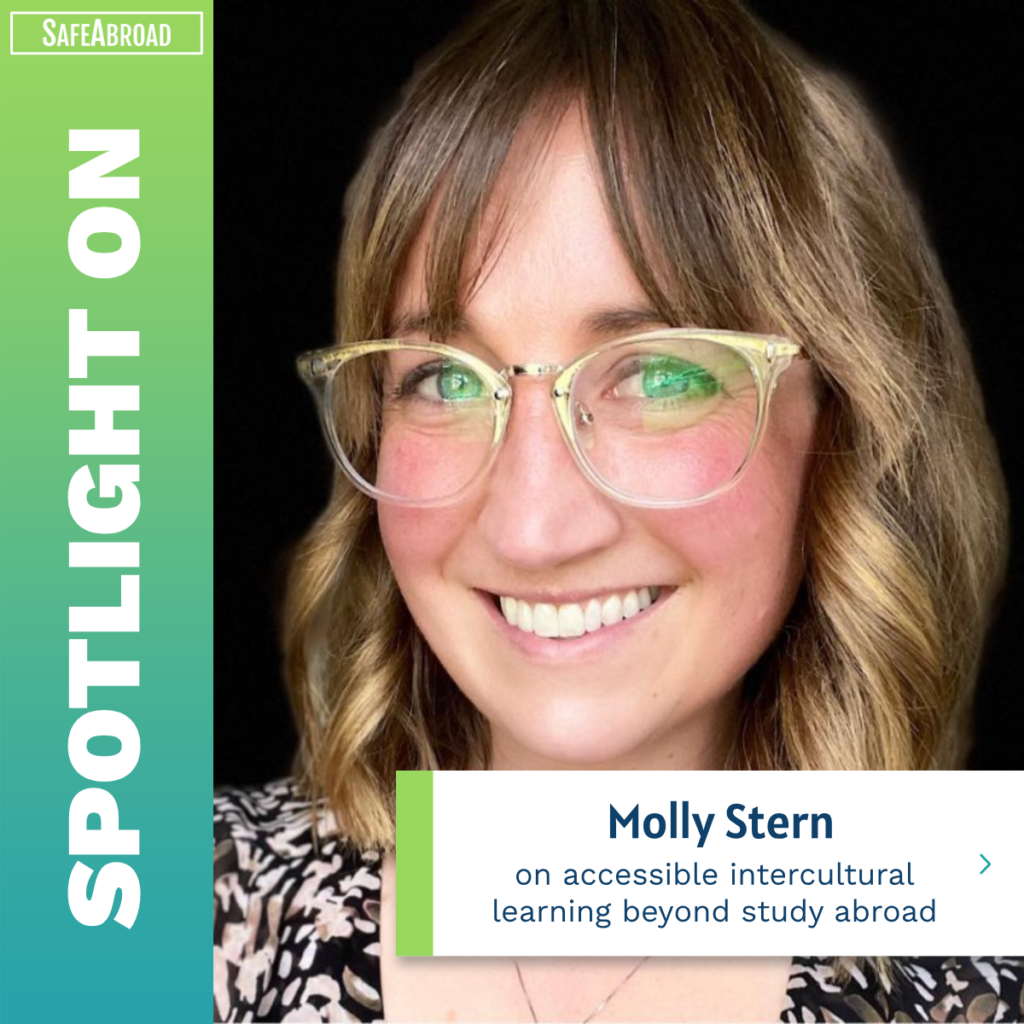
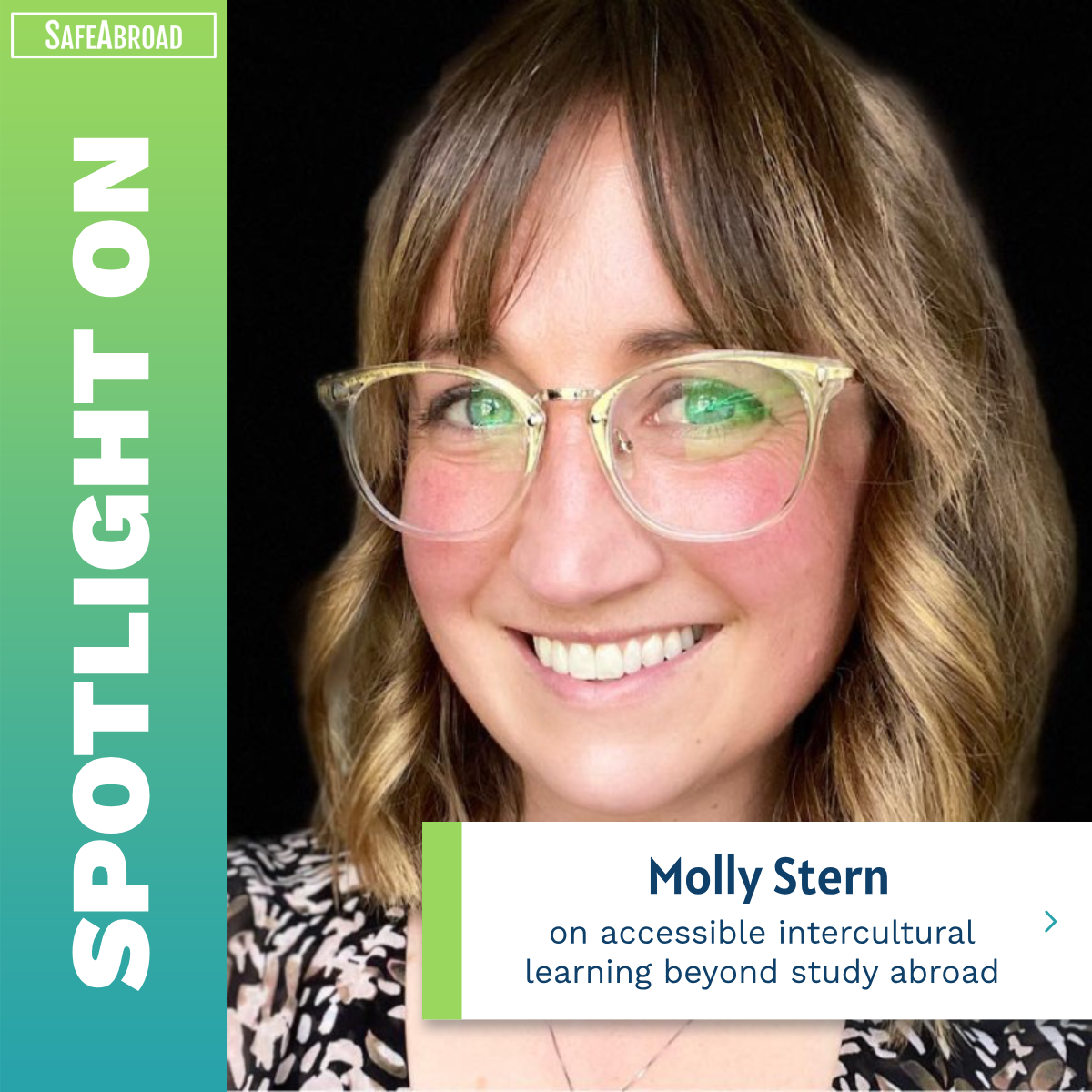
To get started, can you share what led you into this work in intercultural learning and global education—and how you came to AFS and Global Up?
Like many people in our field, I had a transformational experience of my own. I studied abroad and interned in Costa Rica, and I found myself naturally stepping into a resident advisor-type role with my classmates. At the time, I didn’t even know international education was a field—this was 20 years ago.
I was a sociology, women’s studies, and Spanish major, and I thought my dream job would be a study abroad advisor. I did that for a while at the University of Minnesota, and later worked for a nonprofit called Global Citizens Network, sending volunteers abroad to do community projects with rural Indigenous groups. What I loved most was witnessing the personal transformation—how people return home with a deeper understanding of themselves and a new ability to take on different perspectives.
At AFS, we developed the Global Competence Certificate to support that kind of introspective, reflective work. It gives students the tools and theory to unpack their experiences and make sense of the similarities and differences they encounter. I’ve been doing that work at AFS for eight years now, and I love it.
Can you talk about how Global Up is reshaping intercultural learning—especially for diverse and global audiences?
AFS has an incredible history. It began as the American Field Service—ambulance drivers in WWI and WWII. After the wars, they wanted to prevent future conflict and founded an educational organization to build international friendships and humanize “the other.” That mission—building a more peaceful and just world by developing global citizens—remains central.
Global Up began as a way to standardize pre-departure curriculum across AFS’s high school exchanges. The goal was to give all students a consistent, intercultural learning foundation—regardless of where they were going. It’s culturally general but focuses on self-awareness, awareness of others, and bridging differences.
Over time, we’ve expanded Global Up to more than 100 institutions and universities. It’s now used not only in education abroad but also in other sectors—law schools, healthcare, and community colleges. Even students who don’t study abroad can go through “Global Up at Home.” We want to create more access to this kind of learning—whether someone’s preparing for an exchange or needs intercultural skills for work and life.
How does global competence translate into real-world impact—in classrooms, communities, or careers?
We partnered with Purdue University on two research studies. One study looked at three groups: students with no intervention, students with one-to-one mentoring, and students in the Global Up program. The Global Up group made statistically significant gains on the IDI (Intercultural Development Inventory)—8 points in the first study, 13 in the second.
What’s powerful is that these gains happened on short-term programs—two weeks or a month. That challenged the old myth that only semester- or year-long experiences “count” in terms of impact.
But beyond the numbers, we hear stories. One participant at Brenau University told me it helped her understand not only her colleagues at work, but even her husband. It helped her recognize conflict-avoidant communication styles and made sense of behaviors she hadn’t understood. So the skills ripple out into personal relationships, workplace dynamics, and broader community interactions.
What about access and inclusion for students with disabilities or different learning needs?
The curriculum was created by a 15-member international team, drawing on global expertise. We’ve worked with MIUSA (Mobility International), a disability advocacy organization, to make our virtual platform accessible—screen reader compatible, closed captions in multiple languages, and alt text on all slides and materials.
We’ve tried to bake in as many accommodations as possible from the beginning. We’ve also started exploring neurodiversity—asking whether our programs meet the needs of neurotypical and neurodivergent learners. For example, being able to speed up or slow down videos is a small but helpful step.
Let’s talk safety and responsible global learning. How does Global Up address risk awareness—especially in virtual and hybrid spaces?
Our organization has a global risk management team that consults with partners in over 60 countries. I’m not deeply involved in that team, but in Global Up, our responsibility is more on the pre-departure or virtual side.
In virtual exchanges, we’ve had to address online behavior—like a student trying to harass another participant. So we’ve created participant agreements, community guidelines, and anti-hate speech policies. We also field growing concerns about privacy—students worried about being screenshot or outed, especially if they’re sharing sensitive information like undocumented status.
There’s increasing awareness about digital safety, and we’re constantly evolving to keep up. Technology changes fast. We want to create safe spaces, even in virtual programs.
Looking ahead, what excites you most about the future of intercultural education? What role do you hope AFS, Global Up—or you personally—will play?
I think the work of navigating cultural, generational, and communication differences reminds us how human we are—even in a digital world. It’s about relationships. I get excited about equipping people with the tools to build positive, respectful relationships—at work, in their communities, and in their families.
Even when someone doesn’t study abroad, going through this curriculum can be transformative—if they’re open to it. It takes humility and vulnerability to reflect on who you are and how you show up in the world. But for those who are ready, it can be life-changing. That’s meaningful work, and I feel lucky to be part of it.