Overview
SafeAbroad analysts have assessed that ongoing farmer protests in several European countries have a moderate to high likelihood of disrupting travelers’ transportation over the coming months. Anger over both EU and national policies have led farmers to block highways, city centers, airport access among other disruptions. These protests are likely to continue to grow in size and scope in the immediate future.
Key Takeaways
- National and EU policies are fueling farmer anger. Opposition to the proposed EU–Mercosur free-trade agreement, combined with national grievances over subsidies, livestock disease management, and rising production costs, has fueled anger across several European countries (Poland, France, Greece, and Belgium).
- Farmer protests are directly disrupting travel throughout the continent. Road blockades, border disruptions, and protests near airports have caused severe congestion and unpredictable travel conditions in multiple countries, particularly in France and Greece. In extreme cases, protests have spilled onto airport grounds and key highways, contributing to major delays.
- The size and frequency of farmer protests will likely increase over the coming months. With the EU–Mercosur FTA expected to move forward and farmer groups already signaling new waves of action, protests are likely to grow in scale and geographic reach. Travelers should anticipate worsening transport disruptions across Europe, including highways, city centers, borders, and access routes to airports, though these protests will not negatively impact security conditions.
Background
Anger over the proposed EU-Mercosur deal, French livestock policies, and owed payments to Greek farmers continues to drive major protests.
Farmer protests across Europe have erupted in several nations due to long-standing financial burdens created by policy and at both the national and EU levels. A central driver of recent protests is the opposition to a proposed EU-Mercosur free-trade agreement (FTA). Farmers across Europe oppose the FTA due to fears of being undercut by South American agricultural prices; strict regulations and high production costs in Europe would make it extremely difficult for European farmers to compete with farmers in nations not subject to the same regulations under an FTA agreement. The potential EU-Mercosur FTA creates continent wide anger in addition to recent local grievances, particularly over livestock disease management policies and compensation mechanisms.
At the EU level, large-scale demonstrations have shown the breadth of farmer dissatisfaction. Thousands of farmers from multiple countries converged in Brussels on December 18 to protest the proposed EU-Mercosur FTA, flooding central streets with over 150 tractors and throwing produce at police.1 The scale of the protest prompted the US Embassy in Belgium to issue an alert advising against traveling near the protest.2 Similar grievances have driven nationwide protests in Poland, where demonstrations at more than 160 locations targeted expressways and key road junctions.3
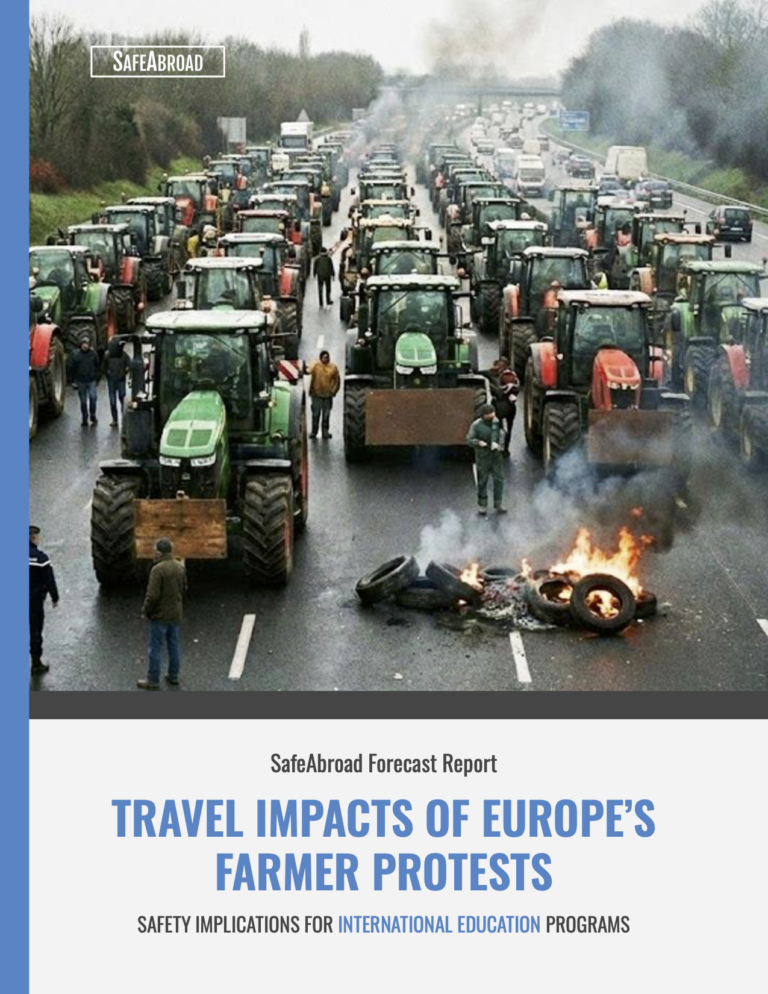
France has been a focal point of recent protest activity. Farmers have repeatedly blocked major roads and highways, including the A64 in southwest France near Toulouse and access points such as the Foix tunnel, disrupting travel to the Pyrénées and surrounding regions.4 5 These actions are closely tied to anger over livestock disease regulations. French authorities started to cull herds which had even a single case of lumpy skin disease which farmers argue is overkill.6 Lumpy skin disease is a potentially fatal and infectious illness to cattle, but has no effect on humans, which causes nodules to form on the skin.7 Without any action to stop its spread in France, lumpy skin disease could take out as much as 10% of the national herd.8 In addition to the mandatory culling of herds due to potential lumpy skin disease spread, the EU–Mercosur deal has also contributed to anger.9 As a result, protests have led to severe congestion and unpredictable closures which have affected regional travel, especially during peak holiday periods.10
Nationwide farmer protests have caused disruptions across Greece since December 10 by staging blockades that block key routes such as the Athens-Thessaloniki highway.11 Protests initially started out of anger over the delay of payment of owed EU subsidies combined with high production costs. An EU audit following fake land ownership fraud caused delays in the disbursement of funds owed to Greek farmers, at a time when a mass culling of diseased sheep and goats was driving up production costs.12 In addition to blocking major highways, border crossings at both the North Macedonian and Bulgarian borders have several rounds of blockades.13 Farmer protests have even affected air travel; protesters stormed Crete’s tarmac on December 8 and attempted to block the road to Thessaloniki Airport on December 5.14 These and other disruptions have had a significant toll on Greece’s winter tourism, with up to 50% of bookings cancelled in some key areas.15
On the Horizon
Overall, Europe will remain a safe destination but one increasingly plagued by travel difficulties stemming from farmer protests. Following the likely passage of the EU-Mercosur FTA, farmer protests will most likely grow in size and scope disrupting travel across entire nations as opposed to strictly major cities.
What to watch for over the next months:
- The EU-Mercosur FTA will likely be signed. The FTA, which is 26 years in the making, will likely be passed by the necessary two thirds majority. The initial vote was delayed following farmer protests in Brussels on December 18.16 The vote in mid-January is likely to pass for two primary reasons. First, the issue has become politicized beyond just the agricultural sector, with supportive members such as Germany throwing the weight of their EU funding around as well as worries about EU negotiating credibility should the deal fail to materialize.17 18 Secondly, the addition of safeguard clauses, which look helpful on paper but have debatable practical effects, to protect EU farmers will help make the deal more acceptable.19
- Farmer protests will likely increase over the coming months. Following the likely acceptance of EU-Mercosur FTA with amendments, mass farmer protests are likely to grow in size and impact. Some groups are already planning to expand their protests in early January, such as in France where farmers are already planning a new wave of protests.20 Similarly, Greek farmers met on January 4 to before deciding to carry out two major escalatory strikes on January 7-8.21
- Further travel disruptions will likely result from additional farmer protests. Roadblocks have proved a common method for voicing anger over policy throughout Europe. Protests in city centers have also proven to be disruptive across entire countries as opposed to strictly large cities which widens their impacts.22 During previous rounds of farmer protests, these protests have even led to farmers dumping manure and rotten produce in city centers leading to disruptions to travel through downtown areas.23 Recent history also shows that travel to airports will also likely be increasingly difficult amidst any increase in the size of current protests.24
- https://www.aljazeera.com/news/2025/12/18/angry-farmers-block-brussels-roads-with-tractors-over-mercosur-trade-deal
↩︎ - https://be.usembassy.gov/demonstration-alert-u-s-embassy-brussels-belgium-december-18-2025/
↩︎ - https://www.polskieradio.pl/395/7784/Artykul/3627433,polish-farmers-stage-nationwide-protests-against-eumercosur-trade-deal
↩︎ - https://www.lemonde.fr/en/economy/article/2025/12/14/french-farmers-block-highways-over-culling-of-diseased-cattle_6748476_19.html
↩︎ - https://www.aa.com.tr/en/europe/french-farmers-persist-road-blockades-despite-christmas/3780827
↩︎ - https://www.lemonde.fr/en/france/article/2025/12/13/french-farmers-block-roads-to-protest-cow-disease-cull_6748463_7.html
↩︎ - https://www.woah.org/en/disease/lumpy-skin-disease/
↩︎ - https://www.thebeefsite.com/news/french-farmers-protest-culls-as-lumpy-skin-disease-spreads
↩︎ - https://www.france24.com/en/france/20251216-french-farmers-ire-over-cattle-cull-leads-blocked-roads-likely-delay-mercosur-trade-deal
↩︎ - https://www.aa.com.tr/en/europe/french-farmers-persist-road-blockades-despite-christmas/3780827
↩︎ - https://www.ekathimerini.com/news/1291109/farmers-escalate-protests-blocking-highways-and-border-crossings/
↩︎ - https://www.reuters.com/business/environment/protesting-greek-farmers-disrupt-port-operations-nationwide-blockades-persist-2025-12-10/
↩︎ - https://www.ekathimerini.com/news/1291109/farmers-escalate-protests-blocking-highways-and-border-crossings/
↩︎ - https://apnews.com/article/greece-farmers-subsidies-protest-airport-crete-db70ada19d960049354e2375b5f9ac15
↩︎ - https://www.travelandtourworld.com/news/article/farmers-strikes-cause-major-disruptions-in-greeces-winter-tourism-fifty-percentage-cancellations-in-key-destinations
↩︎ - https://www.pbs.org/newshour/world/eu-delays-massive-free-trade-deal-with-south-american-bloc-mercosur-amid-farmer-protests
↩︎ - https://valorinternational.globo.com/foreign-affairs/news/2025/12/19/eu-mercosur-trade-deal-signing-delayed-to-january.ghtml
↩︎ - https://www.pbs.org/newshour/world/eu-delays-massive-free-trade-deal-with-south-american-bloc-mercosur-amid-farmer-protests
↩︎ - https://www.foodwatch.org/en/eu-mercosur-trade-first-standards-later
↩︎ - https://www.thelocal.fr/20251230/farmers-plan-fresh-protests-in-south-west-france
↩︎ - https://www.keeptalkinggreece.com/2026/01/04/farmers-escalate-protests-48h-blockades-jan-7-8/ ↩︎
- https://www.rfi.fr/en/france/20251212-french-farmers-step-up-protests-over-regulations-and-compulsory-cattle-culls
↩︎ - https://www.cbsnews.com/news/france-farmer-protest-manure-toulouse/
↩︎ - https://www.aljazeera.com/gallery/2024/1/31/thousands-of-protesting-farmers-have-frances-government-in-a-bind
↩︎