Overview
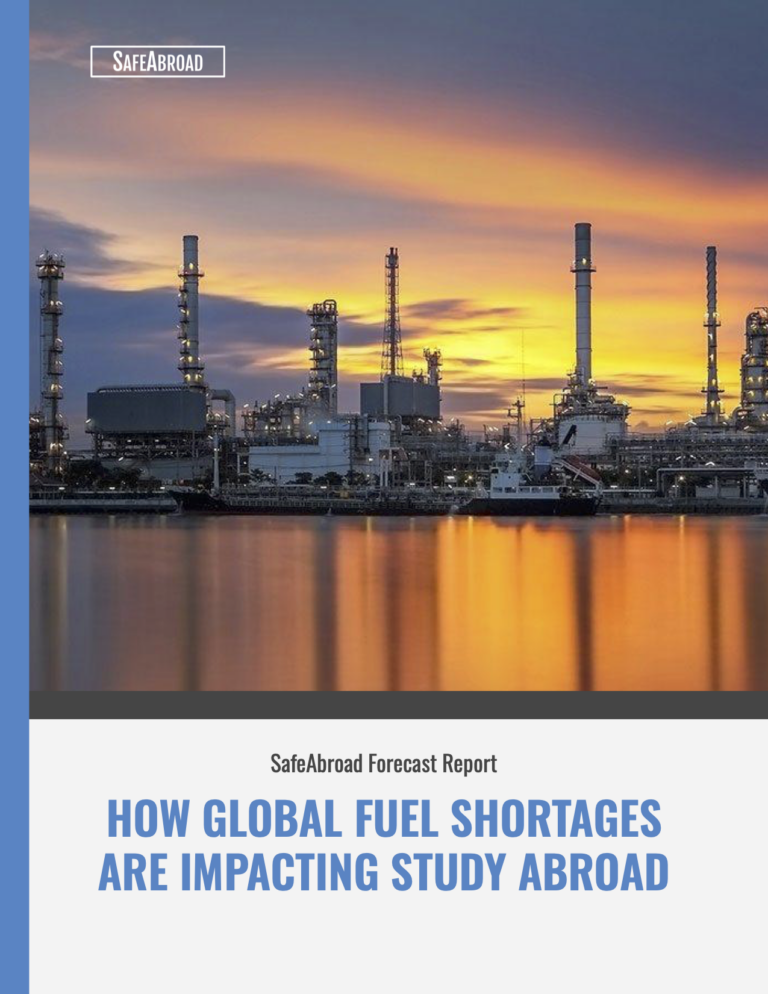
SafeAbroad analysts have assessed the global impact of fuel shortages and their effects on study abroad programs. Disruptions to energy supply chains are impacting student mobility, including flight cancellations, increased travel costs, and reduced access to transportation and essential services in several regions.
Key Takeaways
- The conflict in the Middle East has severely disrupted global energy supply chains. Attacks on critical infrastructure and the closure of the Strait of Hormuz have significantly constrained global oil flows, triggering production slowdowns and supply shortages. Despite large-scale, coordinated releases from strategic reserves, these measures have proven insufficient to stabilize markets as ongoing security risks and shipping disruptions continue to drive volatility and keep prices elevated.
- Regions with high dependence on Middle Eastern energy imports are experiencing the most severe disruptions and economic strain. Asia, the Pacific, and Africa are facing the most severe impacts including fuel shortages, government-imposed conservation measures, and economic pressure. Limited strategic reserves and reduced access to refined fuel exports are forcing some countries to ration fuel or curb industrial activity.
- Jet fuel price spikes and shortages will increase travel costs. The disruption to crude oil flows has limited the global output of refined products including jet fuel. Many airlines across the world have taken short-term measures to limit rising ticket prices, including operating at a loss and internal restructuring to cut costs. These actions are emergency stopgap measures, making flight cancellations and fuel surcharges more likely the longer energy supply chains are disrupted.
Background
Escalating attacks on Middle Eastern energy infrastructure and Iran’s closure of the Strait of Hormuz have severely disrupted global oil supply chains, driving global oil prices up and creating shortages.
The outbreak of the current conflict across the Middle East on February 28 has led to the destruction of some of the world’s most productive oil-producing and refining infrastructure. After an initial wave of attacks across the region, drones and missiles switched from largely targeting military sites to energy infrastructure. Iran has been targeting sites such as Qatar’s Ras Laffan facilities, which alone supply around one fifth of the world’s Liquid Natural Gas (LNG).1 Energy infrastructure has also been targeted in Kuwait, Saudi Arabia, Oman, and the United Arab Emirates (UAE).2 Iran claims that many of these attacks are in retaliation to joint US-Israeli strikes on its own drills and refineries; on March 18, Israel struck the South Pars oil field, which is the world’s largest natural gas field and jointly shared by Iran and Qatar.3
The largest shocks to global fuel supplies came when Iran announced the Strait of Hormuz was closed and began targeting oil tankers on March 4.4 The strait is a narrow passageway in which nearly 25% of the world’s seaborne oil supplies transit through.5 The closure of the strait has also led oil producing states to lower their production due to an inability to ship their oil.6 This dramatic reduction of the global oil supply has led the International Energy Agency (IEA) to agree to release 400 million barrels of member countries’ 1.2 billion barrels of oil.7 The IEA is comprised of 32 of the world’s most advanced economies.8 Despite the release of strategic reserves, global oil prices remain around 51% higher at the end of March than the previous month’s end.9
US leadership has signaled that naval escorts of oil tankers through the strait are possible, but none of these navigation missions have yet materialized.10 A regional buildup of marines and other specialized air and amphibious assault units raises the possibility of an invasion of Iranian territory along the strait, which would largely reopen the passage.11 12 Despite US strikes against the Iranian Revolutionary Guard Corps Navy, such as the strike on March 26 that killed its top commander, Iran has managed to keep the Strait effectively closed.13
Regional Impacts
Disruption to energy supply chains in the Middle East does not affect regions equally. However, the spike in global oil prices is causing challenges even in areas that rely minimally on Middle Eastern oil.
Asia & Pacific | Asian and Pacific governments have already begun implementing a wide range of measures to limit the impact of fuel shortages stemming from their heavy reliance on Middle Eastern oil.
- Asia and the Pacific are some of the regions that are most dependent on oil from the Middle East. In 2024, Asia was the destination of 84% of all oil and 83% of all LNG that passed through the Strait of Hormuz.14 The sudden stoppage of this flow has prompted governments across Asia to implement a number of emergency measures ranging from mandating remote work to the partial release of strategic reserves.15 The loss of crude oil has forced Asian jet fuel refineries to cease operations, in turn leading to some nations curbing exports of the fuel (China and South Korea) and others cancelling flights.16 Pacific islands, small and large, are also heavily reliant on Middle Eastern oil, with many tourism-based economies being especially prone to shocks.17
- Japan imports 90% of its oil from the Middle East, which has presented a major challenge for the nation.18 The Japanese government has announced they are releasing 80 million (45 days of domestic consumption) of their 470 million barrels of strategic oil reserves (254 days).19 The combination of Japan’s robust economy and release of strategic reserves has allowed it to avoid an inflationary spike, university closures, and flight cancellations thus far.20
- South Korea is also heavily dependent on energy from the Middle East; the nation imports 94% of its energy, with 70% of those imports coming from the Middle East.21 In an effort to curb energy demand, the government is considering limiting the public’s vehicles to driving only four out of every five days, enforced by license plates similar to measures already in place for government employees.22 Korean airlines have managed to avoid mass cancellations at this moment by delaying several projects and cutting internal costs, yet these are emergency stopgap measures that do not preclude future cancellations.23 Rapidly rising prices combined with the possibility of cancellations has led to a massive surge in bookings of available flights.24
- Despite being the world’s largest importer of energy, China has not been hit as hard by the energy crisis as many of its neighbors. The nation’s massive 1.39 billion barrels of oil in strategic reserve provides an additional 120 days’ worth of net crude imports at 2025 levels.25 These reserves have allowed the government to implement a managed increase of gas prices (20%) since the start of the conflict.26 China has cut jet fuel exports in recent weeks, benefiting domestic carriers, which are contemplating additional fuel surcharges as they continue to lose profit.27 28
- Despite being a net energy exporter, Australia imports around 90% of its refined fuel, making the country reliant on energy supply chains.29 30 After a national cabinet meeting, leaders agreed to a four-stage plan where the government would monitor fuel levels and implement a range of measures from advocating remote work for the public to fuel rationing to critical industries and emergency services.31 Australia imports 80% of its jet fuel, primarily from China and South Korea, which have moved to limit exports.32 The halving of an existing fuel tax will go into effect on April 1 in an attempt to reduce soaring gas prices that have jumped around 40% since the outbreak of conflict in the Middle East.33 34
Europe | Strategic oil reserves and a diversification of energy sources following the outbreak of the Russo-Ukrainian war have limited the worst impacts of the global energy crisis across Europe; however, some nations have begun calling for energy conservation measures across the continent in the near future.
- While less directly exposed to fuel shortages than other regions, the prospect of a prolonged conflict in the Middle East is leading to the consideration of fuel conservation measures across Europe.35 Since the outbreak of the conflict, gas prices have risen around 70% in Europe.36 The spike in jet fuel prices has affected carriers to varying degrees. Many have been able to avoid short-term price swings due to their own reserves while others, such as Scandinavian airline SAS, have announced the cancellation of over 1,000 flights through April.37
- The United Kingdom (UK) has seen gas prices increase, but price levels remain below 2022 levels following Russia’s invasion of Ukraine.38 39 At this time the British government is encouraging normal energy consumption behavior, as opposed to advocating its citizens to conserve fuel.40 British airline carriers have thus far avoided fuel surcharges, however this may change in the short term following the warnings from providers such as EasyJet.41
The Americas | While the majority of oil across the Americas is sourced from within the Western Hemisphere, the global spikes of oil prices are still having a muted but real inflationary impact across the region.
- The conflict in the Middle East has had a muted effect on Latin American economies thus far. This is primarily due to the region sourcing its crude and refined oil from within the Western Hemisphere.42 43 Many Central and South American nations have seen only modest fuel price increases in large part due to price caps implemented by their governments.44 Latin America and North America are more likely to see flight prices spike due to their reliance on international jet fuel prices.45
Africa | Africa is largely reliant on refined oil products with comparatively low levels of strategic reserves, making nations across the continent susceptible to massive price swings in the event of a prolonged conflict in the Middle East.
- The African continent is heavily reliant on net imports of refined oil, importing 61% of its refined products from the Middle East.46 This has become especially problematic in light of Asia’s financial strength that has allowed it to outbid most African economies for the limited crude oil that is available.47 Limited strategic oil reserves present a challenge to many African nations.48
- Kenya is facing a particularly acute shortage as a nation that imports roughly 90% of its crude oil primarily from the Middle East.49 This is especially concerning due to the nation’s lack of strategic oil reserves which instead relies on private oil companies’ reserves, with the law mandating that companies maintain 21 days’ worth of reserves.50 The government mandated a price cap since the start of the energy crisis, but now these private companies are threatening to halt all fuel sales unless they are allowed to sell their oil closer to market value.51 This comes as oil companies also claim that their existing reserves are now running low.52 Additional operating costs will likely exacerbate existing financial struggles for many Kenyan universities, which have been experiencing strikes over the last year due to their inability to pay staff under duress from large debts.53 54 Multiple Kenyan airlines will also begin implementing fuel surcharges beginning April 1.55
- Gas stations in South Africa have already begun to run dry thanks to localized shortages caused by mass runs to purchase fuel before price hikes went into effect.56 Despite price caps on fuel, prices of both gasoline and diesel will be dramatically higher in April compared to prices before the outbreak of the conflict in the Middle East.57 In an effort to curb mass runs to purchase fuel, many stations began limiting the amount individuals can purchase.58 Public transportation is also being affected, with some bus lines being limited due to an inability to acquire enough fuel.59
On the Horizon
Despite the likely reopening of the Strait of Hormuz in the coming months, elevated fuel costs and heightened prices are likely to persist, especially in countries without domestic refineries.
Strait of Hormuz | The Strait of Hormuz will likely reopen over the next two months. The closure of the strait has had a devastating effect on the global oil trade, which makes its opening of paramount importance for the world. The deployment of 2,500 marines along with other specialized soldiers signals that President Trump may attempt to open the strait by force if negotiations with Tehran’s government fail. If the strait is opened by force, it may only become partially reopened while subject to sporadic attacks from deeper in Iranian territory. Even this scenario would likely create a dampening effect on the skyrocketing price of oil on the global market.
Fuel Surcharges | Fuel surcharges are expected to become more commonplace, pushing flight prices higher. Many airlines have been able to operate thus far without the addition of fuel surcharges by taking short-term losses or through minor restructuring processes. As jet fuel prices continue to climb, however, these policies are expected to become untenable. Flights traveling over longer distances and international flights are the most likely trips that fuel surcharges will be applied to first, before eventually being applied to all flights regardless of distance or destination.
Refined Export Limitations | Nations with oil refineries will likely continue to limit exports of refined products such as gasoline and jet fuel. Already nations such as China and South Korea have acknowledged the needs of their domestic industries take precedence over exports in light of energy shortages. This will effectively mean that nations such as Australia and regions such as Africa will be forced to pay a premium for these products. Airline ticket prices and consumer good prices (reliant on shipping by gasoline and diesel) will likely rise faster than in those countries with their own refining capabilities.
- https://ember-energy.org/latest-insights/latest-energy-shock-reminds-europe-of-its-risky-gas-reliance/
↩︎ - https://www.theguardian.com/world/ng-interactive/2026/mar/19/visual-guide-oil-and-gas-site-attacks-middle-east
↩︎ - https://mecouncil.org/blog_posts/israels-strike-on-north-field-south-pars-energy-war-and-global-risk/
↩︎ - https://www.congress.gov/crs-product/R45281
↩︎ - https://www.iea.org/news/iea-member-countries-to-carry-out-largest-ever-oil-stock-release-amid-market-disruptions-from-middle-east-conflict
↩︎ - https://www.iea.org/news/iea-member-countries-to-carry-out-largest-ever-oil-stock-release-amid-market-disruptions-from-middle-east-conflict
↩︎ - https://www.iea.org/news/iea-member-countries-to-carry-out-largest-ever-oil-stock-release-amid-market-disruptions-from-middle-east-conflict
↩︎ - https://www.iea.org/about/membership
↩︎ - https://fortune.com/article/price-of-oil-03-30-2026/
↩︎ - https://news.usni.org/2026/03/10/operation-epic-escort
↩︎ - https://www.wsj.com/world/middle-east/marine-expeditionary-unit-arrives-in-the-middle-eastheres-what-we-know
↩︎ - https://www.cbsnews.com/news/special-operations-forces-marines-army-troops-middle-east-sources-say/
↩︎ - https://aawsat.com/شؤون-إقليمية/5256771-الحرس-الثوري-الإيراني-يؤكد-مقتل-قائد-البحرية
↩︎ - https://zerocarbon-analytics.org/insights/briefings/asian-countries-most-at-risk-from-oil-and-gas-supply-disruptions-in-strait-of-hormuz/
↩︎ - https://thediplomat.com/2026/03/southeast-asia-reels-from-middle-east-oil-supply-shortages/
↩︎ - https://www.japantimes.co.jp/business/2026/03/28/asia-air-travel-crisis/
↩︎ - https://www.theguardian.com/world/2026/mar/20/reliant-on-imported-fuel-pacific-islands-appeal-for-help-as-oil-prices-surge
↩︎ - https://fortune.com/2026/03/11/iran-war-fuel-crisis-asia-work-from-home-closed-schools-price-caps/
↩︎ - https://www.theguardian.com/world/2026/mar/24/japan-oil-release-national-reserves
↩︎ - https://diamond.jp/articles/-/386670
↩︎ - https://www.cnbc.com/2026/03/31/south-korea-budget-energy-costs-iran-war-.html
↩︎ - https://www3.nhk.or.jp/nhkworld/en/news/backstories/4692/
↩︎ - https://www.aol.com/articles/korean-air-takes-emergency-action-040130944.html
↩︎ - https://biz.chosun.com/en/en-society/2026/03/31/U73ZIKGUVNGKBN7DODUVVQK3RE/
↩︎ - https://www.energypolicy.columbia.edu/implications-of-the-conflict-in-the-middle-east-for-chinas-energy-security/
↩︎ - https://www.bbc.com/news/articles/cwyvxejqyx4o
↩︎ - https://www.thetraveler.org/china-halts-jet-fuel-exports-as-airlines-weigh-new-surcharges/
↩︎ - https://www.msn.com/en-us/money/markets/china-s-top-airlines-cautious-on-outlook-as-iran-war-raises-fuel-costs/ar-AA1ZN1cA?ocid=finance-verthp-feeds
↩︎ - https://www.mua.org.au/MUA/Content/News_Articles/2026/fuel-crisis-caused-by-just-in-time-supply-chains.aspx
↩︎ - https://www.energy.gov.au/energy-data/australian-energy-statistics/energy-trade
↩︎ - https://www.abc.net.au/news/2026-03-30/four-step-fuel-supply-plan-national-cabinet-fuel-crisis/106512706
↩︎ - https://www.theguardian.com/australia-news/2026/mar/30/australia-jet-fuel-crisis-south-korea-china-restrictions
↩︎ - https://www.9news.com.au/national/fuel-shortage-australia-when-will-petrol-prices-go-down-explained/79bd42b8-cb81-4def-abf3-d4f6fec80680
↩︎ - https://www.theguardian.com/world/2026/mar/25/australians-can-expect-high-fuel-costs-to-linger-for-far-longer-than-the-war-in-iran
↩︎ - https://www.politico.eu/article/brussels-urges-europeans-to-travel-less-to-avoid-spiraling-energy-costs/
↩︎ - https://www.reuters.com/sustainability/boards-policy-regulation/eu-urges-countries-start-filling-gas-storage-early-amid-iran-war-sources-say-2026-03-26/
↩︎ - https://www.politico.eu/article/iran-crisis-eu-airlines-raise-ticket-prices/
↩︎ - https://commonslibrary.parliament.uk/research-briefings/sn04712/
↩︎ - https://www.carwow.co.uk/news/10377/fuel-prices-rising-how-to-save-money
↩︎ - https://inews.co.uk/news/politics/petrol-ambulances-speed-limits-uks-fuel-shortage-plan-4325148
↩︎ - https://www.express.co.uk/travel/articles/2188826/easyjet-warning-flight-charge-fuel-crisis
↩︎ - https://www.france24.com/es/programas/econom%C3%ADa/20260305-el-petr%C3%B3leo-latinoamericano-gana-valor-estrat%C3%A9gico-ante-el-conflicto-en-medio-oriente
↩︎ - https://www.iogp.org/bookstore/wp-content/uploads/sites/2/2018/03/GEB-Central-South-America-ESP.pdf
↩︎ - https://cnnespanol.cnn.com/2026/03/20/latinoamerica/impacto-economico-guerra-iran-america-latina-orix
↩︎ - https://kpmg.com/mx/es/tendencias/2026/03/ao-el-precio-de-volar-en-tiempos-de-guerra.html
↩︎ - https://responsiblestatecraft.org/africa-iran-war/
↩︎ - https://www.dawan.africa/news/africas-oil-squeeze-deepens-as-asia-outbids-the-world-in-global-supply-scramble
↩︎ - https://www.crisisgroup.org/cmt/middle-east-north-africa/iran-israelpalestine-united-states-global/conflict-and-consequences-global-impact-new-middle-east-war
↩︎ - https://www.iea.org/countries/kenya/oil
↩︎ - https://kenyanwallstreet.com/kenya-in-no-rush-to-have-strategic-fuel-reserves
↩︎ - https://nation.africa/kenya/business/fuel-crisis-looms-as-petroleum-dealers-threaten-to-stop-supply-5400744
↩︎ - https://africa.businessinsider.com/local/markets/kenyas-fuel-retailers-are-running-low-on-supply-and-it-could-become-a-total-crisis/wl0fnvp
↩︎ - https://www.nature.com/articles/d44148-025-00324-w
↩︎ - https://kenyanwallstreet.com/kenya-in-no-rush-to-have-strategic-fuel-reserves
↩︎ - https://katakenya.org/airlines-raise-fares-as-jet-fuel-costs-surge-in-kenya-and-globally/
↩︎ - https://businesstech.co.za/news/energy/855348/over-140-petrol-stations-run-dry-24-hours-before-record-price-hikes-in-south-africa/
↩︎ - https://businesstech.co.za/news/energy/855115/here-is-the-official-petrol-price-for-april-7/
↩︎ - https://iol.co.za/news/south-africa/2026-03-31-south-africas-fuel-price-crisis-chaos-at-filling-stations-ahead-of-record-hikes/
↩︎ - https://iol.co.za/news/south-africa/2026-03-31-south-africas-fuel-price-crisis-chaos-at-filling-stations-ahead-of-record-hikes/
↩︎