
Overview
The global spread of insect-borne illnesses poses a risk to all travelers, but particularly to people unfamiliar with or not vaccinated against these viruses.1 Dengue, Chikungunya, and Yellow Fever are global, mosquito-borne viruses whose season and geographical range are expected to change with rising temperatures, changing precipitation, and weather patterns due to climate change. These viruses all pose moderate risks to unvaccinated and unprepared travelers.
| Key Takeaways |
- Areas where Dengue, Chikungunya, and Yellow Fever are endemic (regularly occurring) will see these viruses’ seasons expand due to rising temperatures and changing precipitation. These viruses’ seasons typically coincide with a country’s rainy season or periods of abnormally high precipitation. As mosquito breeding seasons start sooner, so will these viruses’ peak seasons and outbreaks. Warmer winters may also allow these viruses to last longer or start earlier. These changes will be observed over the course of years and decades.
- Over the coming decades, the geographical range of these viruses is expected to slowly expand, and potentially become endemic to new regions. This expansion will most likely take place in “border” regions. Non-endemic areas currently experiencing frequent outbreaks may see these viruses become endemic in the future. Non-endemic areas experiencing increasing frequency of local transmission (infection within the country) of these viruses will pose risks to unaware and unvaccinated travelers.
- Medical, infrastructural, and technological advancements can prevent these viruses from becoming endemic in well-organized, wealthy areas. Wealthy countries with strong monitoring systems will be able to more easily track and combat the spread of a virus to their region. Community infrastructure changes and developments have proven effective in reducing or eliminating the presence of Ae. aegypti mosquitos. However, the existence of this technology and capability does not guarantee a country will effectively prevent a virus’ spread or an outbreak.
Background
Aedes aegypti and Aedes albopictus mosquitoes are primarily responsible for the transmission of Dengue, Chikungunya, and Yellow Fever to humans. These viruses vary in their annual rates of transmission, though all have seen increasing rates of transmission in the past several years. Vaccines are available for each of these viruses in limited capacity.
Aedes aegypti (also known as the yellow fever mosquito, the Egyptian mosquito, and the dengue mosquito) and Aedes albopictus (also known as the (Asian) tiger mosquito or the forest mosquito) are considered the two most significant vectors of many insect-borne (vector-borne) diseases, including Dengue, Chikungunya, and Yellow Fever.2 Ae. aegypti is considered the primary human vector of Dengue and Yellow Fever, and a significant vector of Chikungunya; Ae. albopictus is a significant, sometimes more prolific, vector of Chikungunya, and a secondary vector of Dengue and Yellow Fever.3 4 Ae. albopictus has a more expansive geographic range than Ae. aegypti.5
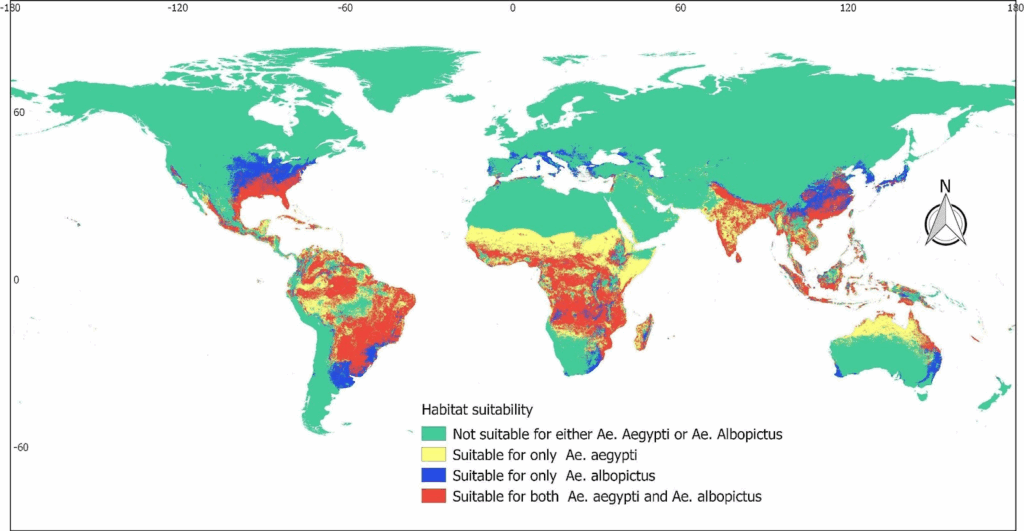
Diagram 1: 2018 map of Ae. aegypti and Ae. albopictus global suitability ranges, which roughly represents their actual geographical ranges with minor annual fluctuations 6
Ae. aegypti and Ae. albopictus geographical distributions and breeding seasons are influenced by many factors including temperature, day-night temperature range, precipitation, humidity, and climate patterns such as El Niño.7 Rising temperatures and changing precipitation due to climate change is expected to allow both species’ ranges to expand geographically and seasonally, which is capable of changing the geographical range and season of their associated viruses.8
The capability of expansion is not alone sufficient for the spread of Ae. aegypti and Ae. albopictus. Barriers to the spread of these species include competition with local mosquito species, the necessity of stagnant water sources (prevalent in urban environments), flight range, and the challenges posed by infrastructural and scientific developments made to combat the spread of these species and their associated viruses.9 10 11 12 13 Furthermore, the global endemicity of Dengue, Chikungunya, and Yellow Fever does not correlate one to one with these mosquito species’ ranges. Mosquitos do not perfectly pick up and transmit these viruses even in ideal conditions, and there are other barriers to these viruses’ spread. Nonetheless, the endemicity of either Ae. aegypti or Ae. albopictus in a region makes local transmission and spread of the three viruses theoretically possible.
Dengue
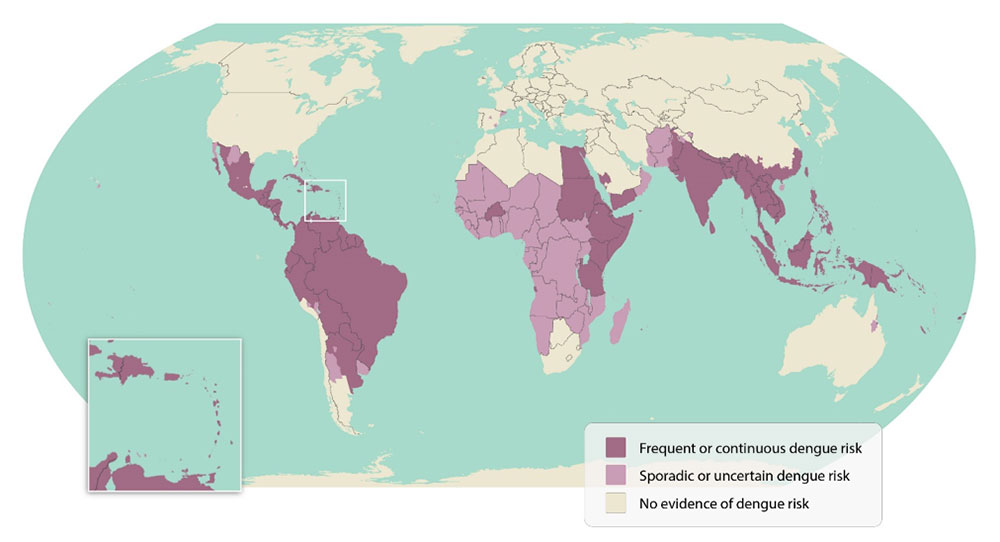
Diagram 2: 2025 global map of Dengue risk according to the CDC14
Dengue (sometimes called Dengue Fever) is the most prevalent worldwide viral disease, and has infected progressively more people each year, with 6.5 million reported cases in 2023 and 13 million reported cases in 2024.15 16 Three out of four Dengue cases are asymptomatic; Dengue can cause flu-like symptoms such as aches and pains, nausea, vomiting, and rash.17 Dengue annually results in approximately 20,000-25,000 deaths, while non-fatal severe cases can still cause permanent damage.18 There is only one dengue vaccine available for prevention, which is available in 27 countries (excluding the US) and only provided to travelers who seek it from health professionals prior to going to a country with endemic dengue.19 20
Chikungunya
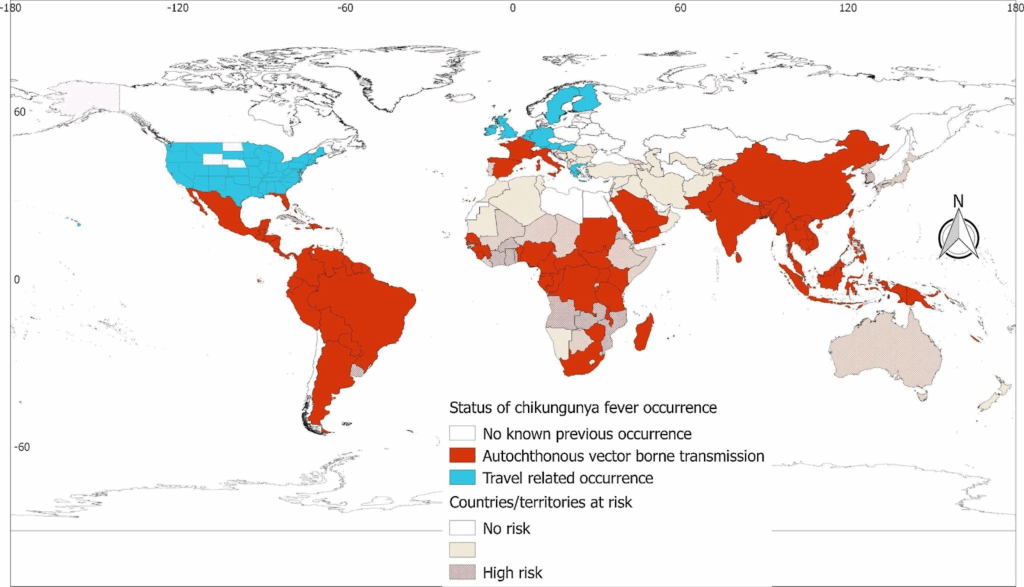
Diagram 3: 2018 global map of Chikungunya occurrence and areas of risk 21
Chikungunya is currently less prevalent than Dengue but minor outbreaks are still common in endemic areas. Large outbreaks are possible, with the most recent large outbreak having occurred in 2013-2015.22 23 Approximately 620,000 cases and 213 deaths were reported in 2024, and many more unreported cases are likely.24 Approximately three in four cases are symptomatic; symptoms are flu-like, including fever, joint pain, headache, muscle pain, rash, and/or joint swelling.25 26 Two vaccines exist but are not widely available, though both are available in the US.27
Yellow Fever
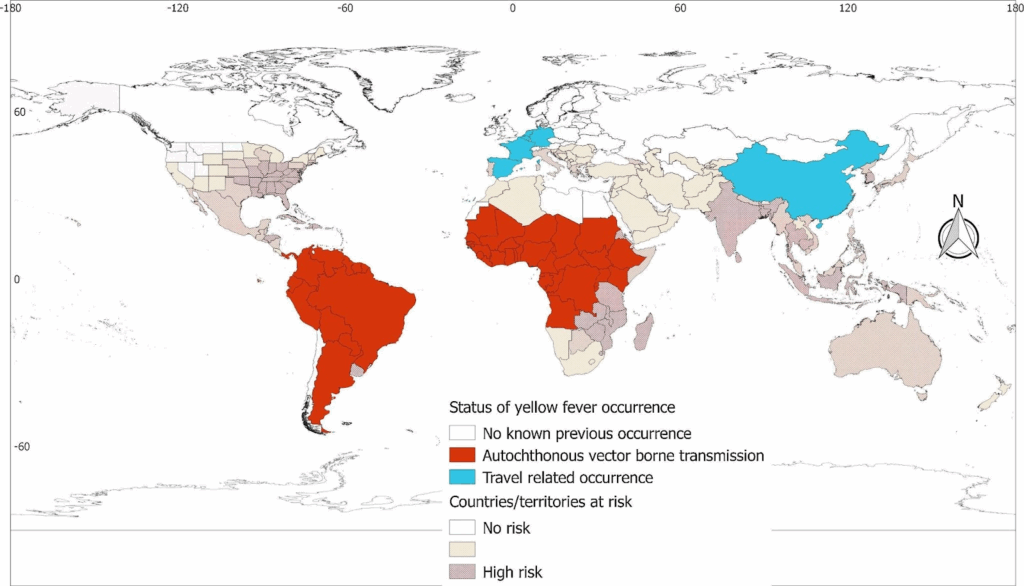
Diagram 4: 2018 global map of Yellow Fever occurrence and areas of risk 28
Yellow Fever’s range is significantly smaller than Chikungunya and Dengue. Only 212 yellow fever cases were confirmed in Latin America from December 2024 to April 2025; however, 85 deaths were also reported for a case-fatality rate of 40%, primarily in unvaccinated individuals.29 30Yellow fever is difficult to diagnose and it is suspected that up to 100,000 cases occur each year.31 The COVID-19 pandemic disrupted Yellow Fever vaccinations and boosters, which has caused a resurgence in the virus.32 Many yellow fever cases are asymptomatic. In symptomatic cases, yellow fever appears flu-like causing fever, chills, severe headache, vomiting, fatigue, body aches, nausea, and weakness; severe symptoms include yellow skin or eyes, bleeding, shock, and organ failure.33 34 Yellow fever vaccines exist and are available in the US and endemic countries; however, they can be difficult to obtain due to shortages in endemic regions.35
Geographical and Seasonal Changes
Dengue, Chikungunya, and Yellow Fever seasonal transmissions (or peak transmissions in areas where infections occur year-round) are expected to start earlier or end later over the coming years. Yellow Fever, however, is also likely to see transmissions decrease in some endemic areas due to rising temperatures being unsuitable for the animal vector of the virus. Dengue is likely to become endemic in areas with frequent outbreaks like China. and increasing imported and local cases of Dengue in non-epidemic/non-endemic areas in Europe and Australia are expected. Dengue, Chikungunya, and Yellow Fever are all expected to spread beyond their current geographical “border” areas of transmission.
Latin America
Dengue is endemic to most of Latin America and non-endemic countries are still prone to annual outbreaks.36 Dengue season typically occurs during the rainy season from February-May, with peak cases occurring in March.37 However, during the 2024 outbreak in Brazil and South America Dengue cases spiked in January-March with a peak in February before returning to approximate historical seasonal levels which have been maintained in 2025.38 39 40 Projected rising temperatures over the coming years are likely to cause the Dengue season to begin earlier, in January or even December, and peak earlier in early March or February. Dengue is also expected to geographically spread across “border” areas of Dengue’s current range in central Mexico, along Mexico’s western coast, as well as in southern Brazil, Uruguay, Paraguay, Argentina, and Bolivia over the coming decades.41
Chikungunya is epidemic in many regions of Latin America, but is only considered to be endemic in Brazil.42 Over the last 9 years, the majority of Chikungunya cases were reported in South America.43 Chikungunya infections can occur year-round, but are most common from October-March coinciding with part of the rainy season.44 Climate change has shifted precipitation patterns and increased the heat index, which both contribute to mosquito breeding, and can potentially expand the seasonal window to September or April.45 Geographically, Chikungunya is unlikely to see geographic expansion similar to Dengue in any region unless the virus develops new adaptations and strains. It is likely to remain a persistent (but relatively minor) threat, primarily stemming from travel-borne infections. Given recent infection rates, Chikungunya could possibly become endemic to Paraguay over the coming decades.46 47
Yellow Fever is endemic to all of Brazil and to parts of other countries, including Colombia, Paraguay, Bolivia, Guyana, and parts of Argentina, Ecuador, Venezuela, and Peru. Infections can occur year-round, however they are most common during the rainy season from January-May (typically peaking in February and March).48 49 Rising temperatures may extend this seasonal range into December. Rising temperatures are also predicted to potentially cause certain areas to become too hot for the animal vector species of mosquito (Haemagogus) to survive, and thereby reduce the severity and spread of Yellow Fever in some areas of Brazil.50 Further geographic expansion along “border” areas in Bolivia, Peru, Colombia, Venezuela, Ecuador, Argentina, Panama, and potentially into Central America is likely over the coming decades.51
Africa
Dengue is endemic to many countries in Africa. West Africa’s Dengue season typically occurs from July to November.52 Rising temperatures are expected to cause the Dengue season to start earlier in July and June over the coming years. Non-endemic areas where outbreaks occur are projected to become endemic under a high-emission climate scenario.53 Dengue is expected to geographically expand along “border” regions close to the Sahara desert, and along coastal or lake regions including in Somalia, Kenya, Zimbabwe, Tanzania, and South Africa over the coming decades.54 55
Chikungunya in Africa typically occurs during the rainy season from July-November and may expand accordingly into June or December over the coming years. Chikungunya is endemic to several countries in sub-Saharan Africa, including Kenya, Tanzania, and Mozambique, however incomplete data collection across other regions makes all determinations approximate.56 57 58 Sporadic outbreaks and import-borne cases still occur in non-endemic countries, though to a lesser degree, including Chad, Ethiopia, Burkina Faso, the Gambia, Mali, Senegal, Cote d’Ivoire, and Mauritius in recent years.59 As with South America, significant geographic change is unlikely with the current strains of the virus, though it may become endemic to more regions over time.
Yellow Fever is endemic to many countries in Africa, and infections typically occur during the rainy season in August-October.60 Rising temperatures and changing precipitation patterns may extend the season into September or December. Yellow Fever is unlikely to have significant geographical movement over the coming years, but may expand to “border” areas in Zambia, Tanzania, Kenya, Somalia, Ethiopia, Eritrea, and Namibia.
Middle East
Dengue is endemic in parts of Saudi Arabia, Egypt, Oman, Pakistan, and Yemen.61 Dengue season varies from country to country, primarily aligning with rainy seasons. Outbreaks sometimes occur as early as April but typically occur from May to July.62 Like with other regions, earlier Dengue seasons starting in April are likely over the coming years with changing temperature, though precipitation shifts could lead to unexpectedly late or early Dengue seasons. Dengue recently expanded along the Nile River in Egypt and is predicted to similarly expand along coastal regions including Saudi Arabia, Yemen, Oman, and possibly Israel and Lebanon over the coming decades.63 64
In the Middle East, Chikungunya season typically lasts from July to October following the monsoon season.65 Above-average rainfall and an increasing heat index in the Middle East means the season is likely to expand into June or December over the coming years.66 Sporadic outbreaks and imported cases have been observed in Djibouti, Pakistan, Saudi Arabia, Somalia, and Sudan.67 As with South America, significant geographic change is unlikely with the current strains of the virus, and additional endemic regions are unlikely in the coming years due to relatively fewer cases in the region.68 69
Asia
Dengue is endemic to most countries in Southeast and South Asia, with Dengue being particularly prominent in India, Indonesia, Myanmar, Sri Lanka, and Thailand. Dengue season varies between regions, but cases typically peak between June and September in Southeast Asia, and July through November in South Asia.7071 As these regions receive substantial rainfall, the Dengue season is forecast to possibly start earlier in June and May or end later into December depending upon precipitation and temperature changes.
In East Asia, Dengue is spread to China, Japan, and South Korea from imported cases caused by travel to and from endemic regions in Southeast Asia. Epidemics regularly occur in southern China, though a few cases have been reported as far north as the Xinjiang region.72 Imported and local infections will continue to expand northward over the next several decades, particularly along coastal China and near hotspots such as Chongqing.73 74 Outbreak seasons in China typically occur from July-November, and, alongside Southeast Asia, are likely to expand to June or into December over the coming years.75 The growing severity of annual Dengue epidemics in Guangdong and Chongqing is likely to lead to Dengue becoming endemic to China. Imported cases of Dengue are comparatively infrequent in Japan and South Korea, however outbreaks are expected to slowly become more common due to imported infections.76 77
Chikungunya season in South and Southeast Asia is generally in August-December. However, due to rising temperatures and changes in precipitation, many cases have been reported as early as the start of June in 2025, meaning that the Dengue season may expand over the coming years to regularly start in July or June.78 79 Chikungunya is endemic to India, and imported cases are frequent throughout South and Southeast Asia.80 Outbreaks involving local transmission have recently occurred in Thailand, Cambodia, Malaysia, Indonesia, the Philippines, Timor Leste, Maldives, Bangladesh, and Sri Lanka.81 Chikungunya is not expected to geographically expand into new countries, however, it may become endemic to countries with frequent outbreaks and may expand farther north in India and China.82
Despite some imported cases to the Asia-Pacific region, no outbreaks or local cases of transmission of Yellow Fever have been reported. The reason for this is not well-understood by scientists. Though no outbreaks have occurred, Chinese workers have been documented importing Yellow Fever to China from Angola, suggesting that outbreaks are possible.83 Currently there is no risk of transmission in Asia and Oceania, however, if an outbreak were to occur, it would pose a significant risk to people in Asia and Oceania due to a lack of immunization against Yellow Fever.84
Europe
The possibility of Dengue spreading to Europe is debated amongst scientists, however cases of imported and local infections are gradually becoming more frequent in Italy and Spain. Europe is likely to see an overall increase in cases of Dengue over the next several decades, particularly in countries who border the Mediterranean Sea.85 Ae. albopictus is already established in many areas of southern Europe, although Ae. aegypti is currently only established in Cyprus and parts of Russia, Georgia, and Turkey along the Black Sea.86 87 Reported cases of Dengue in France, Italy, and Spain have slowly but notably increased over the past decade, with a significant increase in cases in 2023-2024.88 Although the number of imported and local dengue cases in Europe is not expected to grow as rapidly as in regions with Ae. aegypti, the number of cases is still likely to rise in Portugal and Mediterranean countries, such as France and Spain.89 Dengue may not become endemic, but outbreaks are likely to become more regular, more severe, and expand along coastal, urban regions of southern Europe. Nonetheless, strong monitoring capabilities, wealth, and scientific advancements makes many of these areas capable of significantly combatting the spread of Dengue.
Southern Europe has reported only a relatively small number of imported Chikungunya cases; local transmission is uncommon, but cases have been observed in parts of Italy and France from July-November.90 91 If Chikungunya grows more prevalent again in endemic and epidemic regions, imported cases will similarly increase in Europe, and local transmission is possible. Chikungunya is highly unlikely to become epidemic or endemic to any countries in Europe over the coming decades, barring possible epidemics due to new strains of the virus.
Europe has also had a small number of imported Yellow Fever cases, but there is no indication that Yellow Fever will spread to Europe over the coming decades.92 Even if Yellow Fever did spread, monitoring capabilities, the availability of the Yellow Fever vaccine, and wealth make European countries capable of preventing and significantly hindering major epidemic outbreaks.
Australia
Dengue infrequently spreads to Australia through travel-borne infections. Ae. aegypti is already established in Queensland, and further spread to urban areas in Queensland, the Northern Territories, and Western Australia is expected over the next several decades which may be slowed or prevented through infrastructure adaptations.93 94
Similar to Europe, imported cases of Chikungunya have been observed in Australia, but no local transmissions have been reported. Should Chikungunya cases increase in endemic and epidemic regions, imported cases to Australia would also increase. Nonetheless, Chikungunya is highly unlikely to become epidemic or endemic to the region over the coming decades, barring possible epidemics due to new strains of the virus.
No imported cases of Yellow Fever have been reported in Australia. The presence of Ae. aegypti means that local transmissions are possible but unlikely given Yellow Fever’s failure to spread to Asia or Oceania.
On the Horizon
The expanding range and season of all three viruses will not pose an immediate risk to prepared travelers, but will pose a moderate risk to unprepared travelers. The presence of these viruses in a country do not pose such a significant risk that travelers should avoid traveling entirely, but travelers should be aware of the risk of contracting these viruses in their destination country and take preventative measures.
What to watch for over the coming years and decades:
- Dengue, Chikungunya, and Yellow Fever seasons are expected to start earlier and last longer. Travelers should be aware of whether or not contracting any of these viruses in their destination country is a risk year-round or if there are seasonal outbreaks. As these seasons begin to start earlier, travelers should take increased precautions prior to and after the typical season of these viruses.
- These viruses are expected to expand geographically along “border” regions, potentially into areas without protections against these viruses. The vaccines for these viruses are typically only given to people traveling to areas with high risk of contracting these viruses. As the geographic range of these viruses slowly expands over the coming decades, populations without the protection of vaccines are likely to see major outbreaks. This can potentially be lessened or counteracted with sufficient medical treatment, response, and monitoring capabilities.
- Travelers should appropriately prepare preventative measures against these diseases when traveling to countries where local transmission is common. Discussing vaccination with medical providers, using insect repellent, wearing skin concealing garments, and using mosquito control such as mosquito nets where needed all significantly reduce a traveler’s chance of being infected and severely injured by these viruses in both endemic countries and countries that experience frequent outbreaks.
- https://www.ncbi.nlm.nih.gov/sites/books/NBK609732/
↩︎ - https://targetmalaria.org/latest/blog/anopheles-aedes-or-culex-how-to-tell-mosquito-species-apart/
↩︎ - https://targetmalaria.org/latest/blog/anopheles-aedes-or-culex-how-to-tell-mosquito-species-apart/
↩︎ - https://www.sciencedirect.com/science/article/pii/S1201971217300899
↩︎ - https://targetmalaria.org/latest/blog/anopheles-aedes-or-culex-how-to-tell-mosquito-species-apart/
↩︎ - https://www.sciencedirect.com/science/article/pii/S1201971217303089
↩︎ - https://ehp.niehs.nih.gov/doi/10.1289/ehp.01109s1141
↩︎ - https://www.worldmosquitoprogram.org/en/news-stories/stories/explainer-how-climate-change-amplifying-mosquito-borne-diseases
↩︎ - https://targetmalaria.org/latest/blog/anopheles-aedes-or-culex-how-to-tell-mosquito-species-apart/
↩︎ - https://www.ecdc.europa.eu/en/disease-vectors/facts/mosquito-factsheets/aedes-aegypti
↩︎ - https://parasitesandvectors.biomedcentral.com/articles/10.1186/s13071-019-3837-5
↩︎ - https://pmc.ncbi.nlm.nih.gov/articles/PMC5531422/
↩︎ - https://www.cdph.ca.gov/Programs/CID/DCDC/CDPH%20Document%20Library/InnovativeAedesControl.pdf
↩︎ - https://www.cdc.gov/dengue/areas-with-risk/index.html
↩︎ - https://www.sciencedirect.com/science/article/pii/S2772707624001309
↩︎ - https://www.cdc.gov/dengue/outbreaks/2024/index.html
↩︎ - https://www.cdc.gov/dengue/signs-symptoms/index.html
↩︎ - https://www.ncbi.nlm.nih.gov/books/NBK430732/
↩︎ - https://www.who.int/news-room/questions-and-answers/item/dengue-vaccines
↩︎ - https://www.vax-before-travel.com/vaccines/qdenga-dengue-vaccine
↩︎ - https://www.sciencedirect.com/science/article/pii/S1201971217303089
↩︎ - https://www.ijidonline.com/article/S1201-9712(17)30089-9/fulltext
↩︎ - https://www.who.int/news-room/fact-sheets/detail/chikungunya
↩︎ - https://www.ecdc.europa.eu/en/publications-data/chikungunya-virus-disease-case-notification-rate-100-000-population-january-2024
↩︎ - https://www.cdc.gov/chikungunya/about/index.html
↩︎ - https://www.who.int/news-room/fact-sheets/detail/chikungunya
↩︎ - https://www.who.int/news-room/fact-sheets/detail/chikungunya
↩︎ - https://www.sciencedirect.com/science/article/pii/S1201971217303089
↩︎ - https://www.paho.org/en/news/4-2-2025-epidemiological-alert-increase-yellow-fever-cases-latin-america
↩︎ - https://www.who.int/emergencies/disease-outbreak-news/item/2025-DON570
↩︎ - https://pmc.ncbi.nlm.nih.gov/articles/PMC8955180/
↩︎ - https://pmc.ncbi.nlm.nih.gov/articles/PMC6954598/
↩︎ - https://www.cdc.gov/yellow-book/hcp/travel-associated-infections-diseases/yellow-fever.html
↩︎ - https://www.cdc.gov/yellow-fever/symptoms-diagnosis-treatment/index.html
↩︎ - https://www.paho.org/en/news/27-5-2025-public-health-risk-yellow-fever-remains-high-americas-due-continued-occurrence-human
↩︎ - https://www.who.int/emergencies/disease-outbreak-news/item/2023-DON498
↩︎ - https://www.sciencedirect.com/science/article/pii/S1201971224002637
↩︎ - https://pmc.ncbi.nlm.nih.gov/articles/PMC11768874/
↩︎ - https://www.sciencedirect.com/science/article/pii/S1201971224002637
↩︎ - https://reliefweb.int/report/brazil/dengue-epidemiological-situation-region-americas-epidemiological-week-27-2025
↩︎ - https://www.nature.com/articles/s41467-025-58609-5
↩︎ - https://www.nature.com/articles/s41591-025-03703-w
↩︎ - https://www.thelancet.com/journals/lanam/article/PIIS2667-193X(23)00247-8/fulltext
↩︎ - https://pmc.ncbi.nlm.nih.gov/articles/PMC10549908/
↩︎ - https://www.climatecentral.org/climate-shift-index-alert/brazil-february-2025
↩︎ - https://www.who.int/publications/m/item/chikungunya-epidemiology-update-june-2025
↩︎ - https://www.ecdc.europa.eu/en/chikungunya-virus-disease/surveillance/travel-associated-cases
↩︎ - https://www.cdc.gov/yellow-book/hcp/travel-associated-infections-diseases/yellow-fever.html
↩︎ - https://www.paho.org/en/news/4-2-2025-epidemiological-alert-increase-yellow-fever-cases-latin-america
↩︎ - https://pmc.ncbi.nlm.nih.gov/articles/PMC8955180/#B26-vaccines-10-00372
↩︎ - https://www.cdc.gov/yellow-book/hcp/travel-associated-infections-diseases/yellow-fever.html
↩︎ - https://www.medrxiv.org/content/10.1101/2024.10.22.24315827v1.full
↩︎ - https://pubmed.ncbi.nlm.nih.gov/39347019/
↩︎ - https://www.nature.com/articles/s41564-019-0476-8
↩︎ - https://www.nature.com/articles/s41467-025-58609-5
↩︎ - https://pmc.ncbi.nlm.nih.gov/articles/PMC11578454/
↩︎ - https://www.who.int/publications/m/item/chikungunya-epidemiology-update-june-2025
↩︎ - https://www.nature.com/articles/s41591-025-03703-w
↩︎ - https://www.who.int/publications/m/item/chikungunya-epidemiology-update-june-2025
↩︎ - https://www.cdc.gov/yellow-book/hcp/travel-associated-infections-diseases/yellow-fever.html
↩︎ - https://www.who.int/emergencies/disease-outbreak-news/item/2023-DON498
↩︎ - https://www.sciencedirect.com/science/article/abs/pii/S0001706X1731313X
↩︎ - https://www.nature.com/articles/s41564-019-0476-8
↩︎ - https://www.nature.com/articles/s41467-025-58609-5
↩︎ - https://pmc.ncbi.nlm.nih.gov/articles/PMC5501693/
↩︎ - https://pmc.ncbi.nlm.nih.gov/articles/PMC5501693/
↩︎ - https://www.who.int/publications/m/item/chikungunya-epidemiology-update-june-2025
↩︎ - https://www.nature.com/articles/s41591-025-03703-w
↩︎ - https://www.sciencedirect.com/science/article/pii/S1201971217300899
↩︎ - https://timesofindia.indiatimes.com/life-style/health-fitness/health-news/when-is-dengue-most-common-in-india-how-to-stay-safe/articleshow/111736414.cms
↩︎ - https://pmc.ncbi.nlm.nih.gov/articles/PMC2600332/
↩︎ - https://www.nature.com/articles/s41467-024-52460-w
↩︎ - https://www.nature.com/articles/s41467-024-52460-w
↩︎ - https://www.nature.com/articles/s41564-019-0476-8
↩︎ - https://www.nature.com/articles/s41467-024-52460-w
↩︎ - https://www.nature.com/articles/s41564-019-0476-8
↩︎ - https://pmc.ncbi.nlm.nih.gov/articles/PMC3317605/
↩︎ - https://journals.lww.com/jvbd/fulltext/2023/60030/trend_analysis_in_seroprevalence_of_dengue,.2.aspx
↩︎ - https://www.ecdc.europa.eu/en/chikungunya-monthly
↩︎ - https://www.nature.com/articles/s41591-025-03703-w
↩︎ - https://www.who.int/publications/m/item/chikungunya-epidemiology-update-june-2025
↩︎ - https://www.nature.com/articles/s41467-025-58609-5/figures/4
↩︎ - https://pmc.ncbi.nlm.nih.gov/articles/PMC6954598/
↩︎ - https://pmc.ncbi.nlm.nih.gov/articles/PMC8955180/#B26-vaccines-10-00372
↩︎ - https://www.nature.com/articles/s41564-019-0476-8
↩︎ - https://www.ecdc.europa.eu/en/publications-data/aedes-albopictus-current-known-distribution-june-2025
↩︎ - https://www.ecdc.europa.eu/en/publications-data/aedes-aegypti-current-known-distribution-june-2025
↩︎ - https://www.ecdc.europa.eu/en/all-topics-z/dengue/surveillance-and-disease-data/autochthonous-transmission-dengue-virus-eueea-previous-years
↩︎ - https://www.nature.com/articles/s41467-025-58609-5
↩︎ - https://www.ecdc.europa.eu/en/infectious-disease-topics/chikungunya-virus-disease/surveillance-and-updates/local-transmission-previous-years
↩︎ - https://www.nature.com/articles/s41591-025-03703-w
↩︎ - https://pmc.ncbi.nlm.nih.gov/articles/PMC8955180/#B26-vaccines-10-00372
↩︎ - https://www.nature.com/articles/s41564-019-0476-8
↩︎ - https://pmc.ncbi.nlm.nih.gov/articles/PMC5591012/
↩︎