Overview
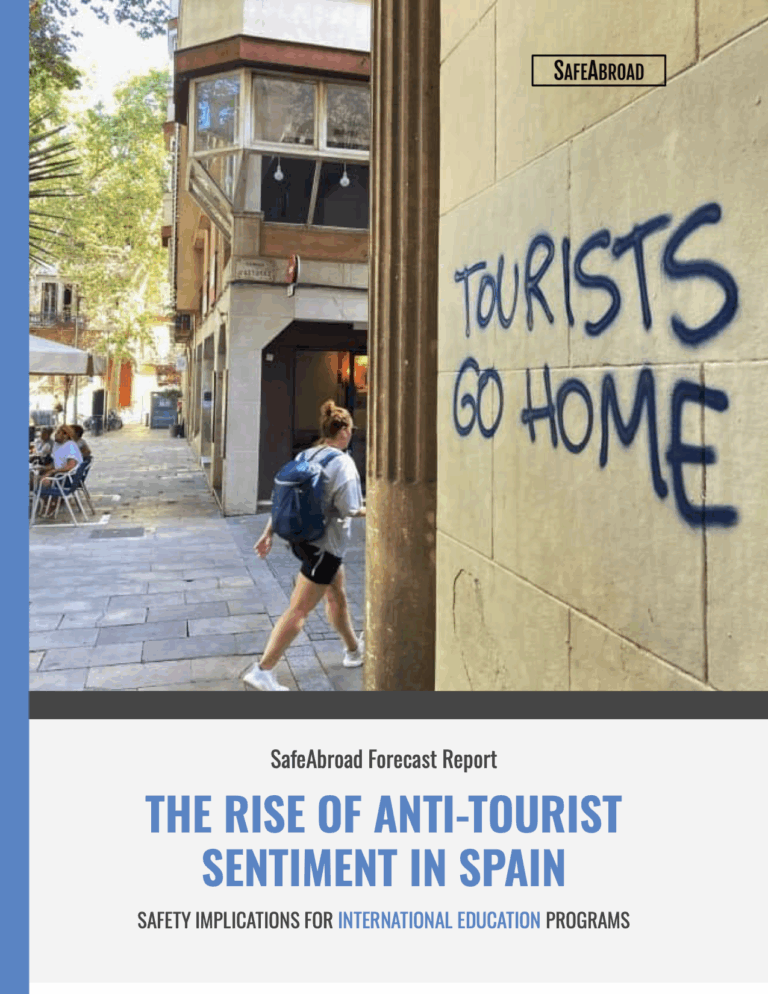
Mass tourism across Spain, particularly in popular destinations such as Barcelona, Palma de Mallorca, and the Canary Islands, has caused increased frustration among locals and a growing anti-tourism protest movement. These demonstrations were common throughout 2024 and are expected to gain momentum through 2025, particularly during the summer months. The Spanish government has implemented several political and economic measures to curtail overcrowding and address local concerns. Although Spain remains a safe travel destination, travelers should be vigilant of planned protests and exercise increased caution to avoid disruptions.
Key Takeaways
- Many protesters have clarified that their aim is not to oppose tourism itself, but rather for more restrictions on booking platforms and other related measures. Mass tourism has led to rising rent, overcrowding, and the loss of local culture. Protesters are calling for the government to regulate booking services and protect local communities from the negative impacts of tourism-driven gentrification.
- The Spanish government is actively implementing strategic initiatives to enhance tourism management, aiming to improve the quality of life for residents. These initiatives include improved regulation of rental properties, revised taxation policies aimed toward tourists, improved management of urban spaces to curtail overcrowding, and the implementation of legislation designed to enhance coexistence among tourists and locals.1
- Travelers should take proactive steps to ensure a safe experience and minimize disruption during periods of heightened protest activity. We recommend monitoring local news and social media, confirming accommodation details and local regulations in advance, and avoiding areas where demonstrations are planned or active to minimize risk exposure and reduce the impact of potential disruptions.
Background
Spaniards are protesting against the negative impacts that tourism is having on the local population, including surges in the cost of living, environmental impact, overcrowding, and cultural erosion.2
Cost of Living | The popularity of short-term vacation rentals has increased housing costs, making it difficult for many residents to afford accommodation. Property owners can generate more revenue by converting residential units into short-term holiday rentals, which drives residents out.3 Accommodations catered to tourists limit the availability of long-term housing, and government support for more affordable housing has also been insufficient.4 In Barcelona throughout the last decade, rental prices have drastically increased by nearly 70%, while home prices have increased by almost 40%.5
Overcrowding | Numerous Spanish cities, particularly Barcelona, face significant challenges associated with overcrowding from tourism. In Barcelona, popular areas like the Gothic Quarter, La Rambla, and Sagrada Familía are often extremely congested, making it difficult for locals to commute within these areas.6 The high number of tourists puts the public transportation system under significant strain and limits availability for locals.
Environmental Implications | The large number of tourists results in increased levels of waste and water consumption. Tourists generally create 50% more waste than residents and use approximately 900 liters of water per day, compared to only 250 liters per day by locals.7 Water scarcity issues, such as drought, are made worse by these habits and create more challenges for locals.8 Mass tourism in Spain increases strain on natural resources and results in increased pollution.
Cultural Erosion | Many Spaniards feel that excessive commercialization and catering to tourism dilutes the authenticity of local traditions and shifts the cultural landscape.9 Locals often feel that the influx of tourists leads to the commodification of cultural practices, where customs are being tailored to meet tourist expectations. While many Spaniards acknowledge the economic benefits of tourism, they are concerned that it may come at the expense of their cultural identity.10
The Government’s Response
The Spanish Government has introduced various measures in recent years to better manage the rapid growth of tourism, aiming to set an example for effective and sustainable tourism management. These measures intend to strike a balance between maintaining Spain’s appeal as a top travel destination while preserving the quality of life for its residents.
Regulation of Rental Properties | By 2028, the city of Barcelona plans to revoke the licenses of over 10,000 short-term rental properties, converting them into long-term housing options for local residents.11 Barcelona has also launched the Habitages d’ús Tourístic (HUTS) Mediation Service, a type of short-term rental accommodation, aimed at fostering better coexistence between residents’ communities and the owners of touristic apartments.12
Taxation of the Tourism Sector | The Canary Islands have recently introduced a tourist tax to address overtourism and promote sustainable tourism practices. Since January 2025, the town of Mogán on Gran Canaria has implemented a fee of €0.15 per person, per day for all visitors staying in the region.13 This initiative aims to generate additional funding for local projects, including beach maintenance, waste management, and sustainable infrastructure development.
Management of Urban Spaces | The Barcelona City Council has launched a plan to manage overcrowding in 15 high-traffic spaces in an attempt to better balance tourism and neighborhood life for local residents.14 In some of these high-traffic areas, the government has installed sensor systems to monitor the movement of both residents and tourists, which they believe will help design urban policies to better manage overcrowding.
Coexistence and Safety | Barcelona has committed to fostering improved coexistence between tourists and residents, acknowledging that excessive tourist activity can adversely affect residents’ quality of life. To improve coexistence between tourists and locals, the City Council launched a communication campaign with three main goals: enforcing strict rules against disruptive behavior, promoting a civic-minded image of Barcelona, and protecting residents’ quality of life by balancing tourism and daily life, especially in high-traffic neighborhoods.15
Sustainability and Resilience | Palma de Mallorca has implemented several sustainability and environmental policies to address the impact of tourism. The Balearic Tourism Law, introduced in 2022, mandates hotels to reduce CO2 emissions, install water-saving devices, and eliminate single-use plastics.16 Hotels are required to develop strategic circular plans focusing on energy, water, waste, and land use, while promoting locally-grown produce in their offerings. Additionally, a moratorium on new tourist accommodations has been enacted to limit environmental strain and allow for older hotels to be converted into housing.17
Timeline of Anti-Tourist Protests: 2024-2025
| Date | Description | Location |
| April 20, 2024 | Environmental protesters advocate for curbs on short-term rentals and foreign property purchases, urging authorities to reassess tourism practices.18 | Tenerife |
| May 24, 2024 | Demonstrators voice concerns over rising housing costs, unsustainable tourism practices, and the dominance of short-term rentals. Protesters call for increased measures to curb tourism’s impact on local life.19 | Ibiza |
| May 25, 2024 | Protesters urged authorities to limit the number of tourists from the United Kingdom to protect local communities. They also urged policymakers to prohibit those who have not lived in the area for more than five years from buying property.20 | Palma de Mallorca |
| June 29, 2024 | The Union of Tenants argues that the housing crisis was driven by the increased number of short-term rentals, which displace locals and make affordable housing scarce.21 | Málaga |
| July 6, 2024 | Thousands of Barcelonans protest against mass tourism, expressing concerns over rising housing costs, gentrification, and the loss of local commerce. Some residents sprayed tourists with water guns, underscoring the growing unhappiness of residents. The protest follows recent city initiatives to limit short-term rental apartments in an effort to restore affordable housing to locals.22 | Barcelona |
| July 21, 2024 | Protesters organized by the group Menys Turisme, Més Vida, demand restrictions on property purchases by non-residents and seek to limit the impact of tourism on the island’s residents and environment.23 | Palma de Mallorca |
| October 13, 2024 | Thousands march in Madrid to demand affordable housing, protesting high rents driven by short-term rental platforms.24 | Madrid |
| October 20, 2024 | Protesters across the island call for a new tourism model, with specific demands for regulations on short-term rentals and restrictions on new tourist accommodations. The regional government announced stricter measures following the protest, including a ban on new buildings used for tourist accommodations.25 | Las Palmas de Gran Canaria |
| October 27, 2024 | An anti-tourism protest is supported by over 50 regional groups who advocate for reducing tourist accommodations and protecting ecologically significant areas.26 | San Sebastián |
| December 6, 2024 | Anti-tourism protesters in Tenerife vandalize over 230 sunbeds on popular beaches, spraying them with anti-tourism slogans.27 | Tenerife |
| February 16, 2025 | The first anti-tourism protest of 2025 is held in Tenerife with several dozen individuals protesting outside a Tourism Industry Congress held in Santa Cruz de Tenerife.28 | Tenerife |
| June 15, 2025 | Coordinated protests take place across southern Europe, with demonstrations in at least 15 cities across Spain, including Barcelona, Ibiza, Granada, and Bilbao. Demonstrators demand stricter limits on tourism and more affordable housing.29 | Nationwide |
| Not an exhaustive list. | ||
Traveler Implications
A range of anti-tourism protests are expected to persist through 2025; however, the Spanish government has introduced measures to regulate tourism, and protests are unlikely to escalate into direct violence against tourists. While protests remain the primary concern for tourists, demonstrators may turn to other methods of expressing their discontent if overtourism continues to affect local life.
What to watch for in 2025:
- The busy summer tourist season will result in continued protest activity. Demonstrations will likely be concentrated in very popular destinations such as Barcelona, Palma de Mallorca, and the Canary Islands. In Mallorca, the grassroots organization Menys Turisme, Més Vida has vowed to intensify its anti-tourism efforts during the summer, including training locals to actively engage in their initiatives.30 Similar movements across Spain may adopt comparable strategies. These demonstrations will likely lead to disruptions during the summer, affecting transportation and access to some areas. Travelers should monitor social media and local news to avoid protests and should leave the area immediately if tensions begin to escalate.
- Spain has introduced several tourist taxes and regulations aimed at managing the impacts of tourism on local communities. Most Spanish cities will or have implemented their own specific taxes, which will vary for day-trip visitors as well as those staying overnight. In Barcelona, an increase in taxes aimed towards tourists brought the city’s tourist tax from €3.25 to €4 per night. Meanwhile, visitors to regions in the Balearic Islands will face a “green tax,” with rates varying by accommodation type: €4 per person per night for five-star hotels, €3 for four-stars, €2 for three-stars, and €1 for hostels and campsites. However, these taxes will only remain in effect during the busy season from May to October.31 Travelers should verify tourist tax rates before booking their accommodations.
- While protests have not historically led to violence against tourists, demonstrators may seek other ways to voice their frustrations. For instance, in July 2024, demonstrators in Barcelona used water pistols during protests, highlighting the growing frustration among locals and their willingness to employ less-common protest strategies.32 Travelers planning to visit Spain in 2025 should stay informed on potential disruptions and protests. It’s advisable to verify accommodation policies, be aware of any restrictions on short-term rentals, and respect local customs and sentiments to ensure a positive experience while minimizing any unintended negative impact on local communities.
- https://ajuntament.barcelona.cat/turisme/en/tourism-barcelona/strategic-tourism-management ↩︎
- https://www.theguardian.com/news/2024/sep/13/third-spanish-people-local-area-too-many-foreign-tourists-survey ↩︎
- https://www.travelandtourworld.com/news/article/how-over-tourism-in-barcelona-is-disrupting-local-life-and-straining-the-economy/ ↩︎
- https://architizer.com/blog/inspiration/stories/public-housing-crisis-tourism-barcelona/ ↩︎
- https://www.forbes.com/sites/isabellekliger/2024/06/21/barcelona-announces-plan-to-ban-tourist-rental-apartments-by-2028/ ↩︎
- https://www.travelandtourworld.com/news/article/how-over-tourism-in-barcelona-is-disrupting-local-life-and-straining-the-economy/ ↩︎
- https://www.fairtourism.nl/en/mass-tourism-in-spain/ ↩︎
- https://turispanish.com/tourism/environmental-impacts-of-tourism-in-spain/ ↩︎
- https://www.theolivepress.es/spain-news/2024/06/24/tourism-will-damage-spains-heritage-and-culture-if-no-action-is-taken-researchers-warn/ ↩︎
- https://www.lavozdelsur.es/opinion/welcome-to-spain_337679_102.html ↩︎
- https://www.theguardian.com/world/article/2024/jul/21/barcelona-plans-raise-tourist-tax-cruise-passengers-few-hours ↩︎
- https://ajuntament.barcelona.cat/turisme/en/huts-mediation-service ↩︎
- https://www.travelandtourworld.com/news/article/how-canary-island-tackling-over-tourism-with-0-15-euro-per-person-per-day-tax-from-international-visitors/ ↩︎
- https://ajuntament.barcelona.cat/turisme/en/tourism-barcelona/strategic-tourism-management/management-high-tourist-traffic-areas ↩︎
- https://ajuntament.barcelona.cat/turisme/en/tourism-barcelona/strategic-tourism-management/management-high-tourist-traffic-areas ↩︎
- https://newsmallorca.com/en/sustainable-initiatives-for-the-tourism-sector-in-the-balearics/ ↩︎
- https://newsmallorca.com/en/sustainable-initiatives-for-the-tourism-sector-in-the-balearics/ ↩︎
- https://www.reuters.com/world/europe/thousands-protest-spains-canary-islands-over-mass-tourism-2024-04-20/ ↩︎
- https://www.independent.co.uk/travel/news-and-advice/mallorca-menorca-spain-tourists-protests-b2551689.html ↩︎
- https://inews.co.uk/news/world/spain-protests-demand-uk-holidaymakers-stay-away-tourism-3075539 ↩︎
- https://efe.com/en/latest-news/2024-06-29/thousands-protest-in-malaga-against-tourist-housing-rising-rents/ ↩︎
- http://lemonde.fr/en/economy/article/2024/07/07/barcelona-residents-protest-against-mass-tourism_6676892_19.html ↩︎
- https://www.independent.co.uk/travel/news-and-advice/mallorca-tourism-protest-where-why-b2769426.html ↩︎
- https://www.dw.com/en/spain-thousands-protest-for-affordable-housing/a-70482497 ↩︎
- https://www.reuters.com/world/europe/thousands-protest-spains-canary-islands-against-over-tourism-2024-10-20/ ↩︎
- https://www.the-independent.com/travel/news-and-advice/spain-overtourism-protest-san-sebastian-b2636676.html ↩︎
- https://www.euronews.com/travel/2024/12/10/anti-tourism-protestors-destroy-sunbeds-tenerife ↩︎
- https://tenerifeweekly.com/2025/02/16/dozens-of-manifestors-concentrate-on-tenerife-against-the-tourist-model-of-the-islands-canary-islands-not-sold/ ↩︎
- https://www.reuters.com/world/protesters-against-overtourism-take-streets-southern-europe-2025-06-15 ↩︎
- https://www.majorcadailybulletin.com/news/local/2025/02/16/131229/mallorca-tourism-protesters-plan-double-the-effort-2025.html ↩︎
- https://www.which.co.uk/news/article/tourist-tax-pay-enter-spain-portugal-greece-aesjR8e5mNUq ↩︎
- https://www.cnn.com/2024/07/08/travel/barcelona-tourism-protests-scli-intl/index.html ↩︎