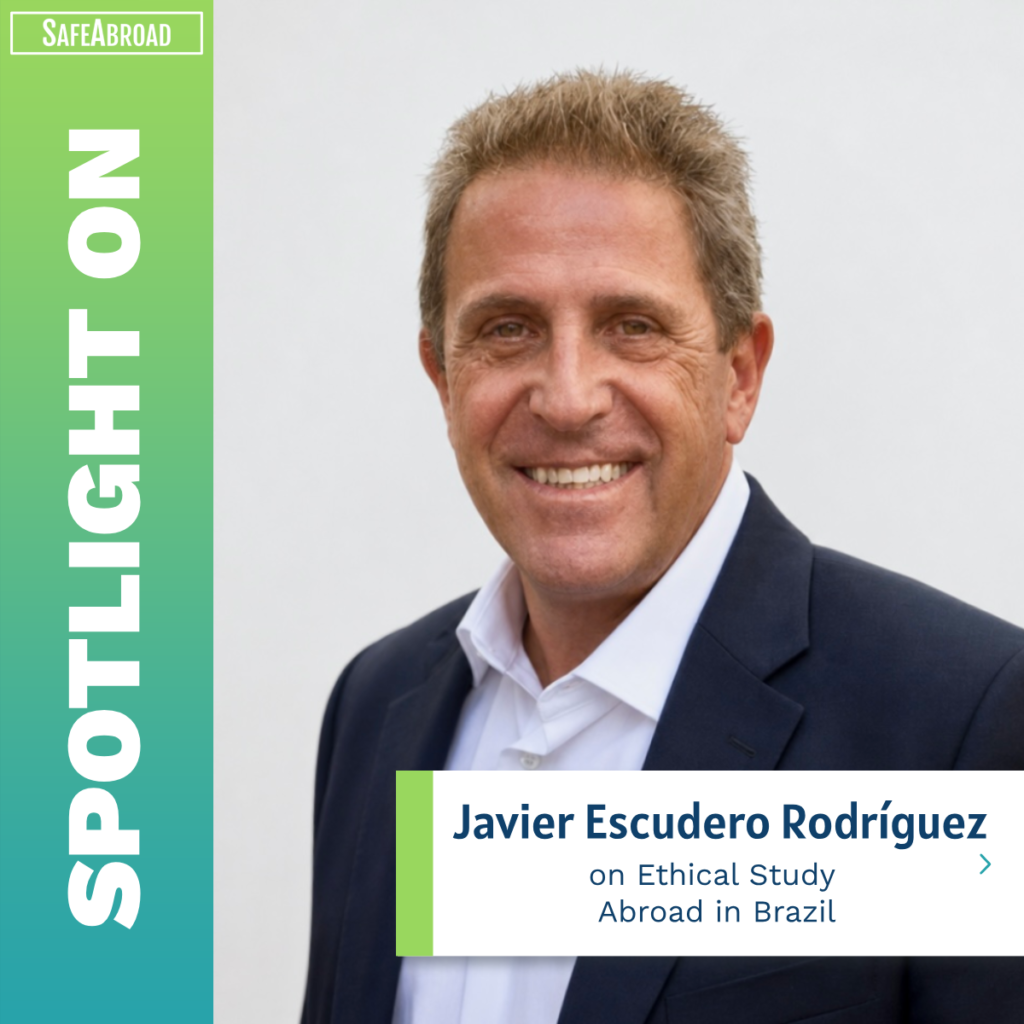

What brought you to Salvador, and what made you want to build study abroad programs there?
The cold winters of Pennsylvania first drew me south. Every winter break, I would travel to a country south of the United States to enjoy warmer weather. Friends kept telling me, “You should go to Brazil,” and finally, in 1999, I made the trip. I’m originally from Spain, and I arrived in Salvador just five days before New Year’s Eve in 2000.
The day I arrived, I met Patricia Burgos, who later became my wife and professional partner. That meeting changed the course of my life.
A year later, in 2001, I was appointed Director of the Cervantes Institute in Rio de Janeiro, a diplomatic appointment. At the time, I was looking for a break from the demands of academia, including research, teaching, conferences, and service.
During the 27 months Patricia and I lived in Rio, we welcomed many friends and colleagues from the United States and Spain. We became cultural ambassadors for the city while I immersed myself in Brazilian society and culture. I improved my Portuguese and learned about Brazil’s history, along with the resilience and struggles of its people.
That experience was transformative. It was like participating in an extended study abroad program myself.
I soon realized that Brazil, which was largely overlooked by international education programs at the time, offered students an exceptional place to learn.
When I returned to Penn State after those two years in Rio, I created a study abroad program in Salvador, Bahia, in collaboration with Penn State’s business school and the Department of Spanish, Italian, and Portuguese.
At the same time, Patricia and I began developing the idea for our own study abroad organization, which we officially founded in 2005.
That year, while I was still teaching at Penn State, we brought our first group of 12 students to Salvador for a six-week program focused on Brazilian culture and doing business in Brazil and/or the Portuguese language. The program was a tremendous success.
Around the same time, I was also invited by my alma mater, the University of Virginia, as an adjunct faculty member, to help lead a program in Salvador centered on the African diaspora in Brazil. Seeing the transformative impact that experience had on African American students confirmed that we were on the right path.
At the end of 2006, after successfully running a second Penn State program in Salvador, I made the decision to leave my faculty position and focus entirely on our company.
Beginning in 2007, Penn State contracted directly with Brazil Cultural to operate its annual Salvador program. That partnership became the foundation that allowed us to gradually expand our work and begin welcoming additional universities.
You’ve now experienced study abroad from multiple perspectives, first as a Penn State faculty member and now as the founder of Brazil Cultural. What do you understand about the work of a local provider that you wish you’d known earlier as a faculty leader?
I’ve actually been involved in study abroad since I was 18 years old. In my twenties, I had the opportunity to work for two small, family-owned study abroad organizations in Spain.
Those experiences taught me how essential local providers are in creating thoughtful programs that are truly integrated into their communities. Having worked on both sides of international education has given me a much better understanding of how programs can create stronger learning experiences for students.
Faculty members naturally focus on academic goals and student learning outcomes. Sometimes, though, they don’t fully recognize the transformative impact that local communities and organizations can also experience through these educational exchanges.
I carried those early experiences with me into every program I developed. While I was at Penn State, I only directly led one study abroad program in Mexico for two years because my primary responsibilities were research, writing, attending conferences, and teaching. But those early experiences working with providers always influenced how I approached program development.
Now, as a provider, I always encourage faculty to think beyond tourism.
For example, I recently worked with a faculty member who considered camel riding an essential part of a program in Morocco. We explained that camel rides carry safety risks and would require students to sign liability waivers.
Rather, we always encourage faculty to consider opportunities where students can work alongside local organizations in ways that create meaningful learning experiences for everyone involved. These experiences not only benefit students but also create value for local partners and communities.
Helping faculty expand their perspective is one of the most rewarding parts of our work. We want them to see international education as a two-way exchange, which is why we use what we call an “exchange learning methodology.”
Our goal is to provide outstanding educational experiences for visiting students while strengthening local organizations, developing local professionals’ and students’ educational backgrounds, and creating lasting partnerships that benefit everyone involved.
When a program brings students into a neighborhood or cultural space in Salvador, or anywhere you work, how do local partners shape what those experiences look like? And what tells you that the experience has been worthwhile for the people hosting the group?
In my opinion, local educational organizations and community collaborators play a vital role in making each program educationally, culturally, and socially successful.
As providers, we need to engage with those partners well in advance. We plan activities together, listen to their goals, learn about their strengths, and work collaboratively to create experiences that are meaningful for everyone involved.
At the same time, we prepare our visiting students so they can participate thoughtfully in this exchange learning experience.
Because we often work with the same organizations in Brazil, Portugal, and Morocco, our partnerships are built on repeat visits and long-term collaboration. Each activity becomes a learning experience for both our visitors and the host organization.
Over time, our partners build a portfolio of programs we’ve developed together. They can continue offering those activities not only to us, but also to other universities and organizations, helping create more sustainable initiatives.
That’s what tells me these exchanges are truly meaningful. Even if a university group only spends two or three hours with a local organization, they’re contributing to a long-term relationship that has been growing over many years and will continue with future groups. The impact isn’t isolated to a single visit; it continues over time.
If a U.S. university is considering a program in Brazil, what questions do you wish they would ask about safety?
Safety is naturally one of the biggest concerns for universities planning programs in Brazil.
Many of the faculty members who contact us have already conducted research in Brazil, so they’re somewhat familiar with the country. Over the past 21 years, we’ve experienced very few safety incidents. They do happen, but they’re uncommon, and our goal is always to prepare students well enough to prevent them.
From the very beginning of the planning process, we discuss safety considerations with faculty members and university administrators.
For example, some faculty members tell us they want to visit a “favela” while they’re in Rio de Janeiro or Salvador. We explain that many marginalized communities are affected by gang or militia activity, and we strongly advise against organizing visits to neighborhoods that are controlled by criminal organizations.
If we do visit a marginalized community, it’s always for a specific educational purpose. We partner with a local school, nonprofit organization, or community group. The focus is on meeting local educators or community leaders, not walking through neighborhoods as observers of people’s daily lives.
We carefully assess every situation, and if we don’t believe a visit can be conducted safely, we don’t include it in the program.
There’s often a fascination with visiting favelas, but our responsibility is to prioritize student safety and ethical engagement.
We also share lessons from previous incidents, even though they’re rare. For example, we consistently advise students not to visit beaches after dark.
Many students see local residents enjoying the beach in the evening and want to do the same. However, based on our experience, we’ve had a small number of robberies occur at beaches after dark—one in Rio and two in Salvador. Because of those experiences, we’ve made it a standard recommendation that students avoid beaches at night.
These situations are uncommon, but when you learn from past incidents, you can establish practices that significantly reduce unnecessary risk.
That’s really helpful. Your point about favelas is especially important because many people assume it’s simply visiting a poorer neighborhood, when in reality there are much more complex safety and ethical considerations involved.
Exactly. Sometimes, although it’s rarely discussed openly, visitors are expected to pay fees that ultimately benefit criminal groups controlling the area. That’s another reason we choose not to participate in that type of activity.
These visits have become very popular with tourists, and while I’m not criticizing people who choose to do them, it’s simply not something we want to be involved with.
Our focus is on creating meaningful educational experiences through partnerships with schools, nonprofits, and community organizations—not through poverty tourism.
On both short-term and semester-length programs, how do you give students enough independence to truly experience a destination while still helping them stay safe? How do you decide when students are ready to explore on their own and when more structure is appropriate?
I believe ongoing orientation is absolutely essential.
During the first several days, we intentionally introduce students to different parts of the city, including neighborhoods they probably wouldn’t feel comfortable visiting on their own. We teach them how to navigate the local environment and what everyday life looks like.
We encourage students to observe how local people move through the city. For example, people certainly use their phones, but they’re not walking around constantly looking at them. We encourage students to adopt those same habits, stay aware of their surroundings, and gradually become comfortable with the environment.
As students gain confidence, they can begin exploring more independently.
We also rely heavily on our local partners. Students receive recommendations from community members, program staff, and local organizations they’ve already worked with.
Sometimes a student wants to return to a particular community after a program visit. Rather than encouraging them to go alone, we’ll connect them with someone they already met, perhaps a dance instructor, community leader, or local educator, who can accompany them and continue building that relationship.
We believe it’s always better for students to explore new places alongside trusted local partners rather than trying to navigate unfamiliar areas completely on their own.
Another important part of our programs is bringing together visiting students and local students through exchange activities. Those relationships often become students’ introduction to neighborhoods, families, and communities they otherwise wouldn’t experience.
That kind of authentic interaction allows students to satisfy their curiosity while developing a much deeper understanding of Brazil in a safe, thoughtful, and meaningful way.
Brazil Cultural designs programs not only in Brazil, but also in destinations like Portugal, Morocco, Argentina, Uruguay, and Spain. What parts of your approach to student safety apply everywhere, and what has to change from one destination to another?
Every destination has its own safety considerations, and they vary significantly from place to place.
For example, pickpocketing is a common concern in cities like Lisbon. Tourists riding the trams or using public transportation occasionally become targets. The same can happen in Buenos Aires. Interestingly, that’s much less common in Salvador, Bahia, where pickpocketing is relatively rare.
On the other hand, Brazil presents different types of risks. Occasionally, robberies involve people on motorcycles approaching someone to steal a phone. That’s something we prepare students for in Brazil, but it’s not something we typically discuss in Lisbon or Morocco.
Another important topic is safety for women. Unfortunately, sexual harassment is something we have to address in every destination, although the situations vary.
In Brazil, students may go to popular bars or social events where local customs around dancing and social interaction are different from what they’re used to. We explain these cultural differences and encourage students to establish clear personal boundaries while remaining aware of their surroundings.
In Morocco, female students traveling together through areas like the old city may occasionally experience unwanted attention or comments. Those situations are different from what students may encounter in Portugal or Argentina.
Every country presents unique challenges, which is why ongoing orientation is so important.
We constantly draw from our previous experiences and past incidents to prepare students. For example, if students will be participating in ocean activities in Salvador, we emphasize water safety. We encourage them to check conditions, identify where lifeguards are present, and understand that the Atlantic Ocean can become dangerous very quickly.
We learned similar lessons in Morocco. Many years ago, one faculty member decided to take students to the beach without informing anyone on the local staff. Fortunately, nothing happened, but it reminded us how important communication and planning are whenever groups participate in activities that involve additional risks.
Every experience helps us improve our orientation. We learn from our partners, from other universities, and from our own experiences so we can better prepare future students and reduce unnecessary risks.
You’ve obviously fallen in love with Brazil. You’re originally from Spain, but you’ve now made Brazil your home. What surprises students the most once they arrive? What assumptions do they often discover aren’t true?
I think the biggest surprise is realizing that many of the stereotypes they brought with them simply don’t reflect reality.
Students often arrive with preconceived ideas about Brazil. Some believe it’s a country where everyone lives the same way or that it’s completely racially integrated. Others arrive with assumptions based on media portrayals or popular culture that don’t accurately represent everyday life.
What surprises them most is how welcoming and approachable people are.
They’re often amazed that they can have conversations with almost anyone. Whether someone is wealthy or experiencing homelessness, people are generally open to talking, sharing their perspectives, and interacting with visitors in a respectful way.
Students quickly discover that those human connections become one of the most meaningful parts of their experience.
Safety perceptions also change.
Many students arrive expecting that something bad will happen simply because of what they’ve heard in the news. Then they spend two or three weeks in Salvador or Rio without experiencing a single safety incident.
That helps them realize an important distinction.
Negative news travels very quickly, while the reality of daily life rarely receives the same attention.
Like any country, Brazil has challenges, but it also has vibrant communities, welcoming people, and extraordinary educational opportunities. Once students experience the country firsthand, many of their assumptions begin to change.
That’s true for so many places around the world. The stereotypes often become much larger than the everyday reality. I think that’s a wonderful place to wrap up our conversation. Thank you so much for taking the time to speak with us today.
Thank you. I really appreciate the opportunity. It has been a pleasure speaking with you.