
Overview:
SafeAbroad analysts have examined the most widely available forms of public transportation in France. They have also included other important travel advice when using public transportation in the country.
Types of Transportation:
Train and Rail Systems
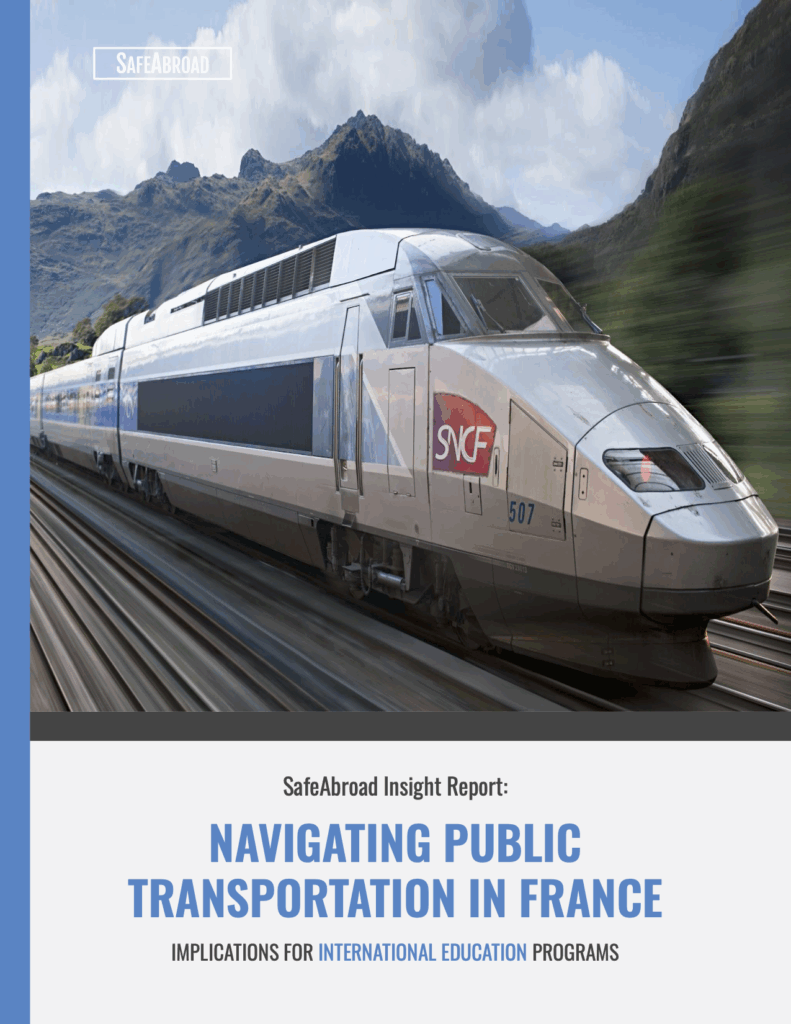
- TGV – The Train à Grande Vitesse or TGV, is a high speed train operated by France’s national railway company SNCF. The TGV goes to over 200 destinations in France and serves several other countries such as Belgium, Luxembourg, Germany, Italy, Spain, Monaco, and Switzerland. This train can reach speeds of up to 199 miles per hour making it a good option for fast trips over long distances. There are no formal check-ins or customs for domestic journeys, but ticket inspections and passport checks take place on international routes. Reservations are mandatory for this type of transportation and tickets must be printed at home or must be digitally on your phone.1
- RER – The Réseau Express Régional (Regional Express Network) is an express train that connects Paris with its outlying suburbs. It goes to popular destinations within the city including Charles de Gaulle airport (CDG) and Disneyland Paris.2 There are 5 RER lines labeled A through E. These lines serve 249 stations, covering almost 373 miles of railway tracks.3 The RER travels both above and below ground as well. RER stations are easily marked by blue background signs and white circles with the letters “RER” in the middle. Travelers should note that it’s common for RER lines to share stations with other metro/train lines.4
- TER – The Transport Express Régional is a regional train service operated by SNCF, though each French region independently manages its own TER network.5 In greater Paris, TERs are known as Transilien. TERs are more suited for those who want to take a longer trip across France’s rural areas.6
- Intercités – Intercités are conventional daytime trains linking medium and long-distance routes. They are slightly slower than TGVs but often cheaper and serve destinations not on the high-speed network.7
- Trams – Trams have made a comeback in France after closing in the 1950s. Reopened in the 90s, trams serve as a more sustainable and cost-effective way to travel. The Paris tram network consists of 11 lines, 235 stations, with about 78 miles of tracks. It also operates 7 days a week, from 5:00 AM to 1:00 AM on weekdays.8 In total, 20 French cities have reintroduced trams systems. Tram tickets can usually be used in conjunction with other local transport options (such as the bus or metro) as part of single or multiple journey tickets. Tickets must be purchased and validated in advance before boarding the tram.9
- Metro – Six cities in France have a metro system: Paris, Lyon, Marseille, Lille, Toulouse, and Rennes. The metro is the most common and quickest way to get around major urban areas of France. Each metro system is relatively easy to navigate; simply purchase a ticket from the ticket machine at a station, scan it, and go through the turnstiles at the entrance.10
Bus Services
Buses in France are operated at a local or regional level, serving either large towns and cities or connecting rural villages with regional centers.11 The center for bus activity in any city or town in France is the Gare Routière (Highway Station, Bus Terminal), usually located next to or near the traditional Gare SNCF train station.12
- Local (City) Buses – Bus services exist in every French city and town and connect the Gare SNCF (train station), Gare Routière (bus terminal) and other transport termini with the city center and other important points.13 Tickets usually run for under $3 USD.14
- Regional Buses – Each of France’s regions has a government-approved regional bus system connecting smaller towns and some villages with major cities and transport hubs.15
- Intercity Buses – French intercity buses are an alternative to trains. However, they may take twice as long as trains and several times longer than planes to make the journey.16 The two main bus companies that serve the majority of intercity routes are Flixbus and BlaBlaBus. Connections between large cities are more common than connections between smaller cities.17 Intercity buses can take you from Paris to Marseille, Lyon, Toulouse, Nice, or Bordeaux. Other popular domestic intercity bus routes include: Marseilles to Nice, Toulouse to Lourdes, Lyon to Grenoble, Lyon to Marseilles, Toulouse to Montpellier, Lille to Lyon, Bordeaux to Lyon, Nantes to Rennes, Nantes to Bordeaux, Bordeaux to Toulouse, Nantes to Bordeaux, Nantes to Rennes, St. Malo to Mont Saint-Michel, Reims to Paris, and Strasbourg to Paris.18
- International Buses – These buses connect major cities in France with nearby countries. Fares are often lower than train or plane fares, but travel times are typically much longer and station facilities are less pleasant.19
- Navettes – A navette is a shuttle bus that takes a short route between related points, such as between terminals at a large airport, or between one train station and another, or from a station to a town center. A navette may be a minibus, short-run train, or full-sized bus.20
- Coach – Coach buses in France are used for domestic and international long journey trips. During these trips, the buses take comfort breaks at highway rest stops along the route. This form of travel is a cheaper alternative to high speed trains but takes longer to get to your destination. Companies that offer coach options include BlaBlaCar Bus, Eurolines, and Flixbus.21
Bus tickets can be purchased in advance at a machine at the bus stop, a local tobacconist (tabac), or onboard from the driver. Tickets are available both as single or multiple journeys and you must validate them when you enter the bus. If you are caught with an unvalidated ticket, you risk a fine of up to €180. Prices of bus tickets differ across France, so it is best to check with your local operator to see how much your ticket will be.22
Many bus stops don’t have a ticket machine because travelers have the ability to purchase them from the driver. It’s important to note that tickets bought from a driver will be slightly more expensive than if you buy them on a machine. Although most drivers will have change at their disposal, it’s better to have the correct change if possible.23 Additionally, buses in France don’t automatically stop at every station, so you’ll have to press the button to notify the driver when you want to get off.24
In Paris, passengers can purchase a Navigo card, a convenient pass that can be used to access transport on buses, metro, tram, and RER. Navigo cards are available for purchase online or at RATP ticket offices. Discounts on Navigo cards are available for senior citizens, students, disabled persons, retired persons, and children under the age of 11.25
Depending on the area, buses in France operate by different schedules. While buses generally start early in the morning, they often stop running early in the evening, especially in more rural areas. Larger cities like Paris and Lyon operate a night bus service. In Paris, the Noctilien night bus operates seven days a week, with buses running from about 12:30 AM to 5:30 AM. In Lyon, the Plein Lune night buses can take you home from the city center between Thursday and Sunday, from 1:00 AM to 4:00 AM.26
Taxi and Ride-Share Services
Taxis and ride-share drivers are plentiful in France. Uber is available in 13 French regions and Bolt is available in 22 French cities. A popular French taxi company called G7 is available in 180 French cities and can be booked in advance through their website, app, or by calling them.27 G7 is especially useful in Paris, as it is the only taxi company that takes credit cards. Most taxis in Paris do not accept credit cards so be prepared to pay in cash.28
In French cities such as Paris or Marseille, you can typically hail taxis in the street or you’ll be able to find them outside train stations and in busier business and entertainment districts. In more rural areas though, you will need to call a taxi company to come and get you.29 It’s also beneficial to understand and speak at least basic French, as many taxi drivers speak little English. One way to get around the language barrier is to write down or print out the location you want to go to in French.30
An important thing to watch out for is illegal taxis. Illegal taxis are run by scam artists who charge would-be travelers more than the normal rate of a legal taxi.31 These taxis often wait around stations and airports, so always take a taxi from a designated rank or book one ahead of time so you know you’re getting a legal ride.32 Some ways to make sure a taxi is legitimate is by checking to see if the taxi has a meter and a visible “Taxi” sign on the roof. Since this scam is usually pulled at Parisian airports and train stations, always find the official line up at the “T” taxi sign with the valet working the line.33
In terms of pricing, taxi meters start at about 2.20€ and the minimum fare is about 6.00€. There’s also something called an approach price, which is when you arrange for a taxi to come to your hotel or apartment. You will be charged for the journey to come and get you. There are also now flat rates when taking a taxi from Paris Charles de Gaulle (CDG) airport to locations across the city.34
Bike Sharing
Many French cities now have a bike sharing system which allows for a more environmentally friendly way of travel. Most cities have dedicated bike lanes where many locals cycle to get to work and to get around in general.35 In Paris, the Vélib’ Métropole is the world’s largest bike sharing system, providing both mechanical and electric bikes to help transport people around the city more efficiently.36
Airports
There are about 30 international and domestic airports in France that facilitate the travel of approximately 90 million international visitors each year.37 In terms of the largest airports in the country, the top five are: Paris Charles de Gaulle Airport (CDG), Paris Orly Airport (ORY), Nice Côte d’Azur Airport (NCE), Lyon-Saint Exupéry Airport (LYS), and Bordeaux-Mérignac Airport (BOD).38
- CDG (Paris) – France’s largest and busiest airport, this is also the second busiest airport in Europe.39 The airport has three terminals and connections to 328 destinations in 119 countries.40
- ORY (Paris) – Located closer to central Paris, Orly is perfect for point-to-point flights within Europe.41 This airport has four connected passenger terminals called Orly 1-2-3-4 and it serves 128 destinations in 48 countries.42 43
- NCE (Nice) – Third largest airport in France and a gateway to Nice, the French Riviera, Cannes, Saint-Tropez, and Monaco. The airport has three passenger terminals and serves 120 international destinations.
- LYS (Lyon) – Centrally located in the Rhône-Alpes region, this airport serves the city of Lyon and southeastern France.44 LYS has two passenger terminals which are interconnected on the landside by a central building that itself has a foot-bridge to the nearby Gare de Lyon Saint-Exupéry high-speed railway station and the Rhônexpress terminus.45
- BOD (Bordeaux) – Bordeaux Airport offers easy access to southwestern France and its wine regions. It serves 124 destinations globally.46
Ferries
Due to its central location and adjacent seas, many ferry services operate out of France. Some of the most popular routes include:
- France to the United Kingdom – There are 10 ferry routes that connect southern England to France. The most popular route is the Dover to Calais crossing, as it offers the shortest journey. All ferries from the UK to France allow you to bring your car, caravan, or camper, making them a good option for road trips and flexible travel.47
- France to Ireland – There are 4 direct crossings from France to Ireland. The routes are: Roscoff to Cork, Cherbourg to Rosslare, Dunkirk to Rosslare, and Cherbourg to Dublin. These ferry routes are popular during the holiday season.48
- France to Channel Islands – The Channel Islands consist of the islands of Jersey and Guernsey. Both islands are popular holiday destinations for French and British tourists. You can take a ferry from either St. Malo or Cherbourg to reach both of these islands. It takes 1 hour and 25 minutes to get from St. Malo to Jersey, and 1 hour and 55 minutes to get from St. Malo to Guernsey.49
- France to Mediterranean Islands – France has ferries that depart from its southern coast to various islands in the Mediterranean sea. Ferry destinations include the islands of Corsica, Mallorca, Sardinia, and Menorca.50
- France to North Africa – From the port city of Marseille, ferries can take you to three countries in North Africa: Morocco, Tunisia, and Algeria.51 There’s also an additional ferry that departs from the city of Sète, and sails to Nador and Tangier in Morocco.52
Transportation Related Strikes
From time to time, transportation strikes can occur in France with little notice. While these can be inconvenient, there are ways to mitigate their effects on travel. Certain websites like worldinparis.com, keep track of upcoming strikes and update daily. No matter the form of transport, it’s always best to check the company’s website to find the status of your mode of transportation. Most modes of transportation and the companies that operate them will offer their riders an exchange or refund if the transportation service was canceled. An important note is that the transportation service must have been canceled before the initially scheduled departure.53
Travelers should keep in mind that during transportation strikes ride sharing apps like Uber increase their prices. During the transportation strikes of September 13, 2021, the prices for both Kapten and Uber were reported as 2-2.5 times the normal rate when people could secure rides. One reliable form of transportation during strikes are private transfers. Unlike Uber, private transfers don’t change their price because of a strike.54
Useful Transportation Apps
- Citymapper – A popular public transit app, it currently covers eight French cities, including Paris, Lyon, and Marseille. You can use the app to plan your journey, find timetables, and check for disruptions.55
- Omio – Great app for longer journeys, it can be used to compare and book different rail, road, and air fares.56
- SNCF Connect – The app of France’s national railway company, it provides integrated maps, live updates, and a journey planner. It can be used when traveling by any of the train and rail systems mentioned above. Additionally, it’s also possible to view bus routes from the app.57
- Bonjour RATP – Specific to the Paris area, this app lets you plan your routes in real time and save your traffic alerts, favorite stations, and addresses. You can also reload your Navigo pass with it.58
- RTM – Designed for the Marseille area, this app lets you check bus, tram, and metro lines timetables in real time. You can also view bus routes and locations in real time on the map and receive push notifications as soon as traffic is disrupted. Another useful feature found on the app is that it lets you find transportation options around you by using geolocation.59
- Tisseo – Made to service the City of Toulouse, you can buy and validate your tickets directly from the app. You can also plan your routes, find out the times of the next departures, consult the network map, and much more.60
Cross-Border Travel
France is part of the 29 member Schengen area agreement. This means when traveling from France to another schengen country such as Germany or Spain, minimal internal area border controls are in place. External border controls are also lax. This applies so long as you’re a citizen of any of the 27 European Union countries that make up the Schengen zone, or you’re a national of a non-EU country (and/or territory) that has signed a visa exemption agreement with the EU. The United States is one of the countries that has signed a visa exemption agreement with the EU. U.S. citizens will only need to have their itinerary and biometric passport when crossing the border to a neighboring country. It’s important to note that two microstates (Monaco and Andorra) border France but are not officially part of the Schengen area. Despite this, they’re considered ‘de facto’ inside the area and therefore do not impose border controls.61
As mentioned earlier, France has ferry service to international destinations. Some of those destinations are not part of the Schengen area or are on a different continent. Non-Schengen/non-European locations have more stringent entry/exit requirements and border controls that travelers should be aware of and prepared for. Some requirements and border controls travelers should be aware of include: currency restriction upon entry/exit of the country, the necessity of having a valid passport with blank pages in it, the restrictions/prohibition of certain goods into a country, and the possibility of having to pay a duty on certain products.
- https://www.raileurope.com/en-us/trains/tgv
↩︎ - https://parisbytrain.com/paris-rer/ ↩︎
- https://www.bonjour-ratp.fr/en/lignes-rer/
↩︎ - https://parisbytrain.com/paris-rer/
↩︎ - https://www.sncf-connect.com/en-en/ter
↩︎ - https://www.raileurope.com/en-us/trains/ter-regional-express
↩︎ - https://www.raileurope.com/en/trains/intercites
↩︎ - https://www.bonjour-ratp.fr/en/lignes-tramway/
↩︎ - https://www.expatica.com/fr/living/transportation/french-transportation-101105/#tram
↩︎ - https://planatriptofrance.com/public-transportation-in-france/
↩︎ - https://www.expatica.com/fr/living/transportation/french-transportation-101105/#bus
↩︎ - https://francetravelplanner.com/trans/bus/index.html
↩︎ - https://francetravelplanner.com/trans/bus/index.html
↩︎ - https://www.paristoolkit.com/briefing/paris_bus.htm#single
↩︎ - https://francetravelplanner.com/trans/bus/index.html
↩︎ - https://francetravelplanner.com/trans/bus/index.html
↩︎ - https://traveling.com/en/blog/bus-france/
↩︎ - https://traveling.com/en/blog/bus-france/
↩︎ - https://francetravelplanner.com/trans/bus/index.html
↩︎ - https://francetravelplanner.com/trans/bus/index.html
↩︎ - https://www.expatica.com/fr/living/transportation/french-transportation-101105/#bus
↩︎ - https://www.expatica.com/fr/living/transportation/french-transportation-101105/#bus
↩︎ - https://www.expatica.com/fr/living/transportation/french-transportation-101105/#bus
↩︎ - https://planatriptofrance.com/public-transportation-in-france/
↩︎ - https://www.expatica.com/fr/living/transportation/french-transportation-101105/#bus
↩︎ - https://www.expatica.com/fr/living/transportation/french-transportation-101105/#bus
↩︎ - https://www.expatica.com/fr/living/transportation/french-transportation-101105/#taxi
↩︎ - https://www.parisinsidersguide.com/paris-taxis.html ↩︎
- https://www.expatica.com/fr/living/transportation/french-transportation-101105/#taxi
↩︎ - https://www.parisinsidersguide.com/paris-taxis.html
↩︎ - https://www.parisinsidersguide.com/paris-taxis.html
↩︎ - https://www.expatica.com/fr/living/transportation/french-transportation-101105/#taxi ↩︎
- https://www.parisinsidersguide.com/paris-taxis.html
↩︎ - https://www.parisinsidersguide.com/paris-taxis.html
↩︎ - https://planatriptofrance.com/public-transportation-in-france/
↩︎ - https://www.velib-metropole.fr/en/service ↩︎
- https://www.france.fr/en/article/your-guide-to-international-airports-in-france/
↩︎ - https://frenchwaytravel.com/5-largest-airports-in-france/
↩︎ - https://www.france.fr/en/article/your-guide-to-international-airports-in-france/
↩︎ - https://frenchwaytravel.com/5-largest-airports-in-france/
↩︎ - https://frenchwaytravel.com/5-largest-airports-in-france/
↩︎ - https://www.france.fr/en/article/your-guide-to-international-airports-in-france/
↩︎ - https://frenchwaytravel.com/5-largest-airports-in-france/
↩︎ - https://frenchwaytravel.com/5-largest-airports-in-france/
↩︎ - https://www.france.fr/en/article/your-guide-to-international-airports-in-france/
↩︎ - https://frenchwaytravel.com/5-largest-airports-in-france/
↩︎ - https://ferrygogo.co.uk/france/ferry-to-france-from-the-uk/
↩︎ - https://ferrygogo.co.uk/france/ferry-to-france-from-ireland/
↩︎ - https://ferrygogo.co.uk/united-kingdom/channel-islands/
↩︎ - https://ferrygogo.co.uk/france/
↩︎ - https://ferrygogo.co.uk/france/
↩︎ - https://ferrygogo.co.uk/morocco/ferry-to-morocco-from-france/
↩︎ - https://worldinparis.com/transport-in-france-strike-news-tips-for-traveling-to-paris#3D
↩︎ - https://worldinparis.com/transport-in-france-strike-news-tips-for-traveling-to-paris#3D
↩︎ - https://www.expatica.com/fr/living/transportation/french-transportation-101105/#apps
↩︎ - https://www.expatica.com/fr/living/transportation/french-transportation-101105/#apps
↩︎ - https://www.expatica.com/fr/living/transportation/french-transportation-101105/#apps
↩︎ - https://www.bonjour-ratp.fr/en/lignes-tramway/
↩︎ - https://apps.apple.com/us/app/rtm/id734548463
↩︎ - https://www.visiteurs-tisseo.fr/index.php?locale=en_US
↩︎ - https://www.axa-schengen.com/en/visa/schengen
↩︎