Overview
SafeAbroad analysts have assessed Mexico to be a moderate risk destination. The death of a major cartel boss recently sparked retaliatory attacks across the country. Violence is expected to grow worse in Mexico’s higher-risk Southwestern states while traditionally safer areas are expected to remain secure.
Key Takeaways
- Cartel members emplaced roadblocks and committed violent attacks across Mexico as a show of strength following the death of their top leader. While the geographic range of these disruptions included wide swaths of the country, violence and roadblocks were not spread evenly. The vast majority of these disruptions took place in Jalisco and its neighboring states.
- Jalisco and its neighboring states are expected to become more violent over the coming months, making the relocation of Guadalajara’s 2026 World Cup games likely. As the CJNG cartel fractures, infighting and expansion by other cartels are likely to turn the former home state of the cartel into a contested territory for control. The Mexican government has already deployed thousands of officers to Jalisco, including Guadalajara, and issued reassurances of stability; however, this is unlikely that this will deter all violence in the area. Additional concerns of participating countries participating in the World Cup are likely to add to pressure to remove Guadalajara as a match venue.
- Popular tourist and study abroad destinations within Mexico are expected to remain safe. Despite a shelter in place order by the U.S. embassy in Mexico, popular and safe areas of the country saw limited disruptions associated with the death of El Mencho. As cartels reorganize, significant fighting is expected to focus violence away from these peripheral areas. The Mexican government is also expected to ensure the safety of these areas; both for economic purposes and to avoid additional pressure from the U.S. government.
Background
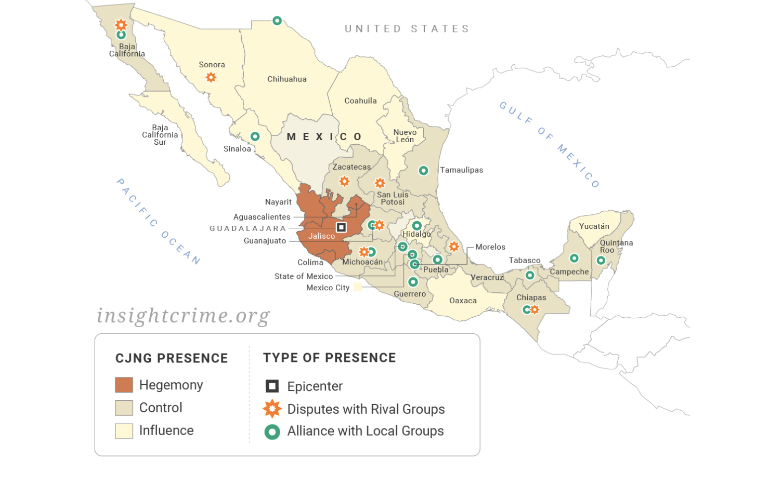
The death of a major cartel leader led to wide-scale roadblocks, arson, and attacks against police across Mexico.
On February 22, Mexican special forces assaulted the compound of one of Mexico’s most powerful cartel bosses. Nemesio Cervantes (“El Mencho”) was killed by authorities which prompted a rapid retaliation by members of his cartel. Cervantes’ Cartel Jalisco New Generation (CJNG) is one of Mexico’s most powerful groups that generates billions of dollars annually.2 This raid came amid stark policy shifts from the Mexican government on how to handle cartels driven by the failure of previous policies, pressure from the U.S government, and domestic pressures. President Claudia Sheinbaum’s predecessor and mentor, Andres Manuel Lopez Obredor (AMLO), instituted a non-confrontational policy often referred to as “Hugs not Bullets.”3 The failure of this policy amplified cartel violence, leading to U.S. President Trump repeatedly threatening to intervene militarily in Mexico. Mexican citizens themselves are also dissatisfied with the Mexican government’s perceived soft-stance on the cartels as exemplified by repeated trucker blockades as well as November’s Gen Z protest outside of the Presidential Palace. These factors are significant drivers of the change in policy that led to greenlighting of this operation.
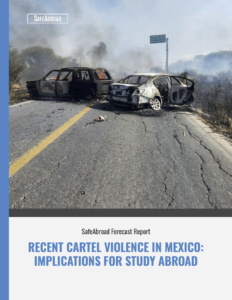
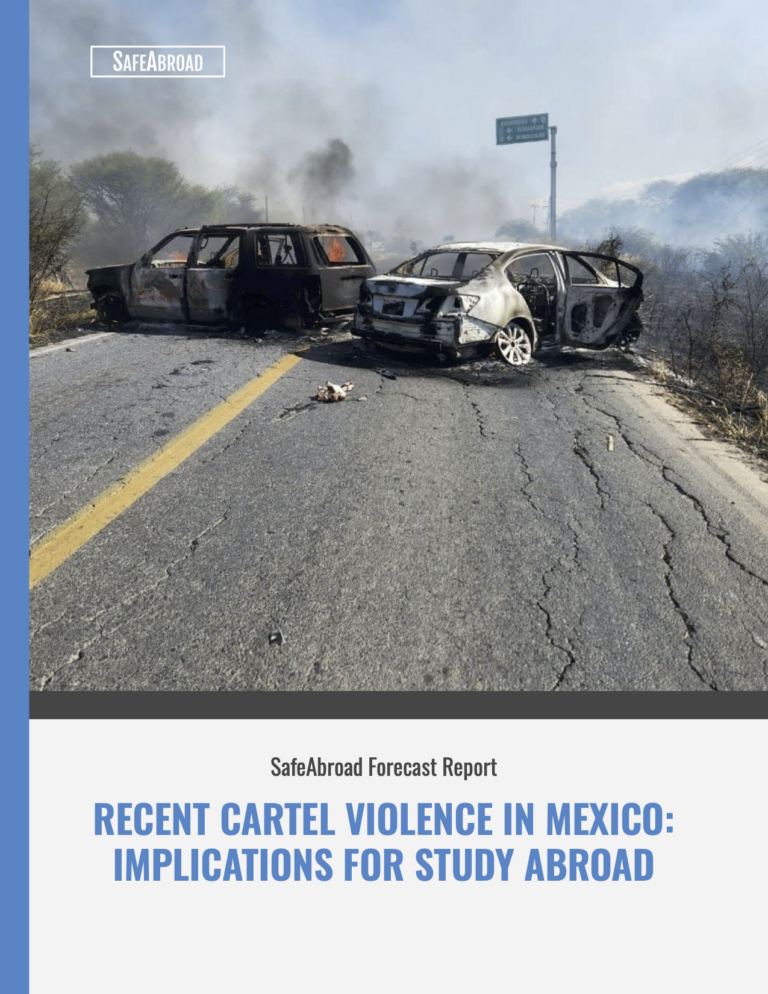
Members of CJNG put up a total of 252 roadblocks that halted traffic across Mexico following the death of their leader, with 85 put up in Jalisco alone.4 While the roadblocks affected a wide geographic area, the number within each state varied dramatically. Jalisco and its neighboring states were the most heavily affected. The majority of roadblocks consisted of vehicles that were set on fire in the middle of roads.
Violence also broke out across the nation, most significantly affecting Jalisco’s two largest cities, Guadalajara and Puerto Vallarta. CJNG members directed retaliatory attacks against police and Mexican armed forces, resulting in the deaths of dozens of soldiers and over 30 criminals.5 While violence was not directed against civilians, cartel members hijacked vehicles to create roadblocks and committed arson across multiple cities.6 7 There are no official civilian death counts at this time, but primary reporting indicates that the number could be as low as one individual.8 The Mexican government has deployed 10,000 troops to put down the violence, with the majority deployed to Jalisco.9 While attacks did take place, there has been a significant amount of misinformation about the scale of the violence. Fabricated and misidentified images/videos have been widely circulated both erroneously and as part of a misinformation campaign by cartel members themselves. This campaign is aimed at promoting an environment of fear in tandem with the wave of violent attacks.10
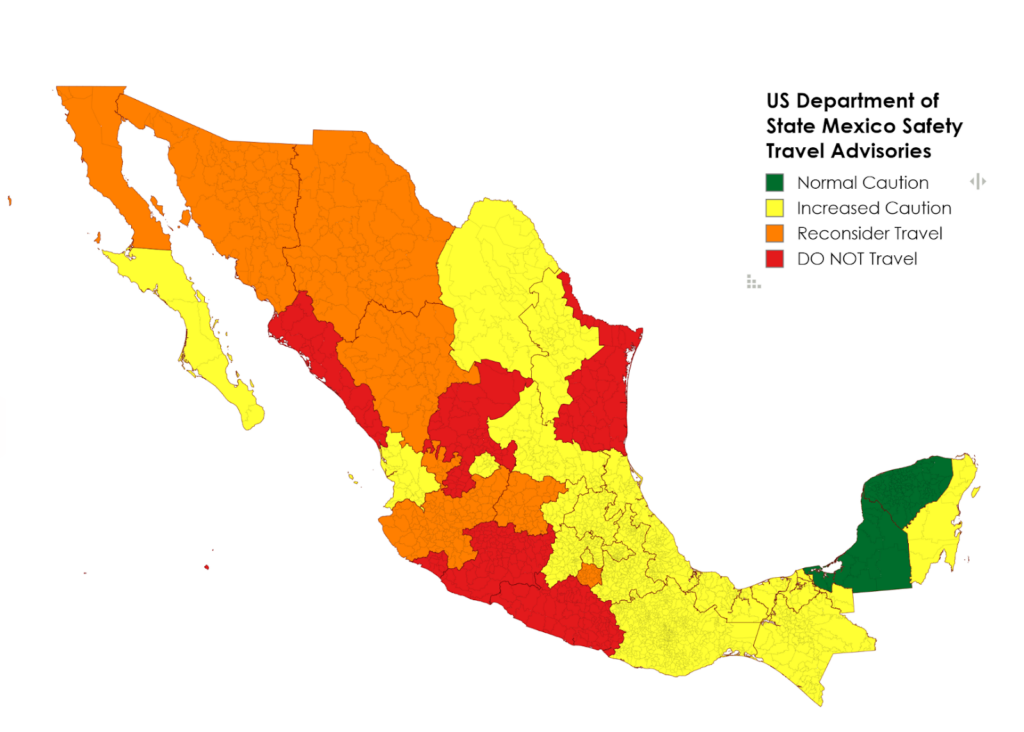
Amid cartel-driven violence, the U.S. embassy in Mexico ordered a shelter in place directive for several states and areas of other states. This included many popular tourist destinations such as Cancun, Cozumel, Playa del Carmen, and Tulum.12 Contrary to the severity of the alert, these areas saw relatively little violence and only sporadic small-scale disruptions, such as the unsuccessful attempt to burn a commercial bus.13 14 They are also all in Quintana Roo state, which is located very far from the epicenter of violence in Jalisco. Reports of sporadic roadblocks and arson also contributed to associated disruptions in Quintana Roo.15 16 17 The disruptions that did take place in Quintana Roo did not target travelers or U.S. citizens. Other tourist areas, such as Los Cabos in Baja California Sur, experienced no violence or roadblocks.18
On the Horizon
Overall, already higher risk destinations in Mexico will become increasingly dangerous while traditionally safer areas will remain safe. The removal of the CJNG’s leader will likely lead to leadership fragmentation, spiking the number of localized attacks in Mexico’s Southwestern states.
- Jalisco and other neighboring high-risk states are likely to see increasing levels of violence. High Value Targeting (HVT), the removal of the head of criminal organizations, has traditionally led to increased violence as organizations fracture.19 Leaders within cartels vie for leadership while simultaneously fending off outside encroachment from other groups, as shown by the arrest of El Mayo Zumbada in July of 2024.20 Violence will likely spike across Jalisco, the home state of the CJNG, as well as in Michoacan, Colima, Nayarit, Guerrero, and Oaxaca. This includes Guadalajara, one of Mexico’s three 2026 World Cup host sites.
- Popular tourist destinations will likely experience little violence. Tourism is an important industry to the Mexican economy. The current administration has made a priority of showing normalcy, as shown by the statements on February 23 by President Sheinbaum stating that the situation is already under control.21 Cartel involvement in the tourism industry also provides an incentive to avoid violence in popular destinations, as the extortion of tourist industries provides significant financial gains. While CJNG control of Quintana Roo is likely to be lost to another cartel, the group will likely have fewer resources to expend while simultaneously protecting their territorial control in Jalisco. This provides another incentive to avoid any U.S. involvement following violence (real or perceived) against U.S. travelers.
- Similar mass disruptions are unlikely over the coming months. The Mexican government responded to pressure by both domestic and foreign audiences, however, the ensuing chaos following the killing of El Mencho exposed a lack of preparedness for potential retaliation. The necessity of better preparing for cartel retaliation in combination with decreased pressure to act makes similarly triggering raids unlikely over the coming months. Massive coordinated disruptions are also unlikely to be initiated by the CJNG as well. Coordination across the organization will likely become increasingly impossible as leadership fractures. The group’s strength will also have to be organized to defend against other cartels/warring factions. Sporadic, localized attacks are more likely to emerge than the nationwide retaliation seen from February 22 to 23.
- https://insightcrime.org/news/five-cjng-hotspots-el-mencho-killing-mexico/
↩︎ - https://www.dni.gov/nctc/terrorist_groups/cjng.html
↩︎ - https://www.cfr.org/global-conflict-tracker/conflict/criminal-violence-mexico ↩︎
- https://english.elpais.com/international/2026-02-23/narco-blockades-lifted-in-mexico-after-cartel-reaction-to-death-of-el-mencho.html
↩︎ - https://www.latimes.com/world-nation/story/2026-02-23/mexico-violence-el-mencho
↩︎ - https://www.latimes.com/world-nation/story/2026-02-23/mexico-violence-el-mencho ↩︎
- https://www.nbcnews.com/world/mexico/videos-puerto-vallarta-smoke-flames-killing-jalisco-el-mencho-rcna260243
↩︎ - https://www.wgcu.org/government-politics/2026-02-23/at-least-73-dead-in-attempt-to-capture-mexican-cartel-leader-and-aftermath
↩︎ - https://www.euronews.com/2026/02/24/thousands-of-troops-deployed-to-end-clashes-in-mexico-over-death-of-drug-lord-el-mencho
↩︎ - https://www.reuters.com/business/media-telecom/after-killing-top-drug-lord-cartels-use-fake-news-spread-fear-mexico-2026-02-24/
↩︎ - https://travelmaps.state.gov/TSGMap/
↩︎ - https://mx.usembassy.gov/security-alert-update-4-ongoing-security-operations-u-s-mission-mexico-february-23-2026/
↩︎ - https://www.hotelinvestmenttoday.com/Regions/Latin-America/How-will-violence-impact-Mexico-tourism
↩︎ - https://www.rivieramayanews.mx/suspected-gang-members-fail-to-set-bus-on-fire-in-cancun-neighborhood/
↩︎ - https://www.hotelinvestmenttoday.com/Regions/Latin-America/How-will-violence-impact-Mexico-tourism
↩︎ - https://www.facebook.com/LineaDeFuegoQRoo/posts/fueron-15-veh%C3%ADculos-y-dos-comercios-quemados-en-quintana-roolos-incendios-provoc/1532648532191910/
↩︎ - https://www.facebook.com/watch/?v=1753396542287724
↩︎ - https://www.hotelinvestmenttoday.com/Regions/Latin-America/How-will-violence-impact-Mexico-tourism ↩︎
- https://www.brookings.edu/articles/how-could-mexicos-drug-cartels-respond-to-us-military-actions/
↩︎ - https://www.ctvnews.ca/world/article/a-cartel-war-bleeding-sinaloa-dry-homicides-rise-400-in-the-year-after-the-fall-of-el-mayo/
↩︎ - https://www.roic.ai/news/mexicos-president-sheinbaum-declares-calm-amid-cartel-violence-fallout-02-23-2026
↩︎