Overview
In March 2025, Hungary passed a law banning LGBTQ+ demonstrations and legalizing the use of surveillance technology to identify and fine anyone in violation of the ban. This is the latest of several unpopular policies restricting Hungarians’ rights and attempting to eliminate foreign influence.1 SafeAbroad analysts have assessed Hungary’s LGBTQ+ demonstration ban to pose a low risk to study abroad students at this time, as it primarily targets native Hungarians. However, the growing number and scale of protests in Hungary denouncing Prime Minister Viktor Orbán’s demonstration ban and the legalized use of surveillance for assessing fines and criminal charges will pose moderate risks to travelers attending or in the vicinity of LGBTQ+-related events.
Key Takeaways
- The LGBTQ+ demonstration ban is just the latest of laws and constitutional amendments made by the ruling Fidesz-KDNP party to suppress LGBTQ+ groups. Same-sex marriage, gender changes, and education involving LGBTQ+ topics have all been banned under Viktor Orbán as part of his plan to protect Hungary’s Christian heritage by fighting the ”LGBTQ offensive.”2
- Frequent, large-scale protests against this ban and other policies of the Fidesz-KDNP party may pose incidental risks to travelers. Although recent protests have remained nonviolent, additional provisions in the LGBTQ+ demonstration ban that allow for the use of facial image analysis to issue fines and criminal charges against violators of the ban may affect travelers in the area of protests.
- The new policy has seen backlash from many EU member states, but it is highly unlikely that Hungary will change its policy under this pressure or seek to leave the EU. The EU has denounced many of Hungary’s “anti-democratic” policies as early as 2011, which have not been repealed despite violating EU directives.3 Leaving the EU has been proposed by far-right groups in Hungary, but is unpopular amongst voters.
Background
The LGBTQ+ demonstration ban is consistent with Fidesz-KDNP’s repressive anti-LGBTQ+ policy; although mass surveillance by the Hungarian government is not new, the legalization of surveillance to punish protesters is notable.
On March 18, 2025, the Fidesz-KDNP coalition led by Prime Minister Viktor Orbán voted in favor of a bill that prohibits LGBTQ+-related gatherings.4 On April 14, the Hungarian parliament passed a constitutional amendment which allowed LGBTQ+ demonstration bans under the guise of protecting children, whom the government believes should not be exposed to gender reassignment and homosexuality.5
Under this law, mass surveillance can be used to identify and fine participants of Pride demonstrations up to 200,000 Forints (approximately USD 578) and criminally charge protest organizers.6 This is the first time Hungary has legalized mass surveillance technology for this purpose, but the government has previously been accused of using surveillance software such as Pegasus to monitor civilians.7
These policies are consistent with Viktor Orbán and the Fidesz-KDNP coalition’s policy and goals for Hungary as an “illiberal Christian democracy” fighting against the “LGBTQ offensive.”8 9 10 Prior anti-LGBTQ+ laws include the prohibition of same-sex marriage in the 2011 Constitution, the banning of legal gender changes in 2020, and the banning of LGBTQ+-related content in education.11 12
Protesters and opposition party members attempted to blockade the entrance to parliament before the constitutional amendment banning LGBTQ+ demonstrations was passed. The amendment, in addition to other unpopular policies, has made the Tisza opposition party increasingly popular ahead of the 2026 general election.13
In 2018, the EU first began Article 7 (internal hearing process) proceedings against Hungary, which have been ongoing for the last seven years. Despite harsh criticism, the EU has not moved to implement sanctions against Hungary under Article 7 due to a lack of majority support.14 Despite violating EU directives, polls show the majority of Hungarians still support EU membership.15
Current Situation
The LGBTQ+ demonstration ban has exacerbated already fraught political tensions ahead of the 2026 Parliamentary Election. Protesters against the ban claim that it is not only anti-democratic, but an indication that after 16 years of Orbán in office, it is clear that he is not what Hungary needs.16This view is supported by various European institutions, media outlets, and academics, who point out that Hungary has already survived the 1990s communist dictatorship, and thus the country should not return to authoritarian rule.17
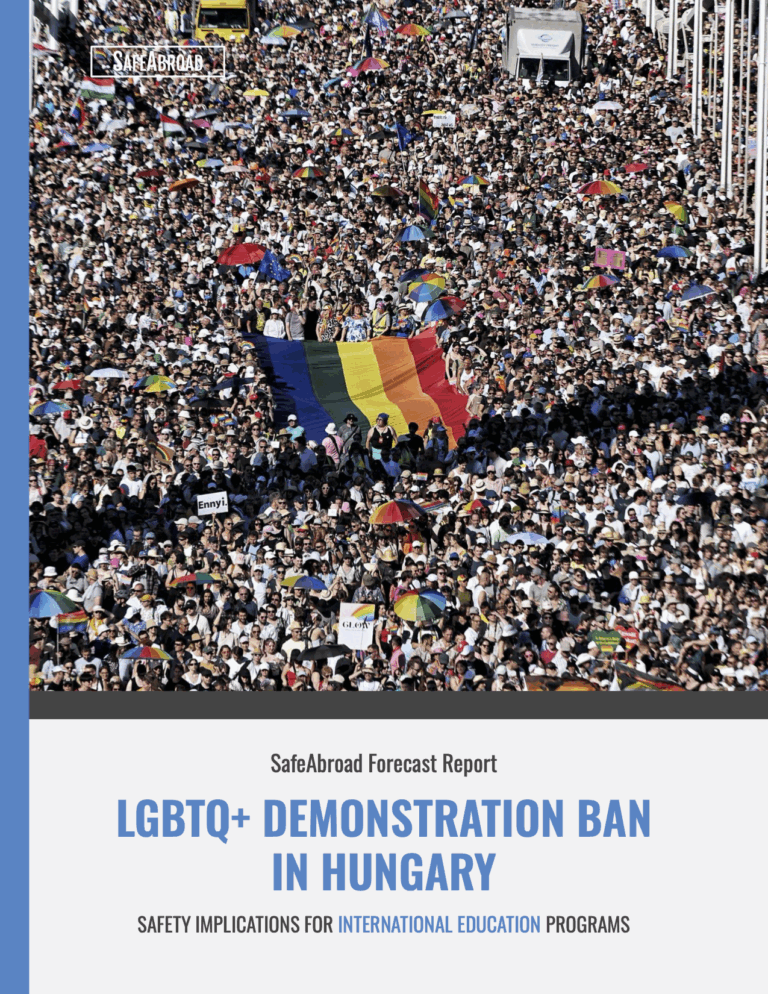
Despite the demonstration ban, over 100,000 people flooded the streets of Budapest on June 28 for the city’s 30th annual Pride March, making it the “largest LGBTQ+ Pride event in Hungary’s history.18 19 More than 50 people were arrested prior to the march, but on the day of, police forces focused on crowd containment instead of attempting to prevent the demonstration, and only one minor clash was reported. Small crowds of anti-LGBTQ+ protesters were in attendance; however, authorities and local media reported no signs of disruption or violence throughout the day.20 Despite police claims that no one will be arrested for participation in Budapest’s Pride Parade, investigations into Budapest’s mayor for being an alleged organizer of the event indicate that related arrests are still likely to occur.21 22
Despite repeated denunciations of Viktor Orbán, the EU has done little to change Hungary’s policies. While many previously argued that interference by the EU would isolate Hungary, there has been increasing pressure for an EU intervention since the LGBTQ+ demonstration ban in addition to other laws. France and Germany have denounced Hungary’s new laws, while many other EU countries have expressed alarm over the country’s actions. Amidst these concerns, the EU has frozen 18 billion euros of funding intended for Hungary, and created a new framework requiring countries adhere to the EU’s core values to secure funding.23 Under this framework, the EU may fully suspend funds to Hungary due to violations against the rights of freedom of assembly and freedom of information, both enshrined in the Charter of Fundamental Rights.
On the Horizon
Overall, Hungary remains a safe destination for student travelers; however, students should be made aware of and take care not to violate any of Hungary’s laws including the LGBTQ+ demonstration ban. The prevalence of large-scale protests leading up to the 2026 election presents a moderate level of risk.
What to watch for in 2025 and 2026:
- Large-scale protests will likely persist in Hungary over the coming months and prior to the 2026 general election. The demonstration ban has polarized many Hungarians and has spurred support for the opposition candidate in the general election. In the likely event that people are arrested for involvement in the Budapest Pride parade, associated protests are also likely. An increased frequency in demonstrations is also likely prior to the Parliamentary election in April 2026.
- Heightened security is expected, and clashes are possible during LGBTQ+ demonstrations. The Pride March in Budapest is a large-scale annual event with 30 years of history, and its massive scale made it difficult for the police to contain. Further protests without a similar scale of support will be more vulnerable to police interference and clashes with counter-protesters. Given the polarizing nature of the demonstration ban, minor clashes may occur at future Pride events.
- Additional anti-demonstration, surveillance, and anti-media laws may be introduced and passed by parliament leading up to the 2026 election. The constitutional amendment prohibiting LGBTQ+ demonstrations under the guise of protecting children has the potential to be used to ban other types of demonstrations. Furthermore, in the fall Hungary will reconsider a proposed law allowing the government to investigate, surveil, fine, and blacklist any institutions deemed to be using foreign funding to threaten Hungary’s sovereignty.24 With growing support for the Tisza party, further laws restricting media and pressuring discontent are likely to be proposed leading up to the 2026 election.
- https://voxeurop.eu/en/viktor-orban-hungary-freedom-press-society/ ↩︎
- https://miniszterelnok.hu/en/speech-by-prime-minister-viktor-orban-at-the-32nd-balvanyos-summer-free-university-and-student-camp/
↩︎ - https://www.voanews.com/a/hungary-defiant-as-eu-mps-protest-media-law-114202834/170448.html ↩︎
- https://telex.hu/english/2025/03/19/hungarian-parliament-adopts-law-banning-pride ↩︎
- https://www.pbs.org/newshour/world/hungary-passes-constitutional-amendment-to-ban-lgbtq-public-events ↩︎
- https://telex.hu/english/2025/03/19/hungarian-parliament-adopts-law-banning-pride ↩︎
- https://www.theguardian.com/news/2021/jul/18/viktor-orban-using-nso-spyware-in-assault-on-media-data-suggests ↩︎
- https://www.hungarianconservative.com/articles/culture_society/fidesz-constitutional-supermajority-2010 ↩︎
- https://www.reuters.com/article/us-hungary-orban/hungarian-pm-sees-shift-to-illiberal-christian-democracy-in-2019-european-vote-idUSKBN1KI0BK/ ↩︎
- https://www.theparliamentmagazine.eu/news/article/budapest-pride ↩︎
- https://www.independent.co.uk/news/world/europe/hungary-homosexuality-law-lgbt-vote-b1864103.html ↩︎
- https://www.theguardian.com/world/2020/may/19/hungary-votes-to-end-legal-recognition-of-trans-people ↩︎
- https://www.reuters.com/world/hungarian-opposition-party-has-15-point-lead-ahead-orbans-fidesz-poll-says-2025-06-18/ ↩︎
- https://www.euronews.com/my-europe/2025/05/27/eu-countries-losing-patience-as-hungary-grilled-on-pride-march-rule-of-law ↩︎
- https://blogs.lse.ac.uk/europpblog/2024/12/27/mixed-economic-results-and-growing-political-conflict-hungarys-20-years-of-eu-membership/ ↩︎
- https://www.npr.org/2025/06/11/nx-s1-5430267/hungary-viktor-orban-lgbtq-protest ↩︎
- https://balkaninsight.com/2025/05/28/a-year-from-hungarys-next-election-the-reintroduction-of-censorship-is-officially-announced/ ↩︎
- https://www.theguardian.com/world/2025/jun/29/turkish-police-arrest-more-than-50-people-before-banned-istanbul-pride-parade ↩︎
- https://apnews.com/article/budapest-pride-march-defies-ban-orban-hungary-6919758b70c812bfe95dddb589e44132 ↩︎
- https://www.washingtonpost.com/world/2025/06/28/budapest-pride-hungary-ban-lgbtq/ ↩︎
- https://www.washingtonpost.com/world/2025/07/14/budapest-pride-ban-arrests-orban/ ↩︎
- https://www.reuters.com/world/budapest-mayor-says-probe-banned-pride-march-sees-him-suspect-2025-07-24/ ↩︎
- https://www.euronews.com/my-europe/2025/07/18/eu-takes-rule-of-law-battle-with-hungary-to-next-level-with-budget-proposal ↩︎
- https://www.theguardian.com/world/2025/may/14/hungary-considering-law-to-monitor-and-ban-groups-seen-as-threat-to-national-sovereignty ↩︎