Genaro LaBanca

Political protesters will gather in major cities throughout Europe on November 22, 23, and 26; exercise caution and expect disruptions.

Pakistan Tehreek-e-Insaf (PTI) organized the protests on November 22, 23, and 26 to condemn the “Islamabad Massacre” in 2024 and to demand the release of Imran Khan, who is jailed in Pakistan. Khan was the Pakistani Prime Minister from 2018 to 2022, and was sentenced to 14 years in prison earlier this year in January for corruption. Known protests will take place in the capitals of Sweden, the Netherlands, France, the United Kingdom, Greece, Denmark, Belgium, Switzerland, and Spain.
A series of nationwide strikes across various work sectors will take place in Belgium between November 23 and 26.

The General Labour Federation of Belgium (FGTB) arranged the strikes to oppose various economic and social austerity policies being implemented by the federal government, and to also influence the country’s budget for 2026-2029. Railway Company of Belgium (SNCB) workers will strike from 10:00 PM on November 23 to 10:00 PM on November 26. Workers affiliated with the General Federation of Public Services – Tram, Bus, Metro (CGSP–TBM) will strike from November 24 to 26.

Cases of Oropouche virus increased and spread across seven regions in Panama as of October 24; exercise caution when outdoors.

Health officials have reported a recent uptick in Oropouche virus infection rates due to deforestation and increasingly warm climates. The virus is primarily transmitted to humans from midge and mosquito bites, and there is currently no vaccine. Common symptoms include high fevers, headaches, muscle and joint pain, and potential skin rashes. The virus is currently active in Panamá Metro, Los Santos, Herrera, Panamá Norte, Veraguas, Panamá Oeste, Coclé, Darién, and Panamá Este.

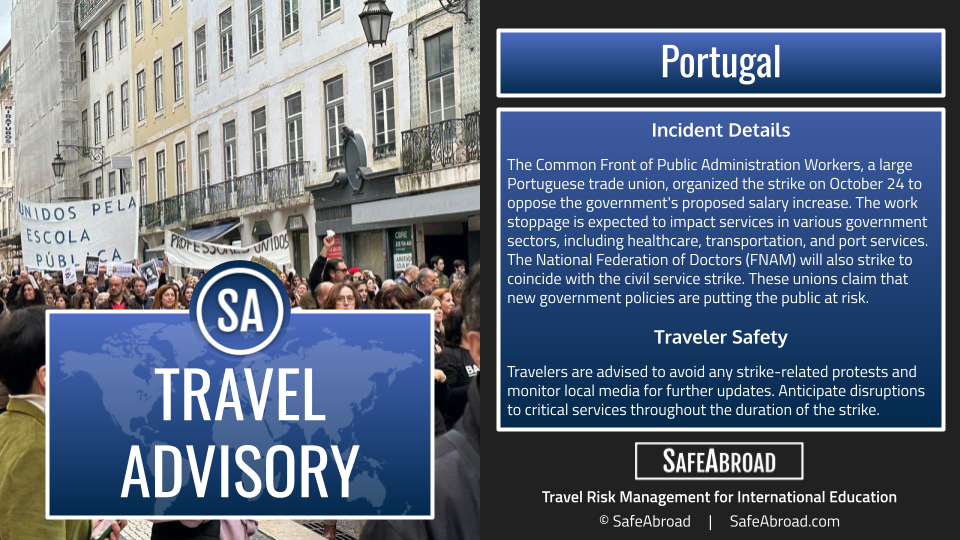
Civil servants will participate in a 24-hour nationwide strike across Portugal on October 24; expect service disruptions and delays.

The Common Front of Public Administration Workers, a large Portuguese trade union, organized the strike on October 24 to oppose the government’s proposed salary increase. The work stoppage is expected to impact services in various government sectors, including healthcare, transportation, and port services. The National Federation of Doctors (FNAM) will also strike to coincide with the civil service strike. These unions claim that new government policies are putting the public at risk.

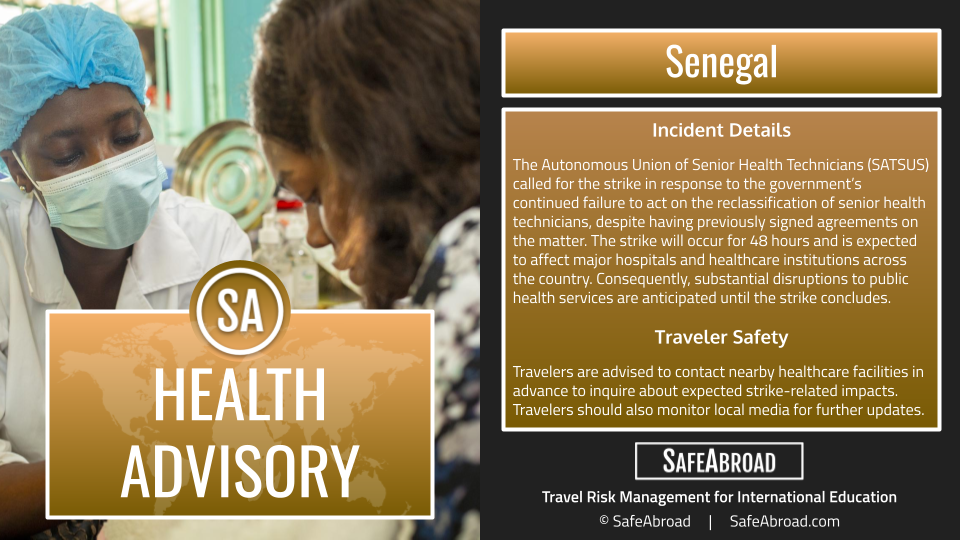
Senior health technicians will strike nationwide in Senegal from October 15 to 16; expect significant disruptions to public health services.

The Autonomous Union of Senior Health Technicians (SATSUS) called for the strike in response to the government’s continued failure to act on the reclassification of senior health technicians, despite having previously signed agreements on the matter. The strike will occur for 48 hours and is expected to affect major hospitals and healthcare institutions across the country. Consequently, substantial disruptions to public health services are anticipated until the strike concludes.

A nationwide 24-hour strike will take place across South Africa on October 7; expect various services to be disrupted.

The Congress of South African Trade Unions (COSATU) organized the strike to demand an end to profit-driven retrenchments. Organizers claim that these retrenchments have caused the country’s economy to grow weaker and the cost of living to increase. Corresponding protests will take place in major cities across the country. Various work sectors will partake in the strike, including transportation and healthcare, likely resulting in widespread service disruptions.

Anti-government protesters will gather in Lima, Peru, on September 28 at 5:00 PM; clashes with police are possible.

Peruvian transport workers, civil society organizations, and Gen Z civilians organized the protest to oppose government corruption as well as the country’s pension reform plan. Protesters will gather in front of Plaza Jose de San Martín and proceed to march through city streets. Similar protests occurred on September 20, 21, and 27, in which over 90 police officers, protesters, and journalists were injured. Police used tear gas and rubber bullets to disperse these demonstrations.

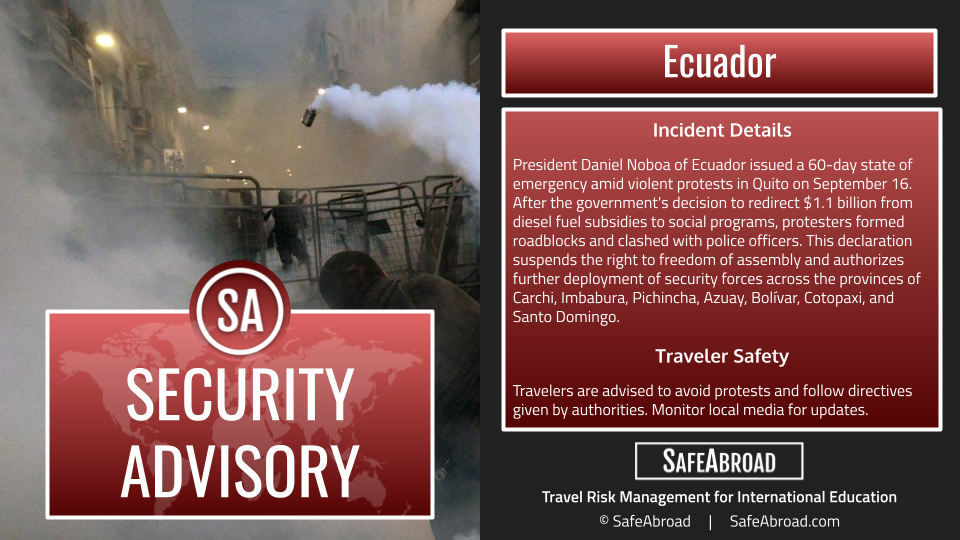
A 60-day state of emergency was declared across seven provinces in Ecuador on September 16 following violent protests in Quito.

President Daniel Noboa of Ecuador issued a 60-day state of emergency amid violent protests in Quito on September 16. After the government’s decision to redirect $1.1 billion from diesel fuel subsidies to social programs, protesters formed roadblocks and clashed with police officers. This declaration suspends the right to freedom of assembly and authorizes further deployment of security forces across the provinces of Carchi, Imbabura, Pichincha, Azuay, Bolívar, Cotopaxi, and Santo Domingo.

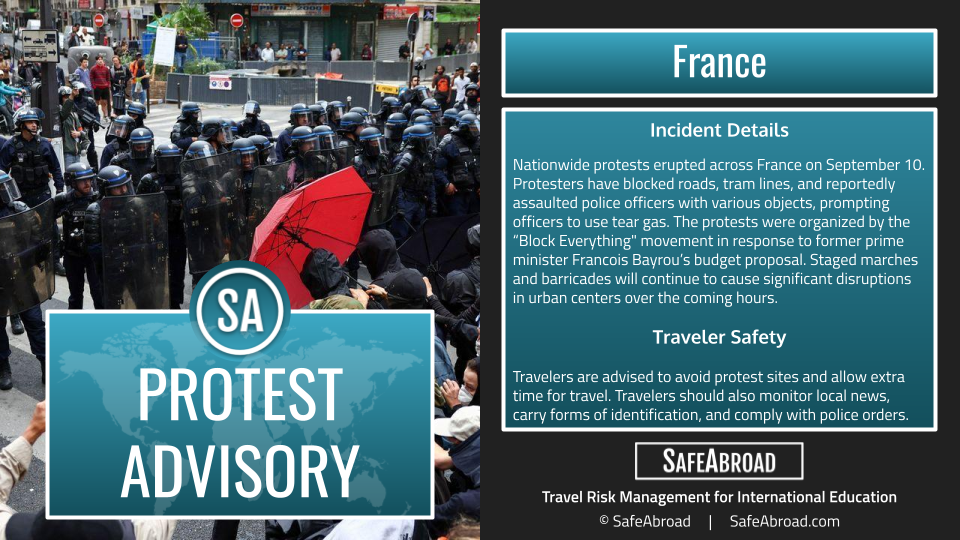
“Block Everything” protests nationwide across France on September 10 will continue to cause disruptions and unrest over the coming hours.

Nationwide protests erupted across France on September 10. Protesters have blocked roads, tram lines, and reportedly assaulted police officers with various objects, prompting officers to use tear gas. The protests were organized by the “Block Everything” movement in response to former prime minister Francois Bayrou’s budget proposal. Staged marches and barricades will continue to cause significant disruptions in urban centers over the coming hours.

Air traffic control workers across France will go on strike from September 18 to 19, resulting in travel disruptions.

The Syndicat Majoritaire des Contoleurs Aeriens (SNCTA), France’s largest air traffic control union representing about 60% of all French air traffic control workers, will engage in a 24-hour strike from the morning of September 18 to the end of September 19. SNCTA is calling for increased wages as well as management reform. A similar strike by smaller unions on July 3 and 4 caused over one million passengers to be affected and thousands of flights to be canceled.

Download this Report for Free