
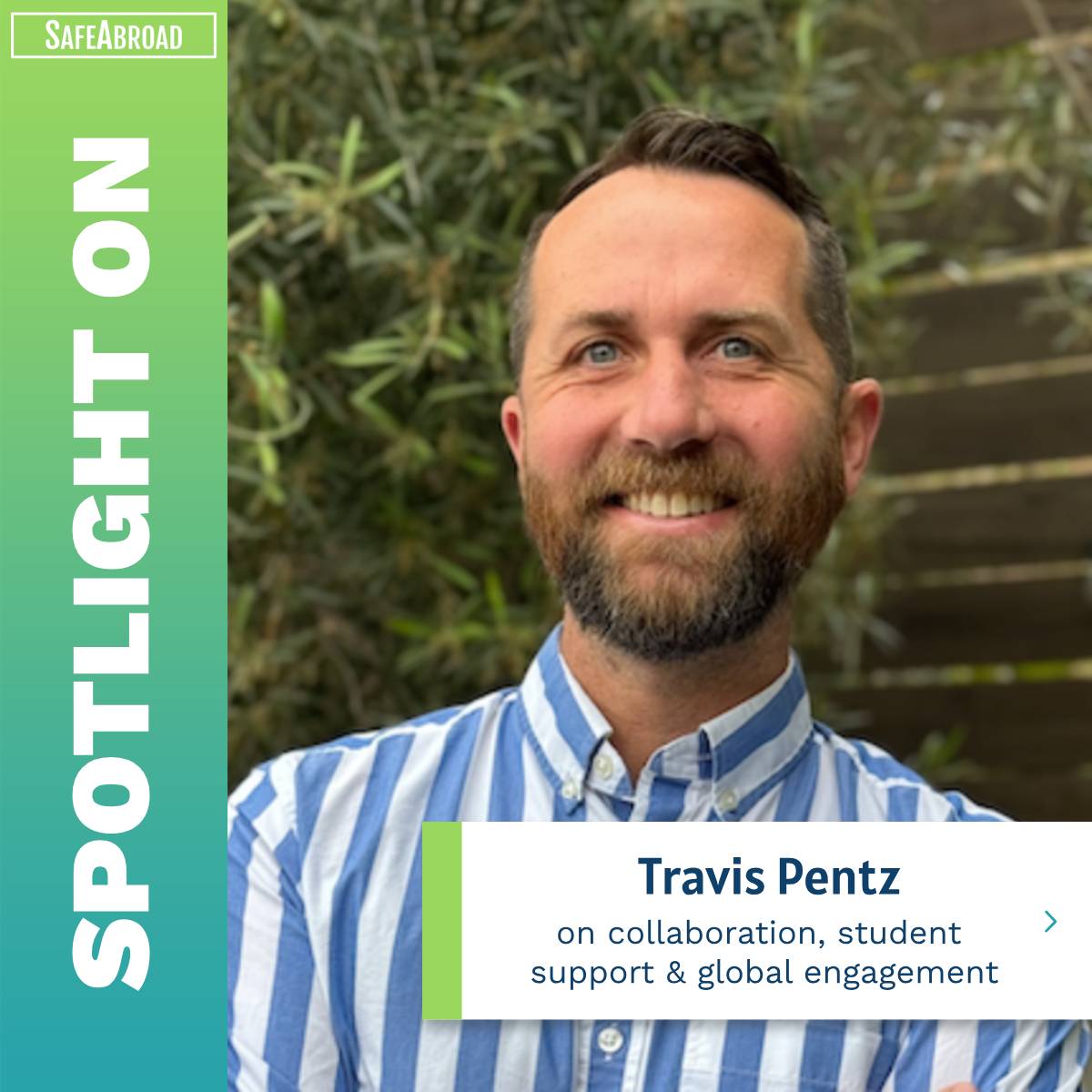
You’ve built your career across several University of California campuses and have spent many years supporting education abroad. Looking back, what first drew you to international education, and what has kept you passionate about this work?
What first drew my attention was actually my high school cross-country coach. Every other summer, he took graduating seniors to Italy. He had studied abroad there himself and had worked in Florence for a while before eventually becoming a high school ceramics teacher and cross-country coach.
The summer after my freshman year at UC Santa Cruz, I found out I was going to be able to go with him. At the time, I was an environmental studies major, but I was having a hard time finding my place. I decided to take an art history class on the Italian Renaissance to prepare for the trip, and I completely fell in love with it.
Then I got to go from seeing these amazing, famous works of art on little slides in class to actually seeing them in person. We traveled throughout northern and central Italy for about three weeks that summer, and it really opened my eyes. Being able to experience firsthand what I had been learning in the classroom, alongside people who genuinely loved and understood it, made a huge impact on me.
That experience eventually led me to study abroad in Rome during my senior year through the UC Center in Rome. It wasn’t the most immersive experience since I was with other UC students, and looking back now as an international educator, I wish I had gone a little deeper. But as a first-generation college student, I think it was exactly the right experience for me at that point in my life. It really sparked my interest.
As an undergraduate, I became involved in a lot of different areas. I was an orientation leader, an RA, involved in student government, club sports, and study abroad. Once I realized I could actually make a career out of international education, I started exploring graduate school options and eventually ended up at Ohio State, where I had another international experience at Lancaster University learning about the British higher education system.
That really confirmed for me that this was the work I wanted to do. Those experiences were truly life-changing for me, as cliché as that sounds, and I wanted to help create those same opportunities for other students.
What has continued to motivate me over the years actually comes from something Bill Nye the Science Guy said while I was working in Residence Life at UC Irvine. He was speaking to a room full of STEM students and told them that they were learning the skills they would need to go out and solve the world’s biggest problems.
I remember thinking, “Well, my art history degree may not save the world, but I can support the students who will.”
That’s always stayed with me. Today at UCSF, I primarily support medical students and students working in global health. Seeing the research they’re conducting, the care they have for improving health worldwide, and knowing that I get to support those efforts is what continues to inspire me every day.
UCSF is quite different from a traditional university. You’re supporting medical students, residents, researchers, and clinical fellows who travel internationally for a wide variety of purposes. How does that shape your approach to global engagement and risk management?
It was definitely quite a change for me, coming from undergraduate study abroad advising to graduate and professional health sciences. As an art history major, I had never taken a health or pre-med class, so there was definitely a learning curve.
I mentioned earlier, though, it’s been incredibly inspiring to see the work our students are doing to improve global health. That’s one of the things I enjoy most about working at UCSF.
I’m part of a small office, but we also serve a relatively small population, which gives me the opportunity to provide much more individualized support.
I think that’s where my approach to risk management has evolved.
Before my position was created, our campus primarily took a location-based approach to risk. If a destination was considered high risk, that generally meant a blanket decision for everyone who wanted to travel there.
What I’ve been able to do in this role is shift more toward understanding the individual traveler’s risk profile.
That means learning about a student’s previous international experience. Many of our students are actually from the countries they’re traveling to or already have strong support systems there. Others have experience traveling to low- and middle-income countries or other low-resource settings. We also spend time talking about their identities and how those identities may interact with the destination and the risks they could encounter abroad.
Understanding the medical school curriculum, as well as the research needs of our master’s and PhD students, has allowed me to move away from saying, “Uganda is high risk, so we’re not sending anyone there,” to instead recognizing that a particular student may already have extensive experience there, be working with principal investigators who have strong on-the-ground resources, and have the preparation necessary for that experience.
This role has really allowed me to dive much deeper into providing individualized support for our students.
Over the course of your career, you’ve helped develop education abroad and risk management resources across multiple institutions. How have you seen the conversation around health, safety, and risk evolve? Do you think institutions are becoming more proactive, and what are we doing better today than we were ten or fifteen years ago?
Absolutely.
I can definitely speak from my experience within the University of California system since I’ve spent so much of my career there.
When I first started at UC San Diego, I don’t even think I knew there was a risk management or risk advisory office that we could partner with. Today, those teams are involved in nearly every conversation and every decision.
Many of the positions that now exist simply weren’t around ten or fifteen years ago. The awareness of health, safety, and security has grown tremendously, and in my experience, institutional support for those roles has grown as well.
I’ve also seen collaboration increase significantly.
Within the UC system, we have a weekly Friday risk call that brings together study abroad offices, export control, risk management, insurance, and anyone else who wants to be part of the conversation. Every week we receive updates from our Crisis24 risk analyst, discuss incidents from the previous week, ask questions, and share resources.
What I appreciate most is how open and supportive those conversations are. There really are no stupid questions. People bring challenges to the table, share ideas, and help one another navigate difficult situations.
I think that’s true across the field as well.
I’m also a member of the NAFSA Education Abroad Knowledge Community Health and Safety Subcommittee, and it’s been exciting to see the diversity of perspectives and the breadth of resources we’re developing together.
Another important change is that health and safety is no longer treated as its own isolated responsibility or simply another box to check. It’s become part of the conversation throughout the entire student experience.
More recently, we’ve also started having conversations about how closely education abroad health and safety overlaps with international student and scholar services. Those two areas have traditionally operated separately, but we’re recognizing that many of the same risk management principles apply to both, and that’s leading to much stronger collaboration across the profession.
Health and safety wasn’t what originally drew me into international education.
What brought me into this field was supporting students.
The work I do today still reflects that same motivation. I get to help students achieve their goals while collaborating with colleagues who care deeply about supporting them, and that’s something I continue to find incredibly rewarding.
Today, we’re preparing students for much more than emergencies. Preparation now includes everything from mental health and identity to cultural expectations and resilience. From your perspective, what do you think students need to understand before they leave that often gets overlooked?
One thing I’ve recognized with our student population is that not only is every destination different when it comes to risk, but every experience can be different as well.
Many of our UCSF travelers have traveled internationally before, sometimes even to the exact location they’re returning to or to destinations with similar risk profiles. Because of that, they may feel like they don’t need to invest as much time in research or preparation.
We’ve heard the same thing from faculty. Someone might say, “I’ve been traveling to this high-risk location for years,” and over time they naturally begin to prepare less because they’re familiar with it.
But risks change. Every trip still requires the same level of preparation, even if you’ve visited that destination before or traveled to similar places. It’s always important to understand the current realities, the individual risks, and how the situation may have changed since your last visit.
That probably reflects the graduate student population I work with, since many already have international experience. It may be different for undergraduate students traveling abroad for the first time.
But for our students, one of the biggest lessons is understanding that situations and risks are continually evolving, and preparation should evolve with them.
Throughout your career, you’ve served in numerous leadership roles with NAFSA and worked across multiple campuses and university systems. What have those experiences taught you about collaboration, and why is it so important in international education?
The word I keep coming back to is support.
Support is what brought me into this field in the first place. I wanted to help students achieve their goals and have the same life-changing experiences that I had studying abroad.
As I’ve grown in my career and taken on leadership roles, I’ve realized how much I also enjoy supporting the colleagues around me.
My focus has expanded from supporting individual students to supporting professionals as they pursue their own goals and grow in their careers.
Serving as Academy Coach for NAFSA Region XII, Conference Chair, and Regional Chair have been some of the most fulfilling roles I’ve had because they allowed me to help colleagues move toward what they hoped to accomplish professionally.
That connects directly to collaboration.
One of the things I love most about higher education is that, for the most part, we’re not competing with one another. Maybe providers compete for student numbers, or faculty-led programs compete within a university system, but generally speaking, our students are our students, and we’re all working toward the same goal of supporting them.
Because of that, it has never felt like a profession where people guard their ideas or keep secrets.
We’re in a helping profession. We want to help our students, but we also genuinely want to help one another.
Whether that’s through NAFSA or other professional communities, I’ve found people who are incredibly willing to share resources, answer questions, and support one another.
I’ve also become involved with the NAFSA Caregivers Interest Group, where our conversations aren’t only about professional challenges. We also talk about balancing our work with raising young children and how those caregiving responsibilities overlap with the work we do supporting students.
To me, it all comes back to support. Supporting students. Supporting colleagues. Working together to move our field forward. Working together to help students succeed. And ultimately, helping move the world forward.
Collaboration is one of the parts of this profession I’ve enjoyed most, and I think it’s also been essential to every success I’ve had.
As you look ahead, what trends do you think will have the greatest impact on international education and global mobility over the next five to ten years? Whether it’s technology, AI, geopolitical uncertainty, duty of care, or changing student expectations, what stands out to you?
I think what stands out to me most is the increasing complexity of international education.
We’re continuing to integrate international experiences into more areas of university life. It’s no longer just traditional study abroad programs. Anywhere a university has an international footprint, we’re asking, “How can students be part of that experience?”
For example, we’re looking at ways that whenever UCSF signs a new international institutional agreement, information about student opportunities is automatically included as part of that partnership.
I think that’s going to create many more types of international experiences for students, which also increases the complexity of supporting them.
At the same time, the world itself is becoming more complex.
We’re navigating evolving risks, political uncertainty, global unrest, climate change, and natural disasters. All of those factors influence the work we do.
As international education continues to expand, I think our work will become increasingly complex as well, and the support students need will continue to evolve alongside that complexity.
Finally, for someone just beginning a career in international education—or perhaps stepping into a health and safety role for the first time—what advice would you give them?
Remember that this is a profession built on support.
The reason many of us entered this field wasn’t that we wanted to become experts in risk management. We came into international education because we wanted to help students have meaningful, life-changing experiences.
As your career grows, you’ll realize that support extends beyond students. It includes your colleagues, your institution, and the broader international education community.
Don’t be afraid to ask questions, build relationships, and collaborate with others. One of the greatest strengths of this profession is how willing people are to share their knowledge and help one another succeed.
International education continues to evolve, and the work is becoming more complex every year. No one person has all the answers, which is why collaboration is so important.
If we continue supporting one another while keeping students at the center of our work, we’ll be well positioned to help them navigate an increasingly complex world safely and successfully.
Travis, thank you for taking the time to share your experiences and insights. Your journey highlights how transformative international experiences can be, not only for students, but for the professionals who dedicate their careers to supporting them.