
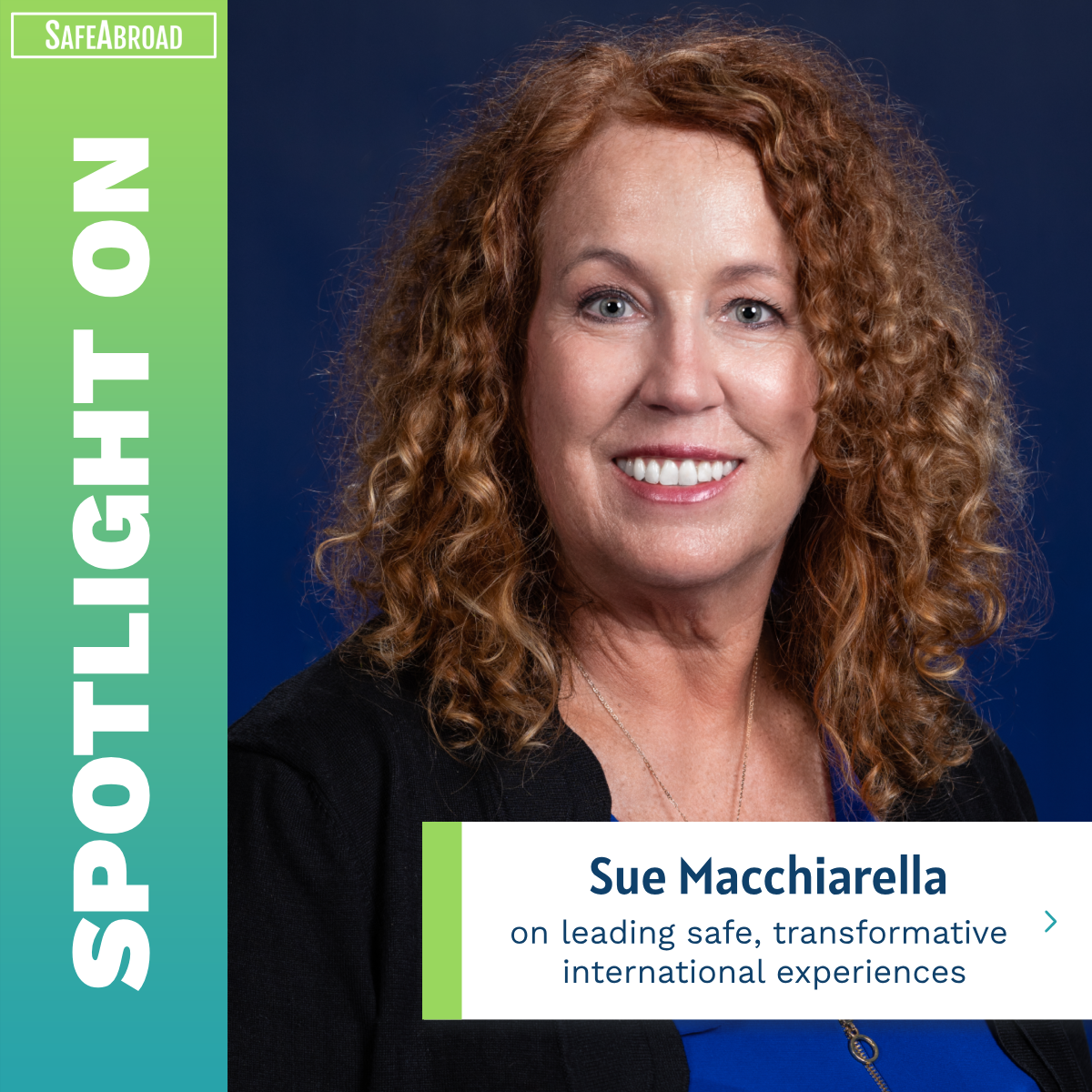
Your path into international education has been anything but conventional. Before leading Global Engagement at Embry-Riddle, you served in the Army, worked as an Army civilian, and had a wide range of leadership experiences. Looking back, what experiences have most influenced your leadership style?
I’ve definitely taken an unconventional path into international education. Before joining Embry-Riddle, I never imagined I’d end up working at a university, and now it’s my favorite job I’ve ever had.
My global perspective actually started long before my professional career. As a child, I lived in Singapore and Hong Kong, attended international schools, and later studied abroad while attending the University of Central Florida. Those experiences helped shape how I see the world and ultimately influenced the work I do today.
When it comes to leadership, though, my military experience had the greatest impact. I had the privilege of serving under some exceptional leaders, and I also saw examples of leadership that weren’t as effective. The biggest lesson I took away was that great leaders take care of their people first.
That’s something I’ve carried with me throughout my career. When new members join my team, I tell them that their health and their family come before their job. If people know they’re supported, they’ll take ownership of their work, they’ll support the mission, and they’ll be happier doing it.
Beyond that, I’ve learned the importance of being a strong communicator and keeping your word. Trust is built through consistency, and I believe those principles are at the heart of good leadership.
You mentioned growing up overseas in Singapore and Hong Kong. Having spent much of my own life abroad, I know those early experiences can leave a lasting impression. That brings me to another pivotal chapter in your life…
You were stationed in Germany during one of the most significant geopolitical moments of the twentieth century: the fall of the Berlin Wall. What do you remember most from that time, and how did experiencing it firsthand shape your perspective?
When people ask about that time, the first word that comes to mind is joy. There was an incredible sense of celebration as the Wall came down and families were reunited. At the same time, from a military perspective, it was a surreal moment because our mission changed almost overnight.
For years, our job had been centered on defending the border between East and West Germany. Suddenly, that mission disappeared. We found ourselves asking, “What happens now?” It’s something most people don’t think about, but it was a profound shift for those of us serving there.
One of my strongest memories is watching families cross into West Germany in their tiny Trabant cars. They’d be packed full of people, honking their horns, waving money they’d just received from the West German government, and smiling from ear to ear. You could literally see what freedom meant to them.
Before the Wall came down, we regularly traveled between East and West Berlin. The contrast was striking. West Berlin was vibrant, colorful, and full of activity. Crossing into East Berlin felt like stepping into another world: gray buildings, long lines, and constant reminders of scarcity. People would wait hours, sometimes longer, just for the opportunity to buy necessities like shoes, regardless of whether they were even the right size.
What has stayed with me most, though, wasn’t the contrast; it was what happened at the border. We would often hear sirens followed by gunfire as people attempted to escape from East Germany into the West. Every time it happened, you wondered whether someone had made it or whether they had lost their life trying.
That experience left a lasting impression on me. It showed just how powerful the desire for freedom really is that people were willing to risk everything to escape an oppressive regime and have the chance at economic opportunity and to live free.
Years later, I drove that same route again. There were no checkpoints, no barriers, no soldiers directing traffic. The tension that once defined that journey was gone. It was emotional because I remembered exactly what that road had represented, and how dramatically history had changed in such a short period of time.
You’ve now spent more than a decade leading Study Abroad and Global Engagement at Embry-Riddle. During that time, how have you seen the conversation around international education evolve, both at your institution and across the field?
The biggest change has been the growing recognition that international education isn’t simply an optional experience; it’s an essential part of preparing students for the world they’ll enter after graduation.
At Embry-Riddle, our students are pursuing inherently global careers. Whether they’re working in aviation, aerospace, engineering, or business, they’ll collaborate with colleagues from different countries and cultures throughout their careers. Developing intercultural competence isn’t just valuable; it’s a professional necessity.
I’ve also seen a much stronger emphasis on health, safety, and student well-being. Earlier in my career, many conversations focused primarily on logistics: getting students overseas, making sure the paperwork was complete, and running successful programs. Those things are still important, but today we’re taking a much more holistic approach.
We’re thinking about physical safety, mental health, crisis preparedness, institutional responsibility, and how to support students before, during, and after they travel. At the same time, we’re working to ensure faculty feel supported as they lead programs abroad.
The field has become far more collaborative as well. Institutions are sharing resources, learning from one another, and recognizing that while every university is different, many of the challenges we face are shared.
Most importantly, I think we’ve become much better at communicating why international education matters. It’s not just about traveling overseas. It’s about helping students become adaptable, culturally aware, resilient professionals who can succeed in a global environment.
Your family has a remarkable legacy of military service spanning four generations. How has growing up and later raising your own family in that environment influenced the way you prepare students to navigate the world?
Living overseas at a young age completely changed the way I see the world, and I believe that travel continues to do that, no matter how old we are.
Every time we step into a different country, our brains wake up. We’re processing new languages, unfamiliar sounds, different foods, different customs, and even different smells. We have to think differently because everything around us is new. That’s one of the greatest gifts international experiences can offer.
When I speak with students before they leave, I encourage them to embrace that feeling instead of being overwhelmed by it. I often tell them they’re about to experience an incredible overload of new sights, sounds, tastes, and perspectives, and that’s exactly what makes studying abroad so valuable.
One piece of advice has stayed with me throughout my career. A longtime partner in Siena, Italy, Dr. Luca Bonomi, once told me:
“I want students to see Siena, smell Siena, hear Siena, and touch Siena.”
That has always resonated with me because international education isn’t something you simply observe; it’s something you experience with all of your senses.
I also encourage students to stay curious. Every place has something remarkable to teach us. It doesn’t matter whether it’s a country that’s familiar or unfamiliar, or whether it’s somewhere that makes headlines for positive or negative reasons. Every destination has its own history, culture, and people, and there is always something meaningful to learn.
At the same time, my military background influences how I approach these experiences. Before anything else, my priority is the safety and security of our students. I tell parents that from the very beginning. We want students to have life-changing experiences abroad, but those experiences have to begin with thoughtful planning and strong support systems.
Once that foundation is in place, students are free to fully engage with the culture, challenge themselves, and grow in ways they simply can’t in a classroom at home.
You mentioned that your military experience influences how you think about preparing students for international experiences. In what ways has that background shaped your approach to health, safety, and security?
My military background definitely influences the way I approach international education, particularly when it comes to health, safety, and security.
The first thing I tell parents is that our number one priority is the safety and security of their students. Everything else builds from there. Once students are safe and supported, they can fully engage in the academic and cultural experiences that make studying abroad so valuable.
At the same time, safety isn’t the only thing I’m thinking about. Over the years, my perspective has expanded beyond traditional risk management.
Of course, we plan for emergencies. We think through scenarios like sheltering in place, communication plans, rally points if a group becomes separated, and making sure faculty know exactly how to respond during an incident. Those conversations happen long before anyone boards a plane.
But other risks deserve attention as well. I think about protecting university technology and intellectual property when we’re overseas. I think about institutional reputation, cybersecurity, and helping faculty understand the unique challenges that can arise in different parts of the world.
For me, health and safety are much broader than emergency response. It’s about creating an environment where students and faculty can focus on learning because the planning has already been done.
If we’ve done our job well, they don’t have to think about all the preparation happening behind the scenes; they can immerse themselves in the experience.
As you look ahead, what excites you most about the future of international education?
I’m optimistic because I continue to see students recognize the value of international experiences, not just as something exciting to do during college, but as something that truly prepares them for their future.
The world continues to become more interconnected, and our graduates will be working alongside people from different cultures, backgrounds, and perspectives throughout their careers. The ability to communicate across cultures, adapt to unfamiliar situations, and approach challenges with curiosity has never been more important.
I also think we’re seeing institutions become much more intentional about how they prepare students. International education isn’t simply about sending students overseas anymore. It’s about providing meaningful preparation before they leave, supporting them while they’re abroad, and helping them reflect on those experiences when they return.
That’s exciting because it means we’re focusing on the entire student journey rather than just the travel experience itself.
At the end of the day, international education changes people. Students come home more confident, more independent, and with a much broader understanding of the world and their place in it. That’s why I believe so strongly in this work.
Finally, for someone just beginning a career in international education, or perhaps stepping into a health and safety role for the first time, what advice would you give them?
First, stay curious. This field is constantly evolving, and there is always something new to learn. Don’t be afraid to ask questions or reach out to colleagues. One of the things I appreciate most about international education is how willing people are to share ideas and support one another.
Second, build relationships. The professional network you develop throughout your career becomes one of your greatest resources, especially when you’re navigating unfamiliar situations or responding to unexpected challenges.
Finally, never lose sight of why we do this work. Yes, there are policies, procedures, risk assessments, and logistics, but at the center of everything are students. Every decision we make ultimately comes back to helping them have safe, meaningful experiences that will shape the rest of their lives.
If you keep that perspective, you’ll find this is an incredibly rewarding profession.
Sue, thank you so much for taking the time to share your story and your insights. Your journey, from military service to leading global engagement at Embry-Riddle, is a wonderful reminder that there are many paths into international education, and that leadership, service, and curiosity transcend any one profession.
On behalf of everyone at SafeAbroad, thank you for everything you do to support students, faculty, and colleagues across our field.
Thank you. It’s been a pleasure. I appreciate the opportunity to be part of the conversation.