Overview
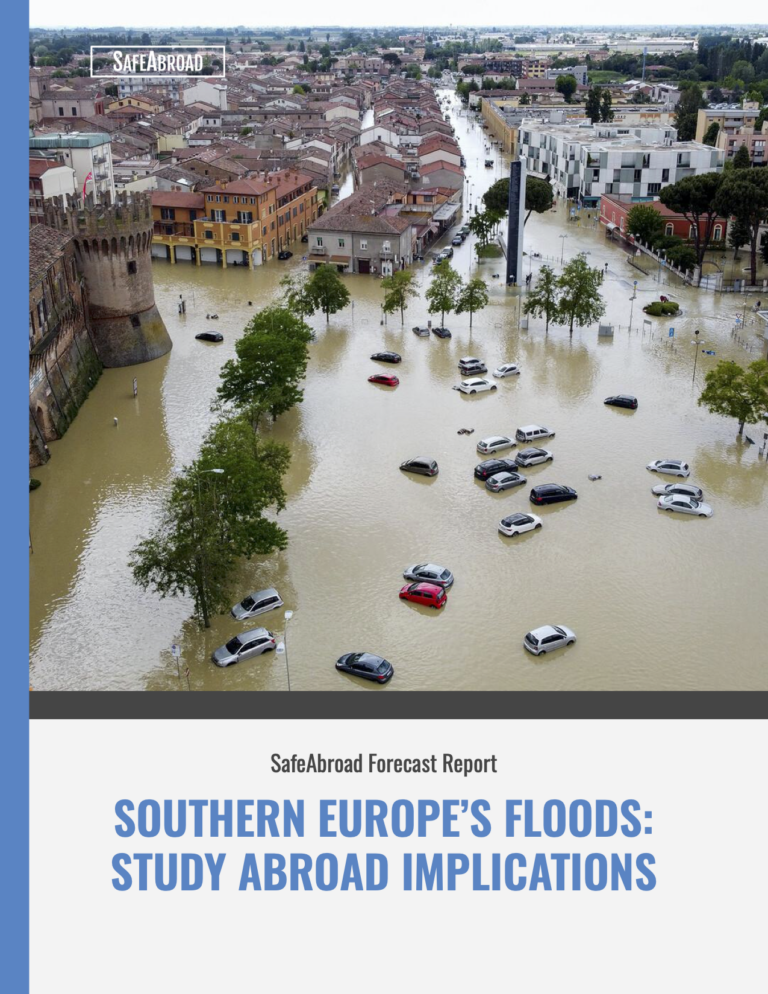
SafeAbroad analysts have assessed that flooding poses a moderate risk to travelers in southern Europe. The Mediterranean region’s topography and seasonal weather patterns are major drivers of flooding throughout the region. These floods pose a risk to traveler safety, as well as often cause disruptions to travel and spark protests over government responses and unpreparedness.
Key Takeaways
- Flooding is seasonal and region-specific. Southern Europe experiences its highest flood risk from October to February, with secondary risks in late winter and spring. Risk varies by country; coastal cities, river valleys, and mountainous regions are typically the most severely affected regions.
- Travel disruptions are common. Flooding can cause road closures, rail delays, airport and ferry interruptions. Multiple other consequences brought on by flooding can also indirectly impact travel including power outages and large scale protests.
- Preparedness reduces risk. Staying informed of local forecasts and alerts, avoiding low-lying areas near bodies of water during prolonged rainfall events, and building buffer time into itineraries significantly mitigates both safety hazards and travel disruptions
Background
Flooding in southern Europe is largely driven by seasonal weather patterns, topography, and snowmelt.
Topography and seasonal weather patterns drive recurring flood risks in southern Europe. Southern Europe lies between several mountain ranges and the Mediterranean, which traps rain from weather systems resulting in the accumulation of rain over a longer period leading to flooding.1 Some of the countries most frequently affected by flooding include Italy, Spain, southern France, Greece, Portugal, and parts of the western Balkans, where coastal storms, overflowing rivers, and flash flooding disrupt life and travel. Flooding usually occurs in localized events, where floods can become dangerous very quickly, especially in old city centers, towns along rivers, and low-lying coastal areas, all of which are popular tourist destinations.
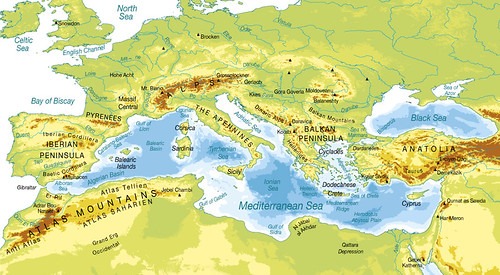
The primary driver of flooding in southern Europe is prolonged rainfall from Mediterranean storm systems contained within the Mediterranean region by topography, from October through February.3 4 5 The Atlas Mountains, Rila-Rhodope Mountains, Pyrenees, Alps, and the Dinarides keep moisture in southern states, in turn increasing soil saturation and raising the likelihood of flash flooding.6 These mountains create the northern/European half of what is known as the “Mediterranean basin.” Warm sea surface temperatures from the Summer combined with the cooler autumn air amplifies rainfall, which contributes to raised river levels.7 Mountainous terrain further increases the risk of flooding from February to April by accelerating snowmelt runoff and triggering landslides; urban flooding is common where aging drainage systems struggle to accommodate sudden water volumes.8 9
Flooding can cause transportation disruptions including road and rail closures, such as the flood in Thessaly in September of 2023 which damaged almost 1,000 miles of roads and around 100 miles of railway tracks.10 Flooding can also cause flight cancellations and delays, potentially leaving travelers stranded. This occurred on the Balearic Islands (Spain) on October 11 when Ibiza’s airport was forced to cancel flights due to flooding in terminals caused by Storm Alice.11 Utility outages and strained emergency services can compound these challenges, particularly during widespread or multi-day flooding events. Recent flooding in Kosovo exemplifies this, after flooding on January 8 led to power outages and interruptions to the water supply.12
Flooding also has led to protests and social unrest throughout southern Europe. Underinvestment in infrastructure and the mishandling of existing developed systems is unfortunately too common across the region.13 14 Outrage against government handling of flooding has resulted in mass protests such as the 130,000 people in Valencia, Spain who demanded the local governor’s dismissal due to his handling of devastating floods.15
On the Horizon
As flooding from prolonged storms begins to decrease, the risk from flooding due to snowmelt will increase, protests from infrastructural inadequacies are likely, and travel will continue to be disrupted.
What to watch for over the coming months:
- The risk of flooding will increase in low-lying areas near mountains. As temperatures begin to rise moving into warmer months, snow run-off from mountains will become the primary source of flooding in Southern Europe.16 As the majority of Southern Europe’s population live in coastal cities, this will be most likely to impact travelers making excursions such as to Italy’s northern regions in April-May.17
- Infrastructural inadequacies will continue to spark flood-related unrest. Devastating floods will continue to expose inadequate infrastructure, exacerbating damage and disruption in turn leading to protests. As climate change continues to make these events more frequent, unrest is likely to build up to additional demonstrations.18
- Flooding will continue to disrupt travel throughout the region. Flooding will impact wide-ranging transportation services including trains, taxis, and air travel. Flooding is unpredictable, and often has widespread consequences across affected areas. Travel cancellations and delays are likely to occur periodically during floods across different transportation sectors.
- https://www.euronews.com/green/2025/10/28/why-is-the-mediterranean-region-so-prone-to-flooding-a-new-study-has-answers
↩︎ - https://www.grida.no/resources/5931
↩︎ - https://www.cmcc.it/article/cul-de-sac-effect-why-mediterranean-regions-are-becoming-more-prone-to-extreme-floods-in-a-changing-climate
↩︎ - https://www.nssl.noaa.gov/education/svrwx101/floods/
↩︎ - https://www.researchgate.net/publication/334656291_Extreme_rainfall_in_Mediterranean_France_during_the_fall_added_value_of_the_CNRM-AROME_Convection-Permitting_Regional_Climate_Model
↩︎ - https://www.cmcc.it/article/cul-de-sac-effect-why-mediterranean-regions-are-becoming-more-prone-to-extreme-floods-in-a-changing-climate
↩︎ - https://illuminem.com/illuminemvoices/the-mediterranean-that-boils-why-storms-are-increasing
↩︎ - https://www.nature.com/articles/s43247-025-02734-y
↩︎ - https://blogs.lse.ac.uk/lseupr/2025/01/24/weathering-the-crisis-valencias-dana-and-the-political-storm-over-accountability/
↩︎ - https://resoilfoundation.org/en/investigation/multiple-impact-floods-europe/
↩︎ - https://www.mirror.co.uk/news/world-news/army-sent-ibiza-storm-alice-36054868
↩︎ - https://albanianpost.com/kushtet-atmosferike-shkaktojne-nderprerje-te-rrymes-dhe-ujit-ne-kosove/
↩︎ - https://www.tiranatimes.com/albania-under-water-a-return-to-a-hobbesian-state-of-nature/
↩︎ - https://www.theguardian.com/world/2025/oct/25/still-angry-more-than-50000-protest-in-valencia-on-first-anniversary-of-floods
↩︎ - https://www.bbc.com/news/articles/cvg4n614v32o
↩︎ - https://www.sciencedirect.com/science/article/abs/pii/S0048969722058715#preview-section-abstract
↩︎ - https://www.grida.no/resources/5900
↩︎ - https://www.eea.europa.eu/en/topics/in-depth/extreme-weather-floods-droughts-and-heatwaves
↩︎