
Overview
SafeAbroad analysts have assessed the threat tropical cyclones pose throughout multiple countries in East and Southeast Asia, as well as provided multiple location specific resources and tips. Tropical cyclones create significant challenges for travelers including travel disruptions, safety risks, communication outages, and essential service disruptions. It is important that travelers be prepared and informed on how to navigate these challenges.
Background
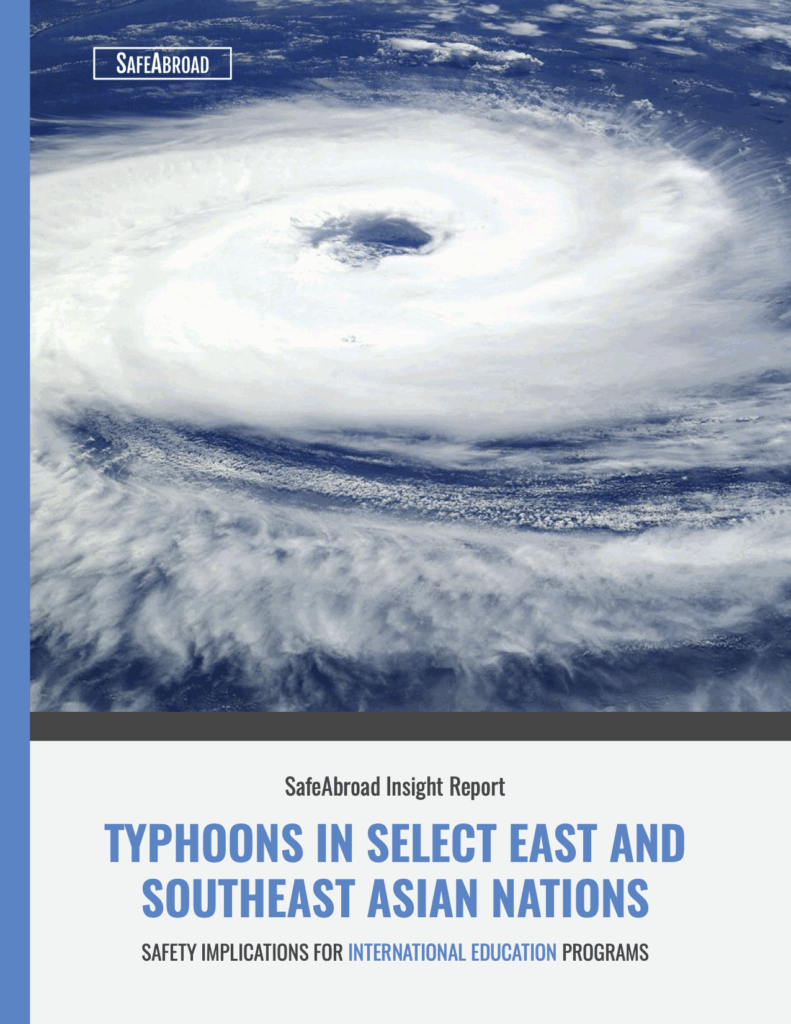
Tropical cyclones are rotating weather systems that form in tropical or subtropical waters and are characterized by heavy winds and rainfall.1 After landfall, tropical cyclones may cause secondary weather events that include flooding, landslides, storm surges, and tornadoes.2 The tropical cyclone season in the Northwest Pacific is year-round with predominant months from May to October.3
Based upon their strength, tropical cyclones are categorized as the following: a tropical depression if the sustained winds are less than 39 miles per hour, a tropical storm if the sustained winds are less than 74 miles per hour, and a hurricane, typhoon, or tropical cyclone (depending on the region) if the sustained winds are 74 miles per hour or higher.4
Tropical cyclones are exacerbated by climate change. While warming global temperatures are unlikely to increase the number of tropical cyclones, they may increase the intensity, creating storms with higher wind speeds and heavier rainfall.5
General Guidance
In areas at a high risk of destruction from typhoons, it is generally advised to prepare an emergency kit including: 6 7
- Bottled water
- Non-perishable food
- Flashlight
- Spare batteries
- Sanitation and personal hygiene items
- Emergency blanket
- Extra clothing
- Copies of important documents
- First aid supplies
- Band-Aids
- Bandages
- Antiseptic wipes
- Antibiotic ointment
- Pain relievers
- Cold medicine
- Antihistamines
- An extra supply of any prescription medication
It is also advised that travelers:
- Monitor weather alerts using the country-specific resources and information.8
- Stay informed about your community’s evacuation routes and evacuation shelters.9
- Sign-up for the SMART Traveler Enrollment Program. This program allows U.S. citizens and nationals to enroll their international trips. The Department of State will then be able to provide destination-specific updates on safety and security.10
Country-Specific Information and Resources
China
Information
On average, 7 to 8 typhoons make landfall in China every year.11 The southern coastal provinces of Guangdong, Guangxi, and Hainan are especially vulnerable to typhoons because of high typhoon frequency, lack of adaptive capacity, and high population density.12 Within the Guangdong–Hong Kong–Macau Greater Bay area, Zhuhai, Zhongshan, Foshan, Dongguan, central-southern Jiangmen, southern Shenzhen, and parts of Huizhou are at a high or very high risk for typhoon-induced gales. Zhuhai, Zhongshan, Shenzhen, central-southern Foshan, northern Dongguan, central Jiangmen, and central Huizhou are at a high or very high risk for typhoon–induced rainstorms. Zhuhai, eastern Zhongshan, and the coastal part of the Pearl River Estuary are at a high or very high risk for typhoon-induced storm surges. Lastly, Zhuhai, Zhongshan, Jiangmen, Dongguan, and Shenzhen are at an overall high or very high risk of a typhoon disaster.13
In the event of a typhoon, China has a four-tiered emergency alert system:14
- Level I (red) – an imminent and dangerous threat (most severe)
- Level II (orange) – a serious threat is likely
- Level III (yellow) – a significant threat is possible
- Level IV (blue) – a general threat is possible (least severe)
Resources
- The China Meteorological Association provides weather updates and alerts.15
- The emergency numbers are 110 for police, 119 for fire, and 120 for medical emergencies.16
- The contact numbers for the consulates and embassy are:17
- U.S. Embassy in Beijing: +(86)(10) 8531-4000 and +(86)(10) 8531-4000 (emergency after-hours)
- U.S. Consulate General in Guangzhou: +(86)(20) 3814-5775 and +(86)(10) 8531-4000 (emergency after-hours)
- U.S. Consulate General in Shanghai: +(86)(21) 8011-2200 and +(86)(10) 8531-4000 (emergency after-hours)
- U.S. Consulate General in Shenyang; +(86)(24) 2322-1198 and +(86)(24) 2322-1198 (emergency after-hours)
- U.S. Consulate General in Wuhan: +(86)(27) 8563-2800 and +(86)(10) 8531-4000 (emergency after-hours)
Japan
Information
Typhoons pose a moderate threat to Japan, particularly in its southernmost islands. On average, 3 typhoons make landfall in mainland Japan every year reaching either the coastline of Hokkaido, Honshu, Shikoku, or Kyushu.18 As of the end of September, three typhoons have made landfall in Japan in 2025.19 Okinawa is especially prone to typhoons because it is a chain of islands situated in the middle of the East China Sea and the Pacific Ocean.20 The island sees 7-8 typhoons on average each year, which is almost five more than the main islands.21 Kagoshima is also vulnerable to these large storms as it is situated in the south of Kyushu (Japan’s southernmost of its four main islands).22
In the event of a typhoon, Japan has a five-tiered emergency alert system:23
- Level 1 (warning) – monitor the weather forecast and make preparations (least severe)
- Level 2 (warning) – determine where and how to evacuate
- Level 3 – prepare to evacuate
- Level 4 – imminent disaster; those in high risk areas must evacuate
- Level 5 – a disaster is happening; take shelter in the safest location possible (most severe)
Resources
- The Japan Meteorological Agency provides weather updates and alerts.24
- The emergency phone numbers are 110 for police and 119 for ambulance and fire.25
- The “J-alert” system is an emergency broadcasting system operated by the Japanese government that transmits critical information in the event of an emergency. These alerts can be received in English by downloading the “NHK World” app.26
- There is free accessible public Wi-Fi (SSID: 00000JAPAN) during a national emergency or natural disaster. Most types of devices are compatible with this Wi-Fi.27
- Local radio stations broadcast emergency information in English. These stations include American Forces Network (AFN) Tokyo (810kHz, AM), AFN Iwakuni (1575kHz, AM), AFN Sasebo (1575kHz, AM), and AFN Okinawa (89.1MHz, FM). These are helpful in the event of cellular service disruption.28
- The “Safety tips” app by the Japan Tourism Agency provides helpful resources to include weather warnings and communication cards that can be used to help navigate language barriers during an emergency.29
- There is a 24/7 visitor hotline operated by the Japan National Tourism Organization that provides information and assists in the event of an accident or emergency. The contact numbers are 050-3816-2787 from Japan and +81-50-3816-2787 from overseas.30
- The contact numbers for the consulates and embassy:31
- U.S. Embassy in Tokyo: 03-3224-5000
- U.S. Consulate in Naha: 098-876-4211
- U.S. Consulate in Osaka: 06-6315-5900
- U.S. Consulate in Sapporo: 011-641-1115
- U.S. Consulate in Fukuoka: 092-751-9331
- U.S. Consulate in Nagoya: 052-581-4501
The Philippines
Information
Typhoons pose a large threat to travelers visiting this Southeast Asian nation. The Philippines lie along the Pacific Typhoon Belt, and an average of 20 tropical cyclones enter its designated weather monitoring area each year, with about eight or nine making landfall in the country.32 The peak typhoon season runs from July to October, during which nearly 70% of storms develop.33 The Annual Report on Philippine Tropical Cyclones (ARTC) compiles post-season analyses, storm tracks, and impacts for all systems in a given year.34 The Philippines is an archipelago of about 7,641 islands and thus has expansive coastlines; therefore, most of the country is vulnerable to typhoons.35 However, direct landfall predominantly occurs in the western and northern provinces to include Cagayan Valley, Bicol and Eastern Visayas.36
In the event of a typhoon, the Philippines through the Philippine Atmospheric, Geophysical and Astronomical Services Administration (PAGASA) classifies storms into one of five categories based upon the wind speed:37
- Tropical Depression (< 62 km/h) – minimal to minor threat to life and property
- Tropical Storm (62–88 km/h) – minor to moderate threat to life and property
- Severe Tropical Storm (89–117 km/h) – moderate to significant threat to life and property
- Typhoon (118–184 km/h) – significant to severe threat to life and property
- Super Typhoon (> 184 km/h) – extreme threat to life and property
Resources
- PAGASA provides weather updates and alerts.38
- The National Hydro-Met Observing Network (PANaHON) administered through PAGASA is an interactive platform that provides location-specific weather information (temperature, pressure, wind, and rainfall accumulation) and a centralized alert system.39
- Typhoon2000 provides tropical cyclone updates and alerts for the country.40
- The emergency numbers are 911 for the National Emergency Hotline, 117 or (02) 8722-0650 for the Philippine National Police Hotline, 143 or (02) 8527-8385 for the Philippine Red Cross, (02) 8426-0219 or (02) 8426-3812 for the Bureau of Fire Protection, and 143 for the Philippine Red Cross Hotline.41
- HazardHunterPH is a tool that provides awareness of natural hazards allowing the user to take steps to prevent and mitigate these natural hazards through preemptive planning.42
- The contact numbers for the consulate and embassy:43
- U.S Embassy in Manila: (+63) 2 5301-2000
- U.S. Consulate Agency in Cebu: (+63) 32 231-1261
Thailand
Information
Thailand, due to its geographic location, is protected from severe typhoons. Travelers should note that these storms can still bring heavy rainfall that can trigger landslides and flooding.44 Heavy rainfall and storms occur during the southwest monsoon season from May to October and the northeast monsoon season from November to January.45 The northern region of Thailand is more susceptible to landslides because of its mountainous topography.46 Bangkok, on the other hand, is more susceptible to flooding due to it being only 1 to 1.5 meters above sea level, which is then exacerbated by rapid urbanization and inadequate infrastructure.47
Resources
- The Thai Meteorological Department and their app – Thai Weather – provide weather updates and alerts.48
- The emergency numbers are 191 for police, 199 for fire, 1669 for ambulance, and 1111 for government resources.49
- The contact numbers for the consulate and embassy:50
- U.S. Embassy in Bangkok: +66-2-205-4000
- U.S. Consulate in Chiang Mai: +66-53-107-700
- The Thai Disaster Alert app – developed by the Department of Disaster Prevention and Mitigation (DDPM) – allows users to receive emergency alerts and report emergency situations.51
- The Thai Red Cross Society provides disaster preparedness and response services. Their phone number is +66 2256 4032- 3, 1664.52
- The Department of Disaster Prevention and Mitigation (DDPM) coordinates national disaster response, including alerts for floods, tropical storms, and landslides.53
Vietnam
Information
Vietnam faces an average of four to six typhoons per year, mostly between June and November, with the central and northern coastal provinces—including Quang Binh, Quang Tri, Thua Thien Hue, Da Nang, Hai Phong, and Quang Ninh—most frequently affected.54 In October 2025, Typhoon Talim and Tropical Storm Sonca brought heavy rain, flooding, and landslides across central Vietnam, displacing thousands and causing significant agricultural losses. The Vietnam Meteorological and Hydrological Administration (VMHA) and the Vietnam Disaster Management Authority (VNDMA) issued early warnings and coordinated evacuations. Around 70% of the population lives in disaster-prone areas, with riverine and coastal flooding posing the greatest risks.55
Vietnam uses a four-tier disaster warning system: Level 4 (Red): Catastrophic threat (most severe) Level 3 (Orange): Serious threat Level 2 (Yellow): Moderate threat Level 1 (Blue): General advisory
Resources
- The Vietnam Meteorological and Hydrological Administration (VMHA) provides official forecasts, strom warnings, and rainfall monitoring across the country.56
- The National Center for Hydro-Meteorological Forecasting (NCHMF) operates under VMHA and delivers frequent updates on tropical depressions, typhoons paths, and rainfall intensity via its official website and mobile applications.57
- The Vietnam Disaster Management Authority (VNDMA) issues alerts and preparedness information, including evacuation zones and flood-risk areas. Emergency numbers are 112 for search and rescue, 113 for police, 114 for fire, and 115 for medical emergencies58.
- The contact numbers for the consulate and embassy:59
- U.S. Embassy Hanoi: +84-24-3850-5000
- U.S. Consulate General Ho Chi Minh: +84-28-3520-4200
- Local English-language sources such as VNExpress International and Voice of Vietnam (VOV World) provide update reports and advisories during severe weather events.60
- Travelers can also access ReliefWeb and ASEAN Disasters Information Network (ADInet) for regional disaster situation updates.61
Singapore
Information
Although Singapore is rarely struck directly by typhoons, it experiences heavy rainfall, flash floods, and strong winds from regional tropical systems particularly during the northeast monsoon season (December–March).62 Intense downpours can cause localized flooding in low-lying areas such as Tanjong Katong, Bukit Timah, and River Valley.63 The Meteorological Service Singapore (MSS) under the National Environment Agency (NEA) provides real-time weather forecasts, heavy rain warnings, and lightning alerts through its myENV app and official website. The PUB (National Water Agency) operates the “myWaters” system, which issues live flood alerts and drainage updates. Emergency numbers are 999 for police, 995 for ambulance and fire, and 1777 for non-emergency medical services. During major storms, the Singapore Civil Defence Force (SCDF) coordinates response operations and public advisories.
Resources
- The Meteorological Service Singapore (MSS) under the National Environment Agency (NEA) provides official weather forecasts, storm warnings, and rainfall monitoring across the country. The MSS website and myENV mobile application deliver real-time updates on tropical storms, lightning activity, wind conditions, and heavy rain alerts.64
- The National Water Agency (PUB) provides rainfall data, flood alerts, and drainage updates through its “Stormwater Management” portal and “myWaters” app, which show live maps of water levels and flash flood locations.65
- The Singapore Civil Defence Force (SCDF) and Singapore Police Force (SPF) issue emergency warnings and coordinate disaster response during severe weather events. Emergency numbers are 999 for police, 995 for ambulance and fire, and 1777 for non-emergency medical services.66
- The contact numbers for the consulate and embassy:
- U.S. Embassy Singapore: +65-6476-9100 67
- Embassy After-Hours Emergency Line: +65-8129-2001 68
- U.S. Local English-language sources such as The Straits Times, CNA (Channel NewsAsia), and Today Online provide frequent weather-related updates and government advisories.69
- Travelers can also access ReliefWeb, the ASEAN Disaster Information Network (ADInet), and the Singapore Government’s “GoBusiness” portal for regional emergency notices and disaster preparedness resources.70
Indonesia
Information
Indonesia, a nation consisting of over 17,000 islands, experiences a moderate threat from tropical cyclones. On average, at least a single level one tropical cyclone can be expected every year to hit Indonesia.71 The majority of the country’s population lives on coastlines (60%), which means travelers will likely be in areas that are vulnerable to severe storms.72 Travelers should note that the Meteorology, Climatology, and Geophysical Agency (BMKG) provides weather forecasts, storm warnings, and marine bulletins across Indonesia.73 BMKG shares real-time updates on rainfall, wind speed, and sea conditions through its official website and the Info BMKG platform.74 The National Disaster Management Authority (BNPB) manages disaster response, issues emergency alerts, and coordinates rescue operations during severe weather.75 Emergency numbers include 117 for disaster emergencies, 110 for police, 113 for fire, and 118 or 119 for medical services.76 During monsoon months, especially November to April, BMKG warns of heavy rainfall, flooding, and strong winds that often affect coastal and island regions.77
Resources
- The Meteorology, Climatology, and Geophysical Agency (BMKG) is Indonesia’s official authority for weather forecasting, earthquake monitoring, and tsunami warnings. The BMKG website and mobile application (Info BMKG) provide real-time updates on tropical cyclones, heavy rainfall, and sea conditions, including radar imagery and early warning bulletins.78
- The National Disaster Management Authority (BNPB) coordinates disaster preparedness and emergency response during typhoons, floods, and other natural hazards. Its official platform, InAWARE, offers an interactive map displaying live disaster alerts and evacuation information.79
- The Regional Disaster Management Agencies (BPBD) operate at the provincial and district levels, providing localized alerts and assisting in community evacuations during severe weather events. Emergency numbers are 112 for general emergencies and disaster response, 110 for police, 113 for fire, and 118 or 119 for medical emergencies and ambulance services.80
- The contact numbers for the consulate and embassy:81
Travelers can also access ReliefWeb, the ASEAN Disaster Information Network (ADInet), and PetaBencana.id, a community-driven platform providing real-time flood and disaster information through social media integration.85
- https://oceanservice.noaa.gov/facts/cyclone.html
↩︎ - https://www.who.int/health-topics/tropical-cyclones#tab=tab_1
↩︎ - https://www.crisis24.com/articles/asian-nations-face-intensifying-typhoon-impacts-in-the-northwestern-pacific-basin
↩︎ - https://oceanservice.noaa.gov/facts/cyclone.html
↩︎ - https://ncas.ac.uk/what-are-typhoons-and-is-climate-change-making-them-worse/
↩︎ - https://www.who.int/westernpacific/newsroom/feature-stories/item/start-of-the-cyclone-season-in-the-south-pacific–tips-on-how-to-prepare ↩︎
- https://www.redcross.org/get-help/how-to-prepare-for-emergencies/survival-kit-supplies.html?srsltid=AfmBOoppg5HyZKGARRohssa4BVnhhGNYpxJDBg_bAsMzO7vEaqz_4kgk
↩︎ - https://mmda.gov.ph/20-faq/5500-disaster-preparedness-typhoons-faq.html?appgw_azwaf_jsc=CLLPb521sPe8RLqzFqQsOuXmPnQC-_QhSYjUaUfsOU8
↩︎ - https://www.who.int/westernpacific/newsroom/feature-stories/item/start-of-the-cyclone-season-in-the-south-pacific–tips-on-how-to-prepare
↩︎ - https://mytravel.state.gov/s/step?gad_source=1&gad_campaignid=21758807661&gclid=CjwKCAjwi4PHBhA-EiwAnjTHuYZOOhUaDIDSPmZDVrmwLtNdTiBu_Qr15g6o3UWOEOkFTKnwgwOEJRoCBZsQAvD_BwE
↩︎ - https://www.frontiersin.org/journals/earth-science/articles/10.3389/feart.2022.839733/full;https://www.frontiersin.org/journals/marine-science/articles/10.3389/fmars.2025.1548763/full#B5
↩︎ - https://www.frontiersin.org/journals/marine-science/articles/10.3389/fmars.2025.1548763/full
↩︎ - ↩︎
- https://news.cgtn.com/news/2025-08-09/Explainer-China-s-4-tier-emergency-response-system-1FHmbI9uZOg/p.html
↩︎ - https://www.cma.gov.cn/en/
↩︎ - https://china.embassy.gov.au/bjng/Consular1_5.html
↩︎ - https://china.usembassy-china.org.cn/weather-alert-typhoon-gaemi/
↩︎ - https://www.data.jma.go.jp/typhoon/statistics/average/average.html
↩︎ - https://www.data.jma.go.jp/typhoon/statistics/landing/landing.html
↩︎ - https://visitokinawajapan.com/discover/okinawa-at-a-glance/;https://visitokinawajapan.com/plan-your-trip/useful-information/typhoon-precautions-okinawa/#:~:text=Typhoons%20mainly%20affect%20Okinawa%20from%20June%20to,Bus%20and%20monorail%20services%20*%20Road%20conditions
↩︎ - https://www.jrpass.com/blog/japan-s-typhoon-season-what-to-expect-and-how-to-prepare
↩︎ - https://www.japanhighlights.com/japan/typhoon-season#:~:text=Typhoons%20usually%20hit%20Japan%20during,heavy%20rains%20when%20typhoons%20hit.
↩︎ - https://tabunka.tokyo-tsunagari.or.jp/english/disaster/howto/alert_levels.html
↩︎ - https://www.jma.go.jp/jma/indexe.html
↩︎ - https://jp.usembassy.gov/services/calling-for-help/
↩︎ - https://jp.usembassy.gov/emergency-preparedness-for-u-s-citizens-in-japan/
↩︎ - https://jp.usembassy.gov/emergency-preparedness-for-u-s-citizens-in-japan/
↩︎ - https://jp.usembassy.gov/emergency-preparedness-for-u-s-citizens-in-japan/
↩︎ - https://www.jnto.go.jp/safety-tips/eng/app.html
↩︎ - https://x.com/JapanSafeTravel/status/1932633902323229082
↩︎ - https://jp.usembassy.gov/
↩︎ - https://www.pagasa.dost.gov.ph/climate/tropical-cyclone-information
↩︎ - https://www.pagasa.dost.gov.ph/climate/tropical-cyclone-information
↩︎ - https://www.pagasa.dost.gov.ph/tropical-cyclone/publications/annual-report
↩︎ - https://geographical.co.uk/science-environment/why-is-the-philippines-experiencing-so-many-typhoons
↩︎ - https://geographical.co.uk/science-environment/why-is-the-philippines-experiencing-so-many-typhoons
↩︎ - https://www.pagasa.dost.gov.ph/learning-tools/tropical-cyclone-wind-signal#:~:text=Tropical%20Cyclone%20Wind%20Signal%20%235.%20WIND%20THREAT:,or%20higher)%20WARNING%20LEAD%20TIME:%2012%20hours.
↩︎ - https://www.pagasa.dost.gov.ph/about-us
↩︎ - https://www.pagasa.dost.gov.ph/press-release/183
↩︎ - https://typhoon2000.ph/
↩︎ - https://ph.usembassy.gov/contact/; https://redcross.org.ph/our-services/
↩︎ - https://hazardhunter.georisk.gov.ph/about-hazardhunterph
↩︎ - https://ph.usembassy.gov/
↩︎ - https://world.thaipbs.or.th/detail/the-economic-toll-on-thailand-from-tropical-storms-may-worsen/54914
↩︎ - https://www.intrepidtravel.com/us/thailand/best-time-to-visit-thailand
↩︎ - https://www.mdpi.com/2412-3811/7/2/17#:~:text=Regarding%20landslides%20in%20Thailand%2C%20it%20is%20known,in%20the%20upper%20northern%20part%20of%20Thailand.
↩︎ - https://www.sciencedirect.com/science/article/pii/S2665972724002277;https://world.thaipbs.or.th/detail/the-economic-toll-on-thailand-from-tropical-storms-may-worsen/54914
↩︎ - ↩︎
- https://www.tourismthailand.org/Plan-Your-Trip/Useful-Call
↩︎ - https://th.usembassy.gov/
↩︎ - https://www.preventionweb.net/media/106742/download?startDownload=20251006
↩︎ - https://english.redcross.or.th/
↩︎ - https://www.disaster.go.th/about/background
↩︎ - https://www.redbus.vn/blog/vietnam-typhoon-season-travel-tips/
↩︎ - https://www.adrc.asia/nationinformation.php?NationCode=704&Lang=en
↩︎ - https://nchmf.gov.vn/KttvsiteE/en-US/2/index.html
↩︎ - https://www.nchmf.gov.vn/kttvsite/
↩︎ - https://phongchongthientai.mard.gov.vn/en/Pages/Home.aspx
↩︎ - https://vn.usembassy.gov/
↩︎ - https://e.vnexpress.net/
↩︎ - https://adinet.ahacentre.org/
↩︎ - https://www.nea.gov.sg/corporate-functions/weather/overview
↩︎ - https://www.propertyguru.com.sg/property-guides/flooding-in-singapore-47633
↩︎ - https://www.weather.gov.sg/home/
↩︎ - https://www.pub.gov.sg/ ↩︎
- https://www.scdf.gov.sg/
↩︎ - https://sg.usembassy.gov/contact/
↩︎ - https://sg.usembassy.gov/contact/
↩︎ - https://www.channelnewsasia.com/singapore
↩︎ - https://adinet.ahacentre.org/
↩︎ - https://climateknowledgeportal.worldbank.org/country/indonesia/tropical-cyclones-historical
↩︎ - https://www.nature.org/en-us/about-us/where-we-work/asia-pacific/indonesia/stories-in-indonesia/indonesia-oceans-and-coasts/
↩︎ - https://www.bmkg.go.id/
↩︎ - https://www.bmkg.go.id/
↩︎ - https://www.bmkg.go.id/
↩︎ - https://www.bmkg.go.id/
↩︎ - https://setkab.go.id/en/bmkg-warns-of-potential-extreme-weather-until-april/?utm_source=chatgpt.com
↩︎ - https://www.bmkg.go.id/
↩︎ - https://www.bnpb.go.id/
↩︎ - https://www.gitews.de/tsunami-kit/en/E6/our_experience/Local%20Disaster%20Management%20Agency.pdf
↩︎ - https://id.usembassy.gov/id/contact-id/
↩︎ - https://www.thejakartapost.com/
↩︎ - https://en.antaranews.com/
↩︎ - https://www.channelnewsasia.com/topic/indonesia
↩︎ - https://adinet.ahacentre.org/
↩︎